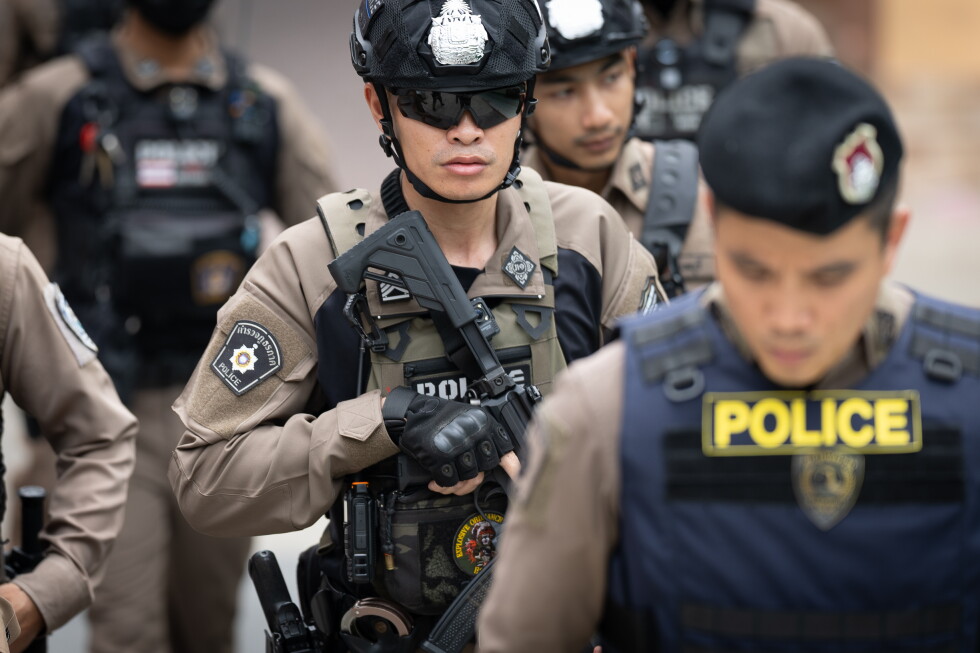
BANGKOK – A shocking act of gun violence has rocked Thailand, with authorities confirming that a 14-year-old student carried out a fatal shooting spree that left at least seven people dead on Friday in Nonthaburi province, a densely populated northern suburb of the Thai capital. Law enforcement officials have confirmed the identities of the victims: five are staff members from Debsirin Nonthaburi School, where the student is enrolled, and the other two are the teenager’s own grandparents, with whom he resided. No immediate updates have been shared on the suspect’s motive or condition as of the publishing of this report. This latest tragedy has once again thrown a spotlight on Thailand’s longstanding challenges with gun accessibility, a issue that has fueled repeated high-profile mass casualty attacks across the country in recent years. Thailand registers one of the highest per capita gun ownership rates across all of Asia, and while targeted attacks driven by political conflict remain rare, unprovoked mass shootings by civilian perpetrators have become an increasingly frequent public safety concern. To contextualize the scope of the crisis, a timeline of major non-political mass shooting incidents recorded in Thailand over the past six years underscores how often these deadly events occur: In February 2026, a 17-year-old male student stole a service weapon from a police officer and opened fire at a public high school in southern Thailand’s Hat Yai province, leaving one dead and two others wounded. The teen was taken into custody following a brief standoff with law enforcement. Less than six months prior, in July 2025, a gunman with a reported personal grudge opened fire at a crowded popular fresh food market in central Bangkok, killing five people before turning the gun on himself to die by suicide. In October 2023, another 14-year-old teen carried out a shooting at a major downtown Bangkok shopping mall, fatally wounding two people before he was apprehended by police. Investigators later confirmed that the weapon the teen used was originally manufactured to fire only blank rounds, but had been illegally modified to fire live ammunition. Three months before that mall attack, in March 2023, a gunman shot and killed three civilians in Phetchaburi province, located roughly 105 miles southwest of the Thai capital. The incident ended after a 14-hour standoff, when police commandos shot and killed the assailant. The deadliest mass killing in Thailand’s recent history took place in October 2022, in the northeastern province of Nong Bua Lamphu. A former police sergeant who had recently been terminated from his position carried out a brutal attack that left 37 people dead, more than two dozen of whom were toddlers attending a local daycare center. After the rampage at the childcare facility, the gunman returned to his home, killed his wife and stepson, and then died by suicide. In February 2020, a soldier enraged over an unresolved land dispute embarked on a 16-hour shooting rampage across the northeastern city of Nakhon Ratchasima. The attack left 29 people dead and dozens more injured, before joint police and military forces shot and killed the gunman following an overnight siege. Just one month prior, in January 2020, a masked gunman robbed a gold shop inside a shopping mall in central Thailand’s Lopburi province, shooting and killing three people including a 2-year-old toddler. The perpetrator was later identified as a local school headmaster; he was arrested less than two weeks after the attack, pleaded guilty to multiple murder charges, and was sentenced to death.
分类: world
-

Spanish-led police raid smashes a vast Mediterranean smuggling network, arresting 78
THE HAGUE, Netherlands – A sweeping cross-border law enforcement operation, fronted by Spanish authorities and coordinated with the European Union’s law enforcement agency Europol, has taken down one of the largest transnational criminal networks operating smuggling routes for migrants, illicit drugs and weapons across the Western Mediterranean, officials announced in a press briefing Friday.
The successful takedown shines a new light on the deeply organized, multi-billion-dollar shadow economy of transnational smuggling across the narrow sea that divides southern Europe from North Africa, where criminal groups have turned irregular migration and drug trafficking into one of their most profitable illicit activities. Spanish Civil Guard officials categorize the dismantled network as among the most significant criminal organizations focused on maritime human trafficking in the entire Mediterranean region.
Friday’s announcement comes just one week after a sharp spike in irregular migration to Spain grabbed global attention, when tens of thousands of migrants crossed into Spain’s North African territory of Ceuta, driven by widespread false online rumors that the border would be opened to new arrivals. The vast majority of those migrants have since returned to Morocco.
According to Europol, the broken-up criminal ring did not operate independently: it provided end-to-end logistical support to smaller smuggling gangs across the region, including secure storage, overland transport, refueling stops, mid-sea transfers of people and goods, vessel maintenance, and counter-surveillance tactics to evade detection by law enforcement. The investigation that led to the arrests was first launched by Spanish authorities in 2023, with Europol coordinating support from law enforcement agencies across France, Poland and Portugal, alongside Spain’s Civil Guard and National Police.
The mass arrests were carried out during a coordinated action day on June 16. In total, 77 suspects were taken into custody across Spain, with one additional arrest made in Algeria. Law enforcement teams seized 18 motorboats — many of them high-speed craft — along with an undeclared quantity of drugs, multiple satellite communication devices, a loaded handgun, and more than €25,000 ($29,000) in untraceable cash. Footage released by Spanish law enforcement shows officers taking suspects into custody and counting large stacks of €50 bills recovered during property searches across the country.
The network ran a profitable two-way smuggling corridor between Algeria and Spain, Spanish Civil Guard confirmed: it trafficked illicit drugs north to Europe from North Africa, then packed undocumented migrants onto unseaworthy boats for the return crossing to coastal towns in southern Spain. Officials estimate the group was responsible for at least 64 separate migrant smuggling voyages, moving more than 2,000 people into Spain illegally and generating total profits exceeding €24 million. All four of the organization’s top alleged leaders are now in custody, authorities confirmed.
Beyond smuggling activity, the group is accused of brutal violence to protect their operations and evade capture. “They used extremely violent methods to protect the vessels and resist law enforcement,” the Civil Guard said in its official statement. Europol added that the network maintained a fleet of unregistered “ghost speedboats” — vessels specifically modified to avoid radar detection and skip official registration, a practice banned under Spanish law. Investigators have also documented severe abuses against the migrants the group trafficked, including reports of sexual assault, routine physical abuse, and the detention of migrants in overcrowded, unsanitary makeshift holding facilities before they are put on crossing vessels.
-

Editor of top Ethiopian independent news site seized by police, publisher says
A coordinated multi-day crackdown by Ethiopian security forces has targeted one of the country’s most prominent independent news outlets, Addis Standard, leaving its editor-in-chief abducted, assaulted, and subjected to lengthy interrogation, according to the outlet’s parent company.
Jakken Publishing, which owns Addis Standard, released a formal statement Thursday detailing the sequence of actions that unfolded over three days starting August 2. The first incident saw editor-in-chief Yonas Kedir forcibly seized by two plainclothes agents on Saturday. In a written statement obtained by Agence France-Presse, Yonas described the abduction as a violent encounter: the pair struck him before forcing him into a double-cab pickup truck, where they accused him of “selling the country out.” He was held in custody for 24 hours during which he endured prolonged interrogation, Jakken Publishing confirmed.
The repression continued the following day, August 3, when an armed security team raided Addis Standard’s Addis Ababa newsroom without presenting any legal warrants or following due process. During the raid, the team confiscated critical production equipment from the outlet’s multimedia studio, crippling its on-site operations. On the third day of action, August 4, local police delivered an official eviction order, giving the outlet just 72 hours to vacate its long-held offices — a space where Addis Standard had operated for 16 years.
The crackdown marks the latest escalation in a year-long campaign against independent media in Ethiopia that began earlier this year. Back in February, the Ethiopian Media Authority revoked Addis Standard’s official media registration, claiming the outlet had violated journalistic ethics and posed unspecified threats to national interests. The outlet never received clarification on which specific reports prompted the action, but it has continued publishing while legally challenging the revocation in Ethiopian courts. To date, the outlet’s website remains operational, and it continues to update readers with on-the-ground coverage of the crackdown and its aftermath, as outlet leadership consult legal and strategic advisors to determine their next steps.
International press freedom and human rights organizations have condemned the coordinated action, framing it as part of a wider pattern of silencing critical journalism in the East African nation. The Committee to Protect Journalists (CPJ) described the recent incidents as an alarming escalation of the Ethiopian government’s systematic campaign to dismantle one of its leading independent news sources.
Human Rights Watch (HRW) echoed that criticism, noting that the harassment of Addis Standard fits into a broader government effort to eliminate any critical coverage of state policy. Over the past 12 months, HRW data shows Ethiopian authorities have arbitrarily detained dozens of journalists, held many of them in incommunicado detention without access to lawyers or family, and stripped multiple independent outlets of their operating licenses. Most recently, the national media authority issued final formal warnings to two other independent outlets — broadcaster Arts TV and radio station Ahadu FM — threatening to suspend or revoke their operating licenses over allegations of repeated violations of national media regulations.
As of Thursday, the Ethiopian government had not responded to repeated requests for comment from the BBC on the recent crackdown against Addis Standard.
-
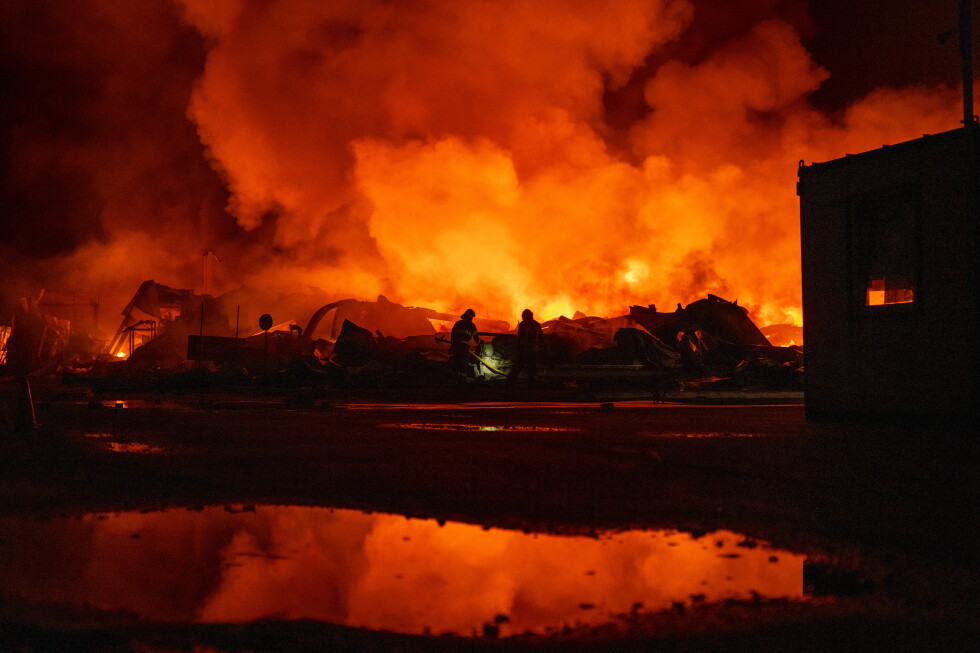
A Russian retail giant’s warehouse burns after Ukraine’s latest long-range drone attack
On Friday, local Russian officials and corporate sources confirmed that Ukrainian long-range drones have targeted a warehouse facility operated by Russia’s largest e-commerce retailer Wildberries, located in the Ural Mountains roughly 2,000 kilometers from the Russia-Ukraine border.
This strike is not an isolated incident. Throughout 2025, Ukraine has repeatedly carried out long-range drone attacks on targets deep inside Russian territory, even reaching an oil refinery in western Siberia nearly 2,500 kilometers from the shared border. These operations underscore the central role that drone innovation has played in Ukraine’s defense strategy against Russia’s full-scale invasion, now in its fourth year. Kyiv’s advancements in drone technology have also attracted global attention: Ukrainian officials confirm the country has already signed drone cooperation agreements with nine nations, and is currently negotiating additional partnerships with 15 more.
The targeted warehouse in this week’s attack is located in Yekaterinburg, Russia’s fourth-largest urban center. Wildberries confirmed the strike ignited a fire at the facility, but noted that most of the stored inventory avoided major damage. This outcome differs from more than a dozen recent attacks on other Wildberries depots across Russia, several of which were completely destroyed. Analysts view these strikes on commercial logistics infrastructure as part of Ukraine’s broader strategy to erode public confidence in the Kremlin and disrupt Russian domestic supply chains.
Regional governor Denis Pasler reported that three drones directly struck the warehouse’s roof. Artyom Zhoga, the Kremlin’s appointed representative for the Sverdlovsk Oblast, added that 800 people were safely evacuated from the facility, with no injuries reported in the aftermath of the attack.
Beyond long-range strike capabilities, Ukrainian President Volodymyr Zelenskyy announced Thursday that Kyiv is accelerating domestic weapons development, with a particular focus on air defense systems to counter escalating Russian ballistic missile attacks. Russia has increasingly exploited gaps in Ukraine’s current defense network caused by shortages of American-made Patriot interceptor missiles, launching repeated barrages that have hit civilian infrastructure across the country.
Zelenskyy revealed that a joint European anti-ballistic missile development program is already active, with 10 participating nations working together to build a new continent-wide ballistic defense shield. The project aligns with widespread European concern that Russia’s territorial ambitions extend beyond Ukraine’s borders. “Ukraine can manufacture its own anti-ballistic missiles and launchers, while our partners will supply necessary components and critical elements like radars and sensors,” Zelenskyy explained in a social media statement. “A large-scale, domestic anti-ballistic program will bring benefits to every country in Europe.”
In parallel, Ukraine is also advancing development of its own domestically produced ballistic missiles for use against Russian targets. Zelenskyy confirmed that initial testing has demonstrated strong operational potential, and work is ongoing to move the project from development to mass deployment as a functional weapon.
While weapons development progresses, Ukrainian frontline defenses in eastern Donetsk Oblast remain under intense pressure. Russia’s larger military force has continued incremental offensive operations, which Western analysts and officials note have come at an extremely high cost in Russian troop casualties, as Moscow seeks a long-sought breakthrough after months of stalled advances.
Kramatorsk, one of four major fortified cities that make up Ukraine’s strategic “Fortress Belt” in Donetsk, has ordered the evacuation of minors amid intensifying shelling. This 50-kilometer line of heavily defended urban centers has been the primary barrier blocking Russia from seizing full control of Ukraine’s industrial Donbas heartland. Vadym Filashkin, head of the Donetsk regional military administration, reported Friday that more than 800 civilians – including 91 children – were evacuated from high-risk areas in the region over the preceding 24 hours. To slow Russia’s push, Ukraine has deployed midrange strike drones to target Russian supply lines and disrupt offensive preparations.
The latest strikes come as both sides continue to exchange nearly nightly drone attacks across the front line and deep into each other’s territory. Russia’s Defense Ministry claimed its air defense systems downed 203 Ukrainian drones between late Thursday and early Friday. In contrast, Ukraine’s Air Force reported that Russia launched 147 long-range strike drones against Ukrainian targets in the same period.
In northern Ukraine’s Sumy Oblast, a Russian drone strike hit a busy public market on Friday morning, leaving 10 people wounded, according to local authorities. Regional administration head Oleh Hryhorov added that Russian forces also launched a combination of glide bombs and multiple drone types against the regional capital, targeting residential buildings, transport links, and civilian infrastructure. Two additional people were wounded in that wave of attacks, Hryhorov confirmed.
-
German airport drone-bomb: Could Russia be involved?
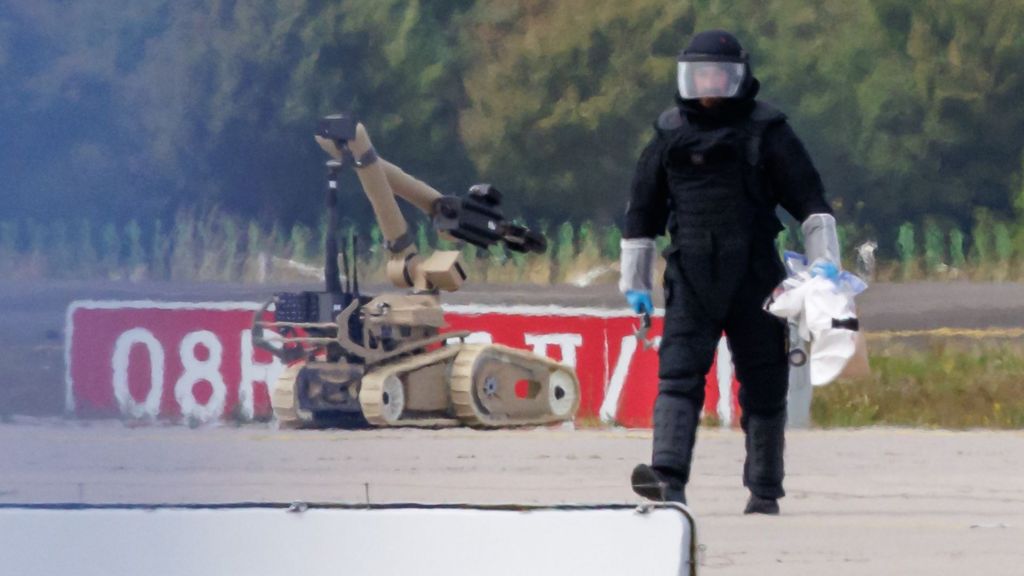
Late on a Tuesday night, security teams at Germany’s Leipzig Airport scrambled to respond to an alarming discovery: a small quadcopter drone carrying explosives, spotted floating near several Ukrainian Antonov cargo planes parked on the tarmac. The discovery triggered an immediate lockdown of one runway, with a specialized bomb disposal robot deployed to safely disarm the device, while aviation authorities launched a full investigation into the incident.
The Ukrainian cargo planes parked nearby carried bold national symbols: their blue and yellow striped livery matching Ukraine’s flag, and one aircraft bore the message “Be Brave Like Kherson,” a tribute to the embattled southern Ukrainian frontline city. Separately, a DHL cargo jet approaching Leipzig reported colliding with an unidentified object mid-climb shortly after the drone was found, and investigators are still working to confirm if this incident involved a second unexplained device.
Germany’s interior minister has sounded the alarm over what he calls a “new level of danger,” noting the attack may have links to foreign actors. While no conclusive evidence currently ties the drone directly to the Kremlin, and Moscow has repeatedly denied any involvement in such hostile acts across Europe, experts point to a well-documented pattern of Russian-linked hybrid operations on the continent that make Moscow a key suspect.
The BBC has obtained exclusive access to court documents connected to a 2024 cross-border terror plot that offers chilling context for the current incident. In that case, prosecutors in Lithuania and Poland are currently trying more than a dozen men linked to a Russian military intelligence network that smuggled explosives and drone components across the European Union. According to the case files, the network hid 6kg of TNT-equivalent RDX explosive in tins of sweetcorn and chopped tomatoes, concealed detonators inside consumer headphones, and transported drone parts purpose-built to carry explosive payloads. Smugglers moved these materials across the Baltic region via secret drop-offs in forests, cemeteries, and roadside locations, before delivering finished drone kits to safe houses in Germany.
One charged defendant, Ukrainian national Vladyslav D., who has pleaded not guilty to all charges, detailed to investigators how he carried out multiple smuggling trips in 2024 for a handler he knew only as “Warrior,” receiving more than $2,000 in cryptocurrency for his work. His assignments included retrieving hidden explosives and drone parts from pre-coordinated drop spots, including a bag of waterlogged headphones on the edge of a Lithuanian forest and drone propellers buried under plastic flowers in a cemetery, before transporting the materials to Germany for final delivery. The intended targets for these 2024 shipments were never identified.
To date, nearly two dozen suspects have been charged with terrorism offenses in connection with the 2024 plot, but key handlers remain at large, believed to be hiding in Russia. Authorities have not confirmed whether the entire network was dismantled or if all cached explosive and drone materials were recovered. While there is still no definitive link between the 2024 network and the 2026 Leipzig drone discovery, German media reports confirm the explosive found on the drone was Semtex, a plastic explosive that contains RDX – the same explosive material seized from the 2024 smuggling ring.
Explosives experts note that even a small drone-carried bomb would be unlikely to cause catastrophic damage to an aircraft unless fitted with fragmentation, but security analysts agree the primary goal of such an incident is not physical destruction, but psychological intimidation. As one of Ukraine’s largest military backers in Europe, Germany has long been a target of Russian hybrid operations designed to undermine public and political support for Kyiv.
Andrei Soldatov, a leading expert on Russian intelligence agencies, explained that the incident sends a deliberate message to European governments: “You get something like that into one of the biggest European airports and you send the message that, ‘Guys, we can do that. Remember. You hint to the adversary that you might cause a really big problem: that tomorrow might be more serious.’” Soldatov added that the operation aligns with Russia’s current strategy, as Moscow faces mounting pressure from Ukraine’s long-range drone campaign and repeated setbacks on the battlefield that have humiliated the Kremlin.
John Lough, a Russia analyst at the New Eurasian Strategies Centre, called the incident a clear case of Russian interference, designed to erode European support for Ukraine by highlighting the risk of escalation and intimidating German authorities. Lough warned that shifting battlefield dynamics that have favored Ukraine have raised the risk of a sharp increase in such hybrid attacks across the continent in the coming months. “I think it’s a dangerous moment,” he added.
As investigations continue, NATO and Antonov Airlines, the Ukrainian cargo firm that operates the planes parked at Leipzig, have both declined to comment on potential targets or direct links, noting that German authorities are still piecing together the full details of the incident.
-

Moment earthquake shakes hospital operating room in Japan
A striking act of professional dedication has been captured on security camera footage from a major Japanese hospital, revealing medical personnel putting a patient’s life ahead of their own safety during a powerful seismic event last month. When the 6.8-magnitude earthquake rippled through central Kumamoto, shaking the walls and equipment of Kumamoto General Hospital’s operating room, the surgical team did not flee the unstable space. Instead, multiple doctors immediately moved to cover the patient lying unconscious on the operating table, using their bodies to protect the vulnerable individual from falling debris and collapsing infrastructure as tremors rocked the facility. The footage, which has since drawn widespread public attention for its raw display of medical professionalism, documents a split-second decision that highlights the life-risking commitment healthcare workers make every day, even amid sudden natural disaster. Japan, which sits on the Pacific Ring of Fire, regularly experiences significant seismic activity, but this rare look inside an active operating room during a quake offers a new window into the on-the-ground crisis response of frontline medical staff.
-

Airport closes in Okinawa as Typhoon Dolphin hits parts of southern Japan
One of the year’s most impactful tropical cyclones to hit southwest Japan has begun wreaking havoc on the island chain of Okinawa, bringing high winds, widespread travel disruption, and minor injuries as authorities urge residents to remain indoors through the weekend.
As of Friday afternoon, the Japan Meteorological Agency (JMA) confirmed that Typhoon Dolphin was positioned just north of Okinawa’s main island, packing maximum sustained wind speeds of 144 kilometers per hour (89 miles per hour). The powerful storm system forced the complete shutdown of Naha Airport, Okinawa’s primary air transportation hub, leading to the cancellation of every inbound and outbound commercial flight, both domestic and international, on Friday.
Local officials from the Okinawa prefectural government confirm that three men in their 70s have already sustained minor injuries linked to the storm. Two of the men were knocked off balance by strong gusts, while the third fell from a stool while he was completing storm preparation work at his property, with officials confirming the fall was caused by a sudden wind blast. By midday Friday, 240 local residents had already relocated to official evacuation centers across the prefecture to wait out the dangerous weather.
The storm’s impending path has also put nearby regions on high alert. After moving past Okinawa, Dolphin is projected to reach parts of Kyushu, Japan’s southernmost main island. This extra risk comes as Kyushu is still recovering from a deadly earthquake that struck just one week prior. Many residents whose homes suffered structural damage in the seismic event have rushed to install waterproof blue tarps over broken roof sections and damaged exterior walls to prevent rainwater from leaking into their properties.
The JMA has warned that the Okinawa region will continue to face severe hazardous conditions through Sunday, including sustained strong winds, torrential downpours that could trigger flash flooding and landslides, and dangerous high ocean swells. The agency has issued a mandatory advisory urging all non-essential residents to avoid outdoor activity entirely for the duration of the storm.
Meteorologists project that Dolphin will gradually lose intensity over the weekend as it tracks northwest toward the eastern coast of China, where forecasters predict the storm will make landfall on Monday morning.
-

American flown to a New Zealand hospital in a rare midwinter Antarctic rescue mission
A rare and high-stakes midwinter medical rescue has successfully extracted a seriously ill American researcher from a remote U.S. Antarctic base, delivering the patient to a New Zealand hospital in a mission that pushed aircraft and crew to their operational limits.
Melbourne-based aviation firm Skytraders, which holds a contract with the Australian Antarctic Program, confirmed that its Airbus A319 Long Range jet, operating under the call sign Snowbird 1, departed the southern Australian city of Hobart on July 31 to answer an urgent request for medical assistance from the U.S. National Science Foundation, which manages McMurdo Station, the largest research base on the southern continent.
The 5.5-hour flight to Phoenix Airfield, located just 3 kilometers from McMurdo on the Ross Ice Shelf, ended with a challenging landing in complete polar winter darkness, where temperatures plummeted to minus 43 degrees Celsius (minus 45.4 degrees Fahrenheit). With conditions at the remote airstrip deteriorating rapidly after landing, the medical evacuation team immediately loaded the patient onto the jet and departed for Christchurch, New Zealand the same day.
The U.S. National Science Foundation confirmed to the Australian Broadcasting Corporation that the patient was admitted to Christchurch Hospital in serious condition. New Zealand’s Ministry of Health declined repeated requests for comment Friday, refusing to confirm the patient’s current status or whether they remain in care.
Speaking after the mission, copilot Louise Robertson described the operation as one of the most demanding of her career, noting that conditions pushed the aircraft to the edge of its certified operating capabilities. “We had what’s called nautical twilight, which is barely any light at all — it’s essentially pitch blackness, paired with extreme cold that put us right on the verge of the aircraft’s temperature limits,” Robertson told ABC. “It got down to minus 43 Celsius, which is the coldest environment I’ve ever operated in. With 8 knots of wind, the wind chill made it even more brutal.”
Robertson added that an initial attempt to launch the rescue a day earlier had to be scrapped entirely due to a severe blizzard that closed the airfield, leaving only a tiny window of acceptable weather to complete the mission. “There was such a narrow window of opportunity to get this done,” she said. “To carry out a landing here in complete darkness at these extreme temperatures is extremely rare — I don’t believe it’s ever been done before.”
Midwinter operations in Antarctica are exceptionally uncommon due to the months-long polar night. The sun set at the geographic South Pole on March 23 this year, and will not rise above the horizon again until September 21. Most overwintering research teams stay at their bases with limited emergency support, and evacuations are only attempted for life-threatening medical cases.
Prior medical evacuations from McMurdo during the Antarctic winter have relied on larger four-engine C-130 Hercules turboprop transport aircraft. In April, which falls in the Southern Hemisphere’s autumn, the New Zealand Air Force used a C-130 to evacuate a New Zealand citizen working with the U.S. Antarctic Program from Phoenix Airfield. A similar mission in August last year, the final month of Southern Hemisphere winter, evacuated three people from McMurdo for urgent medical care using the same aircraft type. This rescue marked the first time a civilian long-range jet has completed a midwinter landing and evacuation at McMurdo’s Phoenix Airfield, setting a new precedent for emergency response in the world’s harshest climate.
-

Anguish and hope: why a Tibetan set himself on fire in New York
On a quiet July evening in midtown Manhattan, while much of New York City and the global public were fixated on pop icon Taylor Swift’s star-studded wedding at Madison Square Garden, a shocking act of political protest unfolded on the steps of the United Nations headquarters that went largely unremarked in mainstream U.S. media.
Fifty-two-year-old Lobga Rangzen, a lifelong Tibetan independence activist and long-time U.S. resident, died after setting himself on fire outside the UN building, becoming the first Tibetan to carry out such an act of self-sacrifice on American soil. None of his closest confidants, including a 30-year monk friend and his niece who lived with him in Queens, had any inkling of his plan that day. His niece, 21-year-old Tenzin Choekyi, was watching the World Cup at her home when a friend called with news that her uncle had been burned. Initially assuming it was a minor accident, the full realization of what had happened hit her with overwhelming terror.
In the hours after his death, fellow exiled Tibetans gathered at the protest site to build a makeshift memorial, piled high with fresh flowers and traditional ceremonial white khata scarves. What began as a space for mourning quickly transformed into a gathering point for Tibetan activists, who have spent decades pushing for global attention to their cause opposing Chinese rule over Tibet. For the exile community, Rangzen’s death carried both deep anguish and profound respect, with many saying his act has reignited their commitment to political action. “His passing has left many of us Tibetans with the fervor to act,” explained Jampa Choedup, a Tibetan monk who first met Rangzen in 1997 and saw him just one day before his death.
Rangzen’s act was not without precedent. He followed in the footsteps of more than 170 Tibetan activists, mostly based inside Chinese-controlled Tibet but also some in Nepal and India, who carried out self-immolations between 2009 and 2022. These acts of last-resort protest began after a bloody Chinese government crackdown on widespread pro-independence demonstrations across Tibet in 2008. Since that time, Beijing has only tightened its political and social control over the region, which China claims as an inalienable part of its sovereign territory. Just one day before Rangzen’s death, Beijing passed a new national “ethnic unity” law that critics warn will further erode basic human and cultural rights for China’s Tibetan and Uyghur minority populations.
Unlike many of his contacts assumed, Rangzen’s act was not a spontaneous impulse, but a carefully planned action rooted in a lifetime of activism. Jigme Ugen, president of the exile Tibetan National Congress, where Rangzen led the New York and New Jersey chapter and was a core organizer of regular protests outside the UN and the Chinese consulate, noted that the activist had spent decades preparing for this step. Footage broadcast live by Rangzen during his protest captures the heavy-set man walking across the street outside the UN wearing a traditional Tibetan chuba robe, planting a Tibetan independence flag in the ground, before bursting into flames that rose twice his height, with thick black smoke billowing into the sky. A UN security guard rushed to intervene with a fire extinguisher, but it was too late. Rangzen was pronounced dead around an hour later at a nearby Manhattan hospital. New York police have confirmed they are still conducting an investigation into the death.
Rangzen was born Lobsang Palden in Tibet, and fled the region as a young man, spending 14 years living as a monk in southern India before resettling in the United States in 2006. He settled in Queens, New York, home to a large community of exiled Tibetans, and changed his name to Rangzen – the Tibetan word for “independence” – to reflect his core political goal. Fluent in Tibetan but not in English, he worked a series of casual jobs before becoming an Uber driver to support himself. Those who knew him remembered him as a joyful, warm person who loved joining weekly traditional Tibetan circle dances called gorshey. He often told friends he was “married to the movement”, and his activism was rooted in family history: two of his uncles fought for Chushi Gangdruk, an anti-China guerrilla force founded in 1958 with CIA backing, with one dying in combat and the other dying in a Chinese prison after being captured. “He grew up with these stories,” Ugen explained.
In a six-minute pre-recorded farewell video released after his death, Rangzen expanded on his motivation, sitting cross-legged as sweat dripped from his brow. “Today, if I engage in alarming activism, it is not because I do not have food, or clothes or out of sadness. I do it for the Tibetan nation,” he said in Tibetan. The day before his death, he had spoken at length with Choedup about the individual responsibility all Tibetans share to work for freedom.
Rangzen’s death has sparked a complex, divided reaction across the global Tibetan exile community. Self-immolation as a protest tactic has placed the Tibetan spiritual leader the Dalai Lama, who has lived in exile in India since 1959 and counts most of the 25,000 Tibetans living in the U.S. as his followers, in a deeply difficult position. Beijing, which argues that Chinese rule has brought dramatic economic and social development to the Tibetan plateau, has long accused the Dalai Lama of glorifying these acts of self-sacrifice. While the Dalai Lama has repeatedly expressed sorrow over self-immolations and questioned whether they advance the Tibetan cause, some scholars have criticized him for failing to take stronger action to discourage the practice.
Following Rangzen’s death, Penpa Tsering, the head of the internationally recognized Tibetan government-in-exile, issued a statement urging all Tibetans to “cherish” their own lives. “While we honor his devotion, human life is precious and must be preserved to serve the long-term struggle for Tibet,” Tsering said. In his own farewell message, Rangzen echoed a similar call, urging exiled Tibetans to continue working to build a free future for their people, adding, “There is no need to mourn for me.”
-
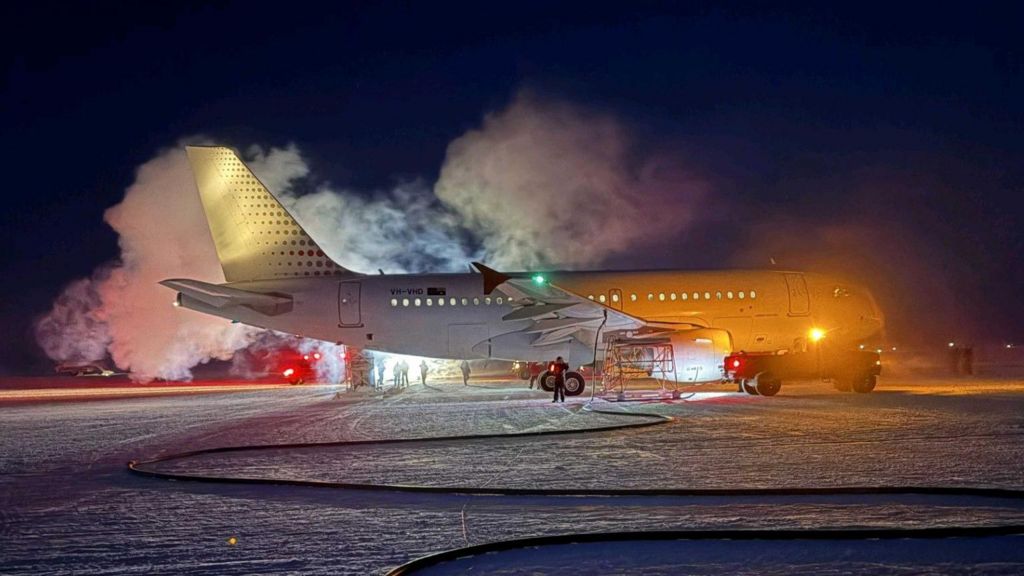
Australian aviation crew carries out daring midwinter Antarctica rescue
In a remarkable feat of aviation skill and emergency response, an Australian aviation team from Skytraders has pulled off a rare and dangerous midwinter medical evacuation of an American researcher from Antarctica, pulling off the operation in extreme darkness and bone-chilling temperatures never before attempted by a civilian airliner this close to the southern hemisphere’s winter solstice.
The urgent mission was triggered last week when the United States government reached out to Skytraders requesting immediate assistance to extract a sick or injured expedition member from McMurdo Station, the largest research facility on the southern continent. Within just 24 hours of receiving the emergency call, the company’s team completed a full refit of their Airbus A319 jet, converting the aircraft into a fully functional specialized medical evacuation configuration ready for the harsh Antarctic conditions.
After the refit was complete, the crew faced a new hurdle: waiting 12 hours for a narrow break in the unpredictable polar weather to get a safe launch window. Finally, in the early hours of Friday, the specially modified plane, callsign Snowbird 1, departed from Hobart, the capital of Australia’s southern state of Tasmania, and began the long journey south to McMurdo Station, located on Ross Island off the coast of Antarctica.
Against all odds, the flight crew successfully landed the jet on the station’s ice runway, facing what pilot Captain Al Wallach described as conditions that pushed even the most purpose-built aircraft to the absolute limit of their operational capabilities. At the time of landing, temperatures plummeted to -43°C (-45.4°F), and the entire region was gripped by the total, unbroken darkness of the Antarctic midwinter.
Following the landing, the patient was safely transferred onto the medevac-configured plane. Snowbird 1 then departed the ice station and flew north to Christchurch, New Zealand, where the patient was immediately transferred to local medical providers for care. Skytraders officials confirmed the patient is now recovering well, though no further details about the individual’s identity or specific medical condition have been released to the public.
Skytraders Deputy Chief Executive Duncan Mackay explained that while the company has completed winter medical evacuations from Antarctica before, this mission marked the closest any civilian airliner has ever operated to the winter solstice, which fell on June 21 in the southern hemisphere. Successfully landing on an ice runway in total darkness at such extreme temperatures, Mackay noted, requires decades of accumulated experience and intimate knowledge of the continent’s unforgiving conditions.
Captain Wallach emphasized that the successful outcome of the mission was a collective effort, crediting the wide range of specialist teams that made the operation possible. Beyond the flight crew, the mission relied on skilled meteorologists to track the fragile weather window, operational planners to map out the risky flight path, on-ice teams to prepare the frozen runway, and medical personnel ready to support the patient during the flight.
“Every Antarctic mission demands absolute precision, but winter operations raise the complexity significantly,” Wallach said. “The conditions we encountered were right on the edge of even the most specialised aircraft capability.”
This is not the first time Skytraders has supported the United States Antarctic Program with emergency medical evacuations from McMurdo Station. In a similar 2020 mission conducted in March, the company evacuated another station member when temperatures hit -30°C, a reading 13 degrees warmer than the conditions faced during last week’s unprecedented operation.