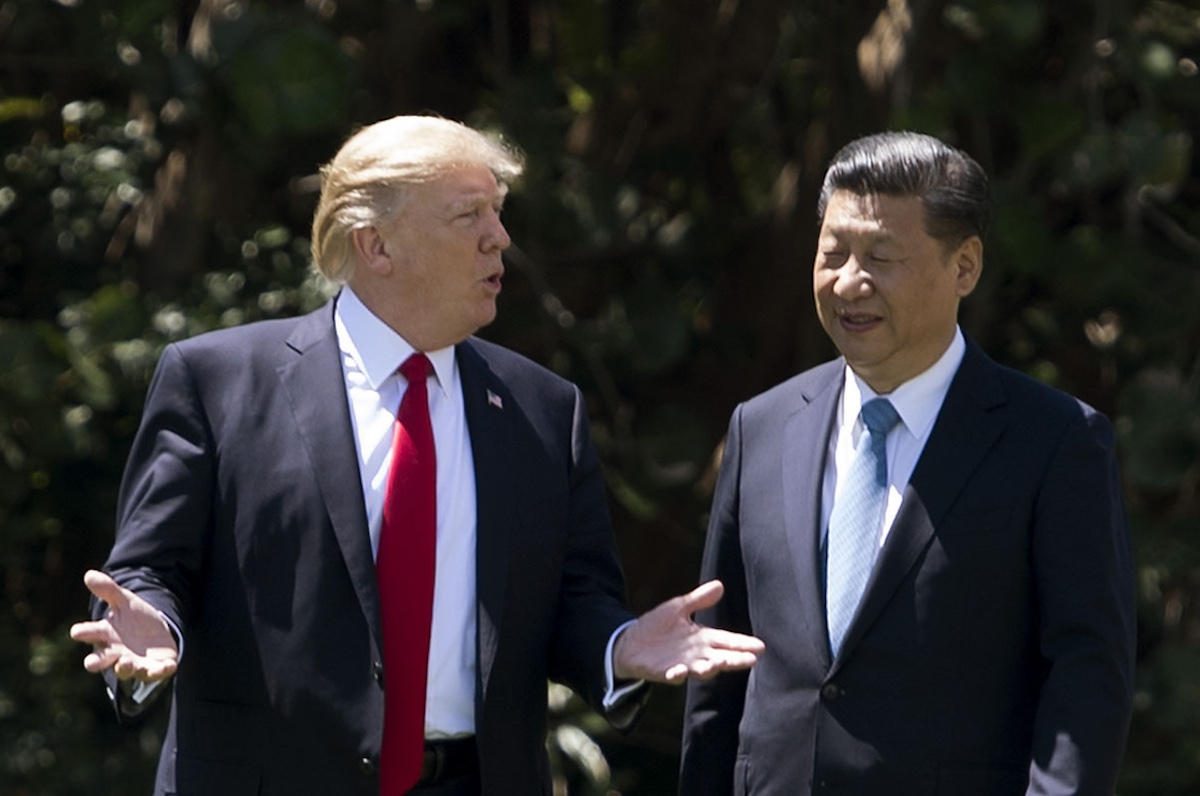
As U.S. President Donald Trump prepares to arrive in Beijing for high-stakes talks with Chinese leader Xi Jinping, the global economic and geopolitical balance between the world’s two largest powers has shifted dramatically—far faster than anyone in Washington predicted 15 months ago, when the second Trump administration took office.
When Trump’s second term began, his top advisors projected unbridled confidence that sweeping new tariffs on Chinese goods would force Beijing to make sweeping concessions, rewriting the terms of the $53 trillion U.S.-China economic relationship to overwhelmingly benefit Washington. Today, that narrative has flipped almost entirely: in the assessment of Chinese analysts and global economists alike, Xi now holds nearly all the leverage as the two leaders meet.
China’s state-run Global Times has framed the moment bluntly, describing the U.S. as a “giant with a limp” heading into the summit. The label comes as Washington grapples with overlapping crises: an escalating conflict with Iran that has pushed oil prices above $100 per barrel, fractured alliances strained by Trump’s tariff policies, and a series of international court rulings that have eroded U.S. global leverage. Chinese state media has emphasized that it is Trump traveling to Beijing in search of a trade agreement, not the reverse, arguing Washington needs a deal far more urgently than Beijing does. Compounding this, any path to reopening the strategic Strait of Hormuz, disrupted by the Iran conflict, may hinge on Beijing using its longstanding diplomatic influence in Tehran—turning the tables on the leverage Trump once expected to wield over China.
The shifting dynamic is on clear display in U.S. domestic economic data. April 2026 saw U.S. year-on-year inflation hit 3.8%, a three-year high, driven largely by energy price spikes stemming from the U.S.-Israeli strike on Iran. This inflation surge has dragged down Trump’s approval ratings and erased any chance the Federal Reserve will cut interest rates this year, a step Trump has repeatedly demanded. Even more consequential, analysts argue, is that Trump’s aggressive trade and technology policies have inadvertently accelerated China’s rise as a global leader in trade and high-value innovation.
More than a decade after Xi launched a national strategy to revitalize China’s economic standing, and 11 years after the introduction of the “Made in China 2025” industrial upgrading initiative, the strategy is delivering tangible results. One prominent example is electric vehicle giant BYD, which has surged past Tesla in global sales and upended the long-dominant European auto industry. Other Chinese tech firms, from AI startup DeepSeek to telecom leader Huawei, have developed successful workarounds to U.S. export controls, proving that Washington’s decoupling efforts have only incentivized faster domestic innovation and self-reliance in China’s high-tech sector.
Trump’s repeated attacks on the independence of the Federal Reserve, meanwhile, have undermined global trust in the U.S. dollar just as U.S. national debt approaches the $40 trillion mark. This erosion of confidence has given new momentum to Xi’s long-running campaign to internationalize the yuan, a goal that has gained unexpected traction amid Trump’s post-inauguration policy volatility. From broad-based tariffs to aggressive military adventurism in Venezuela and Iran, to unfettered fiscal expansion and attacks on independent U.S. institutions, every major policy move of Trump’s second term has weakened global trust in U.S. assets.
As Middle Eastern Gulf states grow increasingly skeptical of U.S. security guarantees amid ongoing wartime disruptions to energy trade, Beijing sees a historic opening to build a yuan-denominated energy settlement framework once hostilities end. This could pave the way for the long-discussed “petroyuan” that Chinese leaders have long envisioned, though economists caution full global adoption of the yuan as a primary energy currency remains decades away.
Union Bancaire Privee economist Carlos Casanova notes that while the trajectory of yuan internationalization is clear, broad adoption is unlikely in the near term. Gulf monarchies still rely on U.S. security guarantees and maintain deep financial ties to U.S. capital markets. For the yuan to become a dominant global energy currency, Casanova explains, Beijing would need to complete a demanding three-part agenda: deepen existing divides between the United Arab Emirates and Saudi Arabia, build up Iran’s military capacity to challenge U.S. regional security dominance (a step that would be destabilizing even for China), and fully liberalize China’s capital account while growing global demand for yuan-denominated assets. “Even under favorable conditions, this would likely take decades,” Casanova said.
Still, Trump’s confrontational approach to the BRICS bloc—Brazil, Russia, India, China, South Africa—has only accelerated moves away from the dollar. After BRICS leaders moved forward with plans to develop a dollar alternative, Trump threatened to impose 100% tariffs on all BRICS imports, a move that reinforced global fatigue with Washington’s unilateral bullying. The policy chaos created by the Trump administration is already doing more to advance the BRICS’ de-dollarization agenda than the bloc could have achieved on its own.
Even close U.S. allies are growing wary of Washington’s economic trajectory. During recent meetings between U.S. Treasury Secretary Scott Bessent and Japanese officials in Tokyo, the public agenda focused on the weak yen and Japan’s support for the U.S. in the Iran conflict. Behind closed doors, analysts say Japanese Prime Minister Sanae Takaichi almost certainly sought assurances about the safety of Japan’s $1.2 trillion holdings of U.S. Treasuries—the largest foreign stockpile of U.S. government debt in the world.
Those concerns are not unfounded. Recent U.S. data shows annual tax revenues fell 17% year-on-year in April, typically the peak month for tax collections. Nearly 17 months into the second Trump administration, policies from tariffs to inflated energy costs have left U.S. households under severe financial strain. A recent Gallup poll found 47% of Americans rate current economic conditions as “poor,” a seven-point increase since March, while 73% say conditions are worsening. A separate Fox News poll found 70% of respondents believe the economy is deteriorating, matching the record high set in 2023.
A core flaw of Trump’s China strategy, analysts argue, is that it has failed to improve U.S. competitiveness at home. Tariffs, a blunt policy tool, have acted more as a political gimmick than a roadmap to revitalize U.S. innovation, strengthen human capital, and preserve the dollar and U.S. Treasuries as the foundation of the global financial system. In fact, Enodo Economics analyst Diana Choyleva notes that U.S. efforts to block China’s technological progress have had the opposite effect, speeding China’s shift up the global value chain toward greater self-reliance and innovation.
Trump’s tariffs have also benefited China in unintended ways, by straining relations between Washington and key U.S. allies across the Indo-Pacific, including Japan, South Korea, Taiwan and Southeast Asian nations. Growing distrust between Washington and these regional democracies has increased China’s diplomatic influence in the region, allowing Xi to position China as a more reliable steward of global free trade than Trump. The Chinese government continues to benefit from Trump’s first-term decision to withdraw from the U.S.-led Trans-Pacific Partnership, and the second Trump administration’s continued focus on narrow bilateral trade deals rather than building a multilateral bloc to counter Chinese influence.
Far from curbing China’s trade ambitions, Trump’s tariffs have coincided with China posting a record annual trade surplus of $1.2 trillion in 2025. While the Xi administration has invested trillions over the past decade to dominate future-focused industries including electric vehicles, renewable energy, aerospace, artificial intelligence, biotechnology, green infrastructure and robotics, the Trump administration has laid out no comparable plan to boost U.S. competitiveness in semiconductors, infrastructure or climate action. In fact, Trump has rolled back support for clean energy sectors, dismissing electric vehicles, solar and wind power as “woke” policies while prioritizing fossil fuel development.
To date, Trump’s economic strategy has relied almost entirely on tax cuts, expansionary fiscal policy and repeated demands for lower Federal Reserve interest rates to support growth. A recent Supreme Court ruling striking down Trump’s unilateral tariff authority has added new stress to U.S. government finances, pushing the national debt to over 100% of GDP. “Tariffs had been functioning as a shadow tax that helped fund spending without explicitly raising taxes,” explained Mark Malek, chief investment officer at Siebert Financial. “Remove that and the deficit widens, borrowing rises, and historically that is the type of development that leans on the bond market and pressures yields higher.”
Given this shift in leverage, Xi is unlikely to grant Trump the sweeping “grand bargain” trade deal he is seeking ahead of 2026 U.S. midterm elections. Most economists predict Beijing will offer only small, symbolic concessions—such as new agreements to purchase Boeing aircraft and U.S. soybeans—with a commitment to continue talks later this year.
Fidelity Investments economist Peiqian Liu notes this Beijing meeting is just the first of several planned encounters between the two leaders in 2026, with the APEC Summit scheduled for Shenzhen in November, the G20 meeting in Miami in December, and a potential reciprocal visit by Xi to the U.S. later this year, possibly before the midterm elections. “Given the array of issues pending discussion, including trade, technology, supply chain controls, and chokepoints — as well as other geopolitical issues such as Taiwan and Iran — we expect the leader-to-leader conversation to be more high-level and broad-based,” Liu said.
The ongoing Iran crisis has created an awkward backdrop for the summit. “It’s awkward that, as the leaders meet, the U.S. Navy is blockading the Strait of Hormuz and intercepting tankers bound for China, Iran’s largest crude buyer,” noted Rush Doshi, an analyst at the Council on Foreign Relations. “Meanwhile, Beijing is providing political and possibly intelligence support to Tehran and could be seeking to renew flows of drone parts, air defense equipment, and missiles. Neither side is likely to make progress on this issue, but the fact that the summit appears ready to proceed despite this unusual situation is proof both leaders want the optics of stability even if its foundations are shaky.”
It is important to note that China still faces significant domestic economic headwinds: the ongoing property sector crisis continues to erode business and household confidence, local government finances are severely strained, and youth unemployment remains stubbornly high. Even so, China’s export sector has held up remarkably well amid global economic weakness: April 2026 saw year-on-year export growth of 14.1%, with passenger vehicle exports surging nearly 85% from a year earlier.
Ultimately, the Beijing summit will underscore a core reality: Trump’s campaign to halt China’s economic rise has backfired dramatically, leaving Washington empty-handed in its quest to rewrite the U.S.-China trade relationship. While a public show of dialogue between Trump and Xi will be a welcome signal for global markets—any step that eases tensions between the two largest economies is an unqualified positive for the global economy—the idea that Trump will leave Beijing having imposed his will on China reads more as a political fantasy than a plausible outcome.