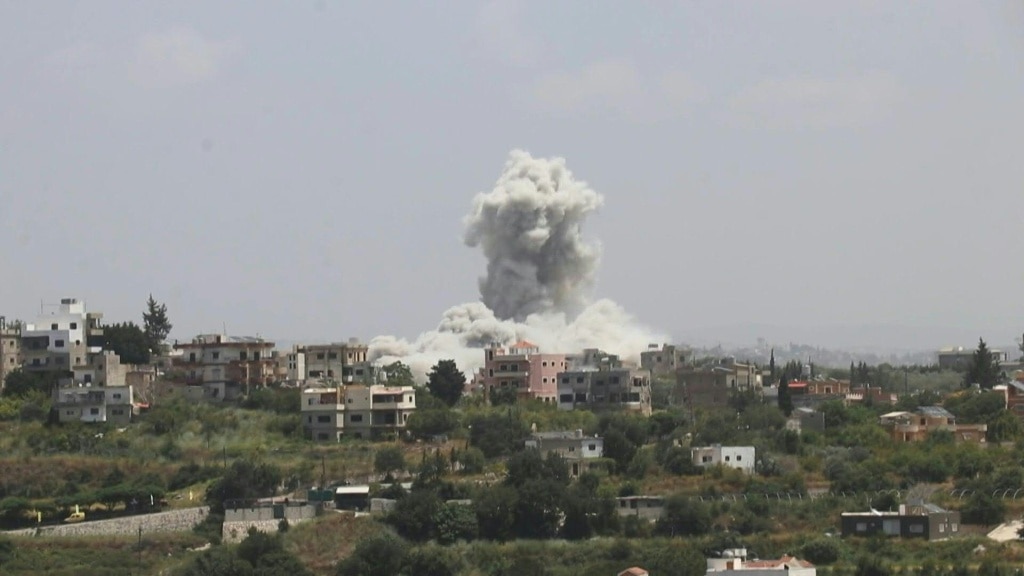
The ongoing Middle East conflict has seen sharp new escalations and shifting global diplomatic and military moves in its latest phase, with deadly Israeli airstrikes roiling Lebanon even as a nominal ceasefire with Hezbollah remains nominally in place.
On Wednesday, Israel ramped up its air campaign across Lebanon, with Beirut’s Ministry of Health confirming nine fatalities – including two children – in strikes targeting vehicles along the route between the capital Beirut and the coastal city of Sidon. The Israeli military confirmed it targeted Hezbollah positions in southern Lebanon, while an Agence France-Presse correspondent on the ground observed thick plumes of smoke rising from Burj al-Shemali in the Tyre region. The violence came a day after even deadlier strikes across southern Lebanon killed 13 people, according to Lebanese health officials. Among the Tuesday casualties were two civil defence rescuers who had been dispatched to extract a wounded survivor from an earlier raid. Since a shaky ceasefire between Israel and Hezbollah took hold on April 17, more than 380 people have been killed in intensifying Israeli attacks, and Hezbollah leader Naim Qassem has pledged to turn the frontline into “hell” for Israeli forces.
In Iran, authorities have executed a 32-year-old man convicted of espionage on behalf of Israel, marking the sixth execution on such charges since the outbreak of the current regional conflict. Iran’s state-run judiciary outlet Mizan Online identified the man as Ehsan Afreshteh, claiming he was trained by Israel’s Mossad intelligence agency in Nepal and passed along sensitive state information to Israeli handlers. But two independent human rights groups – Norway-based Hengaw and Iran Human Rights – have pushed back against the official narrative, saying Afreshteh consistently denied the accusations and that his televised confession was coerced through torture.
Regional geopolitical shifts have also been felt in the United Arab Emirates, which has formally designated 21 Lebanese individuals and organizations as terrorist entities, ordered a freeze on all their assets, and tied the group to Hezbollah, according to the country’s official state news agency. The UAE, which hosts a large Lebanese diaspora community, has emerged as a key target of Iranian missile and drone strikes since the regional conflict was sparked by joint US-Israeli military action against the Islamic republic.
The conflict has already left a marked imprint on global energy markets, the International Energy Agency (IEA) confirmed in its latest monthly market report. The agency reported that nations are drawing down commercial and strategic oil reserves at a “record pace” to offset supply disruptions tied to the conflict. Global stockpiles fell by an additional 117 million barrels in April, following a 129 million barrel drawdown in March.
Multiple nations have announced new military deployments to the region in response to heightened tensions, particularly around the critical Strait of Hormuz chokepoint. Italy confirmed it would reposition two warships closer to the Persian Gulf, but Defense Minister Guido Crosetto told lawmakers any formal deployment through the Strait of Hormuz would only proceed as part of an international mission and following a lasting regional truce, with final approval required from the Italian parliament. Australia also announced it would contribute to a new defensive mission led by France and the United Kingdom aimed at securing commercial shipping through the strait, once the mission is formally established, and will deploy a surveillance aircraft to help the UAE fend off Iranian drone attacks. The mission is strictly defensive in scope, Australian Defense Minister Richard Marles emphasized.
Diplomatic efforts to de-escalate tensions are also underway. Chinese state media reported that China’s top diplomat, Foreign Minister Wang Yi, held a call with his Pakistani counterpart Ishaq Dar, urging Islamabad to step up its mediation efforts between Iran and the United States and help facilitate a “proper” resolution to the reopening of the Strait of Hormuz. The discussion came ahead of a planned visit by former US President Donald Trump to Beijing.
New details have also emerged about Iran’s remaining military capabilities from declassified US intelligence reporting, the *New York Times* confirmed. Classified US assessments conclude Iran retains substantial missile capabilities even after targeted strikes against its program: roughly 70 percent of its mobile missile launchers and pre-conflict missile stockpile remain operational, and Iran has restored access to 30 of the 33 key missile sites located along the Strait of Hormuz coastline.