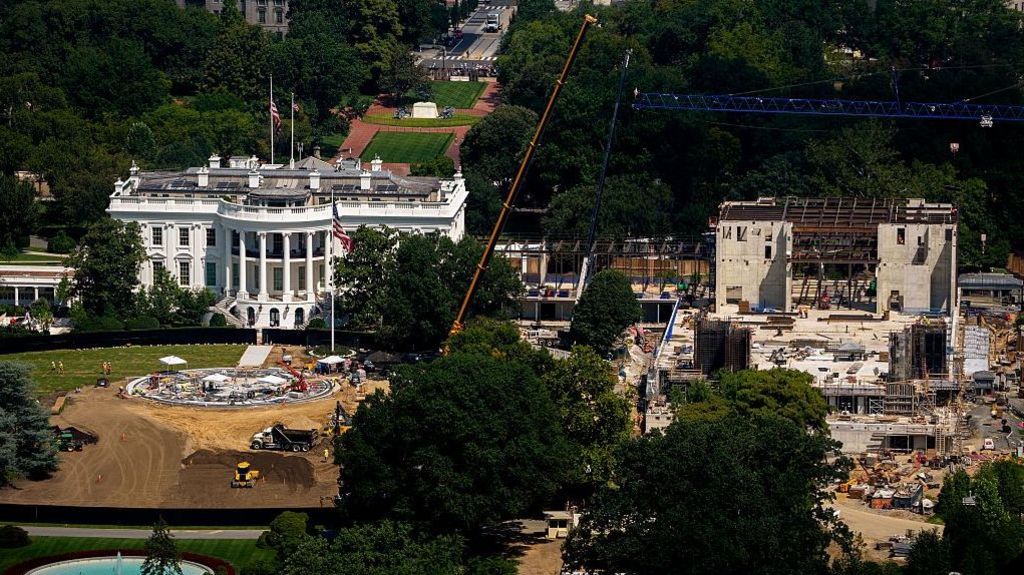
In a highly partisan and closely watched 5-4 decision, the U.S. Supreme Court has ruled to allow the continuation of a $400 million construction project that includes a new ballroom and helipad on White House grounds, handing a legal victory to former President Donald Trump’s administration. The ruling blocks lower court decisions that had ordered work to stop on the above-ground segment of the development, which required the demolition of the historic original East Wing of the White House that Trump ordered launched last fall.
The legal challenge to the project was brought by the National Trust for Historic Preservation, a nonprofit organization that advocates for the protection of culturally significant American landmarks. The group argued that the executive branch lacked unilateral authority to greenlight and carry out major construction on federal property in Washington D.C., pointing to longstanding federal law that requires explicit congressional approval for any new permanent structures on federally managed grounds in the capital.
The ruling’s narrow margin reflects deep ideological divisions on the nation’s highest court. Earlier in the week, Chief Justice John Roberts, a conservative justice, had issued a temporary stay allowing construction to proceed while the court weighed the full emergency request from the administration. In a surprise twist, Roberts ultimately joined the court’s three liberal justices in dissent. In his dissent, Roberts wrote that the planned construction is likely unlawful, noting that Congress has explicitly barred the construction of new buildings on federal District of Columbia grounds without explicit congressional authorization, and no such authorization has been granted for this project.
The five-justice conservative majority that backed the project issued an unsigned order justifying their decision. They wrote that the Trump administration had met the standard for a stay by showing it would face irreparable harm if construction were halted at this stage, and that the balance of legal and equitable considerations favored allowing work to continue. The majority also cast doubt on the challenger’s legal standing to bring the suit, noting the government is likely to ultimately prevail in its argument that the National Trust for Historic Preservation lacks sufficient legal standing to challenge the East Wing project in court.
President Trump has long defended the project, framing it as a necessary upgrade to the White House’s event infrastructure. He has argued that the existing facility lacks a large enough space to host official state events, gatherings, and receptions, and has more recently emphasized that the project includes upgrades critical to presidential security. The work also includes construction of a new helipad on the White House South Lawn, with active construction work ongoing as of August 24, 2026 in Washington D.C.
The National Trust for Historic Preservation has countered that the project already has caused and will continue to cause irreversible damage to the White House, a landmark that holds deep historical and cultural significance for the United States. The legal fight is expected to continue as the case moves forward through lower courts, even as construction can proceed in the interim.