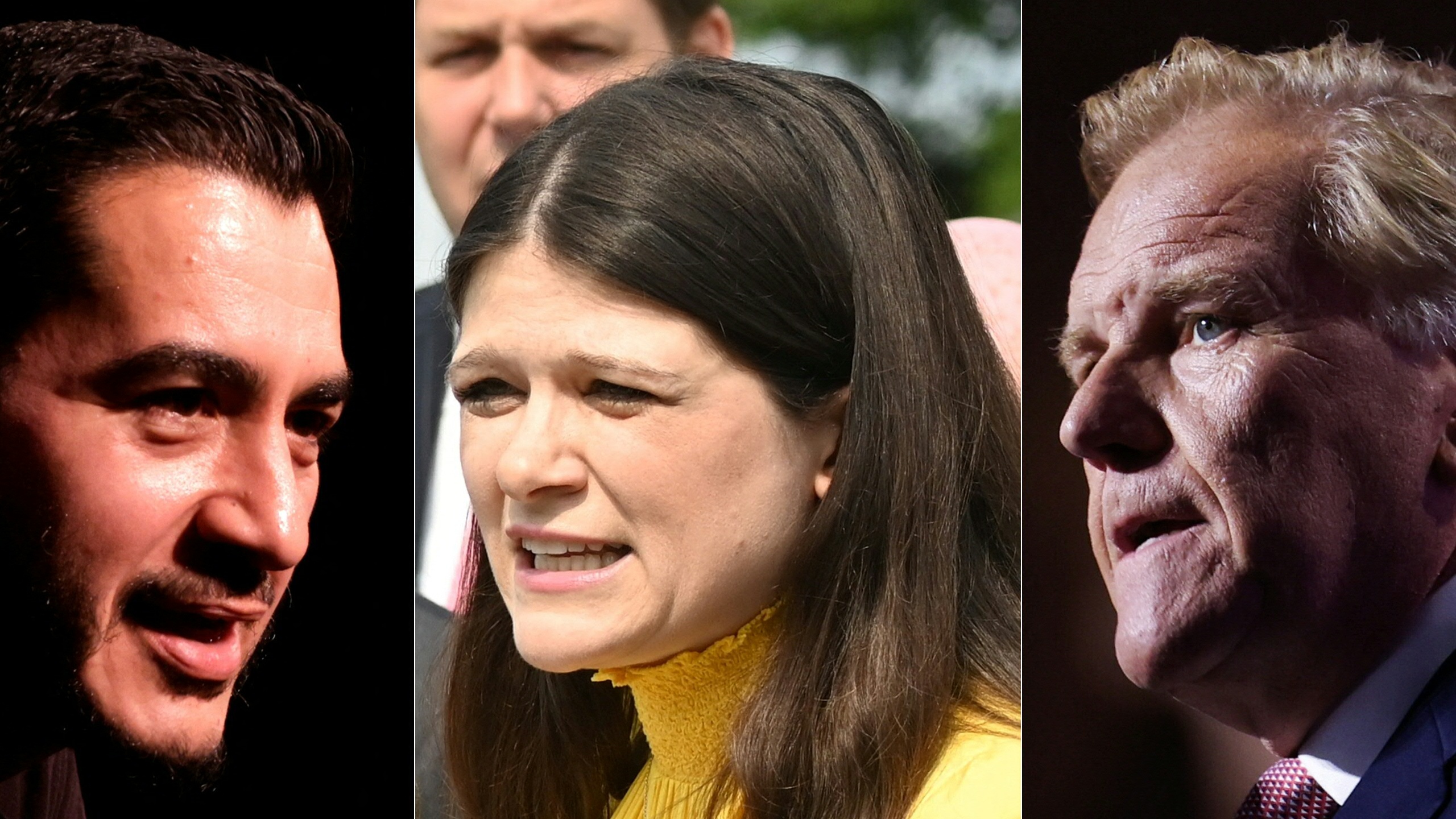
In a stunning 11th-hour political about-face less than 48 hours before Michigan’s critical 2026 U.S. Senate Election Day, long-serving Democratic U.S. Representative Haley Stevens has ignited a firestorm of cross-party condemnation after publicly throwing her support behind Republican nominee Mike Rogers — a direct break from repeated, explicit assurances she gave to fellow party members that she would stand behind her former 2024 primary rival, progressive Democratic candidate Abdul El-Sayed. Per CNN’s verified on-the-ground reporting, Stevens reaffirmed her unwavering commitment to El-Sayed as late as 10 p.m. on Saturday night to a senior, trusted Democratic Party ally, with no hint of a coming policy shift. Just 12 hours later, on Sunday morning, she stood side-by-side with Rogers at a prominent Detroit-area church to formally announce her full endorsement of the GOP candidate, a move that caught nearly every member of Michigan’s Democratic political ecosystem completely off guard. The abrupt reversal immediately set off a wave of fierce pushback from Democratic elected officials, grassroots organizers, and political commentators, with widespread scrutiny focusing on Stevens’ disjointed, often contradictory attempts to justify her last-minute decision during a live primetime CNN interview with anchor Anderson Cooper that same Sunday. When pressed repeatedly by Cooper to name a specific, verifiable event that had triggered her overnight change of heart, Stevens evaded direct answers for several minutes before stating, “Well, look, this is just a weight off my shoulders, OK?” She went on to make unsubstantiated claims that El-Sayed’s campaign had grown increasingly hostile and alienating to moderate Democratic voters, before doubling down with the baffling assertion: “Nothing with me changed, Anderson.” Cooper quickly called out the logical inconsistency of that claim, pointing out that Stevens had spent months on the campaign trail describing Rogers as a de facto rubber stamp for former President Donald Trump’s far-right policy agenda, and repeatedly warning voters that handing Republicans an additional U.S. Senate seat would put critical Democratic priorities at catastrophic risk. As Stevens continued to ramble through vague grievances about El-Sayed without citing a single concrete incident that had shifted her position, Cooper openly expressed frustration at her refusal to answer straightforward questions, noting, “You’re not really answering any of my questions, so it’s somewhat frustrating.” The viral clip of the tense exchange spread across every major social media platform within hours, drawing thousands of critical posts from voters and political observers who mocked the obvious contradictions in Stevens’ public statements. New York City public advocate Zohran Mamdani was among the first high-profile figures to publicly condemn the move, posting on X that Stevens had “betrayed the working class” by endorsing the exact Republican she had previously pledged to campaign against, at a time when Michigan voters’ access to affordable healthcare, housing security, and cost of living relief were all directly on the ballot. Stevens later attempted to frame her endorsement as a stand against antisemitism, claiming she could no longer support El-Sayed due to his public association with popular progressive streamer Hasan Piker, and invoking Piker’s uncle, left-wing political commentator Cenk Uygur, as a core justification for her decision. She also cited a controversial outside group campaign ad that drew widespread criticism for deploying antisemitic tropes by tying Michigan household cost of living struggles directly to U.S. foreign aid for Israel — a spot that El-Sayed had already publicly rejected and disavowed per Axios reporting. But Cooper quickly pointed out that all of these associations and the ad controversy were fully public knowledge weeks, if not months, before Stevens’ sudden endorsement flip, leaving no logical explanation for why she had waited until 48 hours before polls opened to abandon her party’s nominee. The explanation sparked a second wave of viral backlash online, with hundreds of social media posts highlighting the blatant timing gap, including a widely shared clip from a Hasan Piker fan account that mocked Stevens’ disjointed, unhinged on-air rant that left even Cooper visibly confused. Most notably, Stevens’ attempt to wrap her decision in a stand against antisemitism was forcefully rejected by the national leadership of the Democratic National Committee’s Jewish-American Council, which released a blistering joint statement from chair Adam Goldwyn and vice chair Steph Newton. The pair acknowledged that many Jewish Democratic voters held legitimate policy disagreements with El-Sayed over Israeli policy and community safety, but emphasized that those serious, nuanced debates deserved thoughtful public dialogue rather than cynical, last-minute political exploitation. The council’s leadership went on to call out Stevens for her glaring double standard, noting that she had completely ignored well-documented antisemitism controversies tied directly to Rogers’ campaign — including confirmed reports that members of his youth outreach team had defended a local Young Republicans group chat that contained explicit praise for Adolf Hitler. “If Stevens actually cared about protecting Jews, she would have raised those concerns with Rogers’ campaign before endorsing the MAGA Republican. She did not,” the statement read. Multiple high-profile Jewish Democratic officials across Michigan echoed that condemnation, including state congressional candidate Jeremy Moss, who noted that while he had publicly disagreed with several of El-Sayed’s past remarks, Rogers’ far-right alignment with Trump made him an unacceptable alternative for the U.S. Senate seat. The controversy also spilled over into Stevens’ own congressional office, with multiple members of her senior staff submitting immediate resignations in protest of her endorsement, while fellow Democratic lawmakers publicly voiced their shock. Maryland Representative Jamie Raskin, who had spoken directly with Stevens on Saturday night just hours before her endorsement, told reporters he could not wrap his head around the sudden reversal, and veteran Michigan Democratic Representative Debbie Dingell publicly questioned why Stevens had chosen to drop the bombshell endorsement so close to Election Day, with no advance warning to state party leadership. For his part, El-Sayed has largely declined to engage in the public drama, telling reporters gathered at a campaign stop on Sunday that he remains fully focused on speaking directly to Michigan’s voters about their top economic priorities, rather than addressing Stevens’ last-minute political about-face.
Haley Stevens slammed over Republican endorsement, struggles to explain abrupt reversal