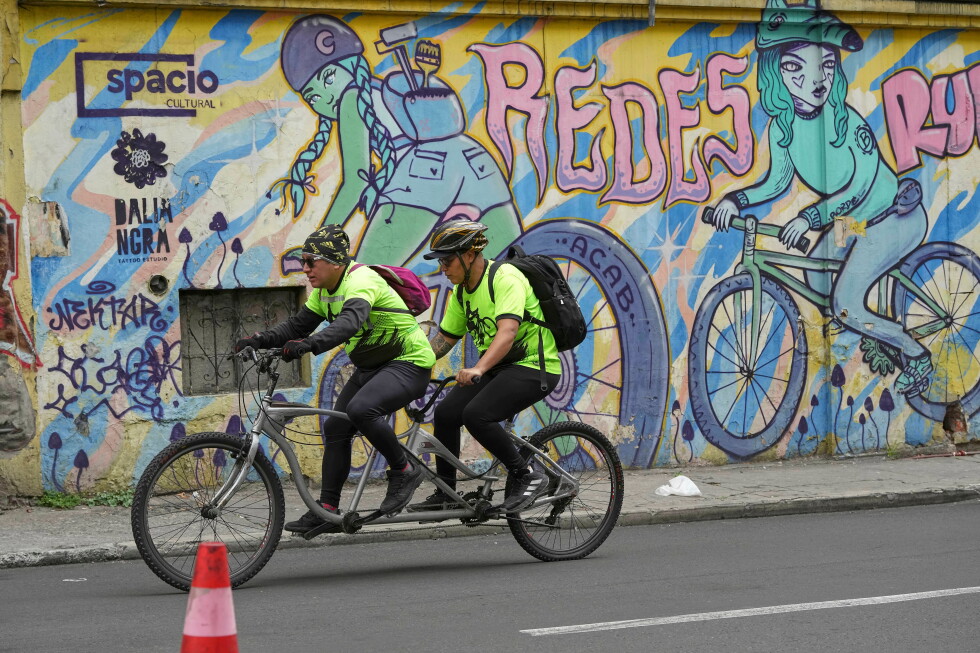
In the mountain-ringed capital of Quito, Ecuador, a 19-year-old community organization is redefining what freedom and inclusion mean for people living with visual impairment. What started as a spontaneous, one-off outing has grown into a thriving cycling collective that has opened up new worlds of adventure for more than 100 blind and low-vision residents across the country.
Franklin Ochoa, a 44-year-old Quito local who lost his vision 16 years ago, is one of the group’s most passionate and adventurous participants. Before losing his sight, he never imagined he would take on long-distance cross-country cycling challenges — but since joining Ciegocleta, a club whose name blends the Spanish words for “blind” and “bicycle,” he has already checked a 1,000-kilometer (621-mile) trip spanning most of Ecuador off his bucket list. For Ochoa, the feeling of rolling into a new town on two wheels brings unrivaled joy. “When I arrive on a bike in a new city I feel like shedding tears of happiness,” he shared. “I love speed and I always tell my guide to let go of the brakes.” His next ambition is even more ambitious: a multi-month overland ride from his home country all the way to Mexico, and he has already found a volunteer partner ready to join the journey.
The story of Ciegocleta begins with Miguel Ramos, a Quito resident who loved cycling and built his own custom tandem bikes in his spare time. Ramos originally constructed the multi-seat cycles to ride Quito’s popular weekly *ciclopaseo* — an event that closes major city avenues to motor vehicles, opening the space exclusively for cyclists and joggers — with his own children. Everything changed when one of his children was unable to join a ride, and he spontaneously invited his blind neighbor to take their place. That single outing turned into a regular tradition, and the informal group of tandem rides with sighted guides gradually evolved into the structured non-profit community Ciegocleta is today. The club now offers multi-seat bikes ranging from two-seat tandems to three and four-seat models that accommodate multiple visually impaired riders per trip.
Today, the organization counts 150 registered members, with roughly 30 riders turning out for the weekly Sunday rides that remain the club’s core activity. Before each public ride, the group prioritizes safety and mutual understanding: visually impaired participants receive detailed safety guidance, while participating sighted volunteers complete a perspective-shifting exercise, riding a short distance with their eyes covered to experience the vulnerability and trust their riding partners navigate on every trip. For long-time member Ximena Lozano, a 54-year-old psychologist who was born without sight, the club has transformed her daily life. After spending much of her younger years confined to indoor activities like reading, writing, and web surfing, Ciegocleta gives her a consistent reason to explore the outdoors. “It gives me the chance to experience freedom,” she explained.
The work of Ciegocleta fills a critical gap in accessibility for Ecuador’s visually impaired community. Official government data puts the total number of people living with vision impairment in the country at roughly 56,000. While blind Ecuadorians have made steady progress in accessing equal employment opportunities in recent years, inclusive access to recreational and sports activities remains a largely unmet need.
Volunteers say the experience of participating in the club is just as transformative for them as it is for the visually impaired riders. José Paéz, one of the club’s long-time volunteers, joined after his father-in-law lost his sight rapidly to illness and fell into depression. Bringing his father-in-law to the club’s free rides became a way to help him regain his joy for life. Even for experienced cyclists, guiding a tandem bike requires new skills and patience. “At first it felt scary to lead a blind person on a bike,” Paéz recalled. “Keeping a tandem bike balanced and sustaining the rhythm is not as easy as when you use a regular bike.”
For founder Ramos, the work of the club is about more than just cycling — it is a model for what genuine social inclusion looks like. “This is true inclusion,” he said. “We have blind people who are now enjoying cycling without any limits.”