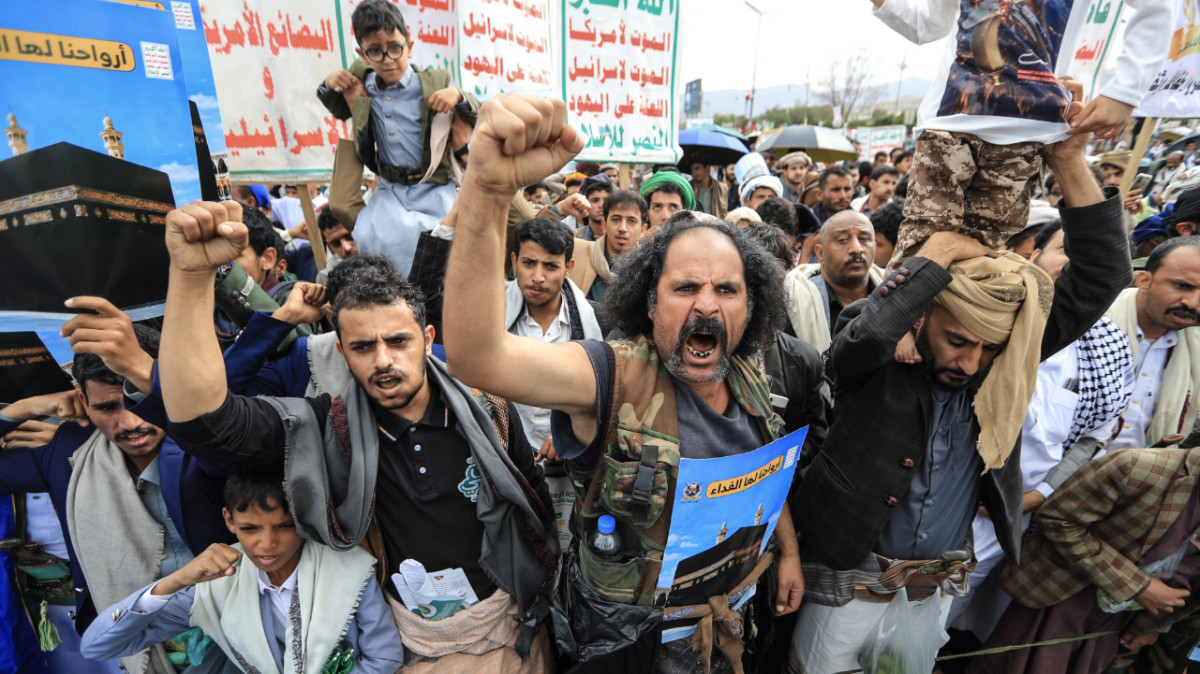
Exclusive accounts from senior Western and Arab officials with direct insight into operational developments, shared with Middle East Eye, reveal that Yemen’s Houthi movement, formally known as Ansar Allah, has carried out a string of previously unpublicized small-scale incursions across the border into Saudi Arabia over recent months, extending the long-running Yemeni conflict beyond its national boundaries.
Targeting isolated border outposts in Saudi Arabia’s rugged, mountainous southwestern frontier, at least one confirmed raid took place in the final days of October, with the entire operation captured and verified via international surveillance systems. The Western official confirmed that Houthi fighters seized a cache of specialized small arms exclusively issued to Saudi border security units during one of these incursions, providing tangible evidence of the ground operations.
These raids represent the first documented Houthi ground assaults on Saudi territory since the formal collapse of the 2022 UN-mediated Yemeni ceasefire. Prior to the truce’s implementation, Saudi authorities regularly documented Houthi infiltration attempts, including coordinated ground strikes on border population centers and Saudi military installations.
Mohammed al-Basha, leading Yemen analyst and founder of the Basha Report Risk Advisory, as well as an associate fellow at the Royal United Services Institute, confirmed he has been closely tracking the steady escalation of Houthi military activity along the shared frontier. He outlined a clear two-phase pattern of Houthi offensive expansion: the first wave relied on long-range drones and short-range ballistic missiles, while the subsequent phase introduced weaponized quadcopters deploying mortar ordnance and targeted sniper operations against Saudi border personnel. Basha noted that the resumption of full ground incursions was a long-anticipated, predictable development, stating it was “only a matter of time” before the group returned to this tactic. He projected that upcoming Houthi ground operations will mirror the hit-and-run guerrilla tactics deployed in the early years of the 12-year Yemeni conflict, where fighters quickly seize coalition personnel, capture weapons caches, destroy military hardware and vehicles, and withdraw before facing sustained counterattack.
In response to the emerging border threat, an Arab official confirmed that Saudi Arabia is leveraging its Mecca Pact allies to reinforce its southern frontier, with military support from Egypt, Pakistan, and Turkey poised to deliver critical defensive capabilities. Both Turkey and Pakistan have publicly announced plans to deploy military units including anti-aircraft defense batteries to Saudi territory, while Egypt’s national parliament formally approved the deployment of defensive military forces to the kingdom just last week. Adding to regional military shifts, Syrian Foreign Minister Asaad al-Shaibani announced on Saturday that Damascus is actively evaluating formal membership in the Mecca Pact, and the Western official confirmed that a contingent of Syrian drone specialists has already been deployed to Yemen to support Saudi-backed Yemeni government forces on the ground.
While these new cross-border ground raids do not shift the broader military stalemate across Yemen, they coincide with dramatic Houthi territorial gains inside the country: per Reuters reporting from Monday, Houthi forces have advanced to a position just 50 miles outside the strategic port city of Aden, the administrative capital of the internationally recognized Yemeni government, and have fully encircled the major urban center of Taiz. For years, the Houthis have launched hundreds of long-range strikes targeting Saudi civilian infrastructure including international airports and energy facilities, attacks that have killed at least 24 people and once forced Riyadh to cancel a high-profile global investment summit.
The new wave of ground incursions has laid bare the critical vulnerabilities of Saudi Arabia’s vast, remote southern border, highlighting the immense operational challenges of patrolling its harsh, mountainous terrain. The operations have also amplified longstanding concerns within Saudi leadership that the Houthi movement holds explicit territorial ambitions over the kingdom’s three southern provinces of Asir, Jazan, and Najran, territories formally ceded to Saudi Arabia by Yemen under the 1934 Treaty of Taif. The Houthi movement originated in Yemen’s northern Saada governorate, a mountainous region directly south of the Saudi border, takes its name from founder Hussein Badreddin al-Houthi, and follows the Zaydi branch of Shia Islam. While the group recruits widely across Yemeni society, its senior leadership claims Hashemite lineage tracing back to the Prophet Muhammad.
Houthis launched cross border raids on Saudi military posts, sources say