分类: politics

  • Macron calls Trump’s remarks on his marriage ‘inelegant’

    Macron calls Trump’s remarks on his marriage ‘inelegant’

    In a rare public rebuke of remarks from former U.S. President Donald Trump, French head of state Emmanuel Macron has pushed back against comments Trump made about his personal marriage, calling the statements out of line and lacking basic diplomatic decorum.

    The clash between the two high-profile political figures centers on comments Trump made publicly regarding Macron’s marriage to Brigitte Macron, who is 24 years his senior. When asked to respond to the former American president’s words during a recent public appearance, Macron did not hold back in his assessment.

    Macron explicitly stated that Trump’s observations about his private marital life fell “neither elegant nor up to standard,” pushing back against what he framed as inappropriate intrusion into his personal affairs by the former U.S. leader. The incident has drawn new attention to the sometimes tense dynamic between Macron and Trump, who have a history of sparring over both policy and personal matters. While the exchange remains focused on the personal comments, it also underscores the broader frictions that have intermittently marked interactions between the two prominent global political figures.

  • US lifts sanctions on Venezuelan interim leader Delcy Rodríguez

    US lifts sanctions on Venezuelan interim leader Delcy Rodríguez

    In a significant shift in U.S.-Venezuela relations that marks the latest step in a rapidly unfolding diplomatic thaw, the United States has removed interim Venezuelan President Delcy Rodríguez from its Specially Designated Nationals (SDN) sanctions list. This policy change comes less than three months after U.S. military forces carried out a high-profile raid in Caracas that captured former Venezuelan leader Nicolás Maduro and his wife, transferring them to New York to face federal drug trafficking charges.

    Rodríguez, a longstanding close ally of Maduro who previously served as his vice president, was first added to the U.S. sanctions roster in 2018 over Washington’s accusations that she had undermined democratic governance in Venezuela. Just days after the raid that removed Maduro from power, she was sworn in as interim president by Venezuela’s National Assembly, which holds a majority loyal to Maduro’s faction. U.S. President Donald Trump has publicly praised Rodríguez, describing her as “a terrific person” who has collaborated effectively with Washington.

    Inclusion on the SDN list carries severe financial restrictions: all assets held by listed individuals within U.S. jurisdiction are frozen, and U.S. citizens and entities are prohibited from conducting any commercial transactions with them. Rodríguez welcomed the delisting in a public post on X, framing the move as “a significant step in the right direction to normalise and strengthen relations between our countries.”

    White House spokesperson Anna Kelly echoed that positive framing, emphasizing that the decision reflects tangible progress “between our two countries to promote stability, support economic recovery and advance political reconciliation in Venezuela.” She reaffirmed Trump’s assessment, noting “Delcy Rodríguez is doing a great job and is working with the United States very well.”

    Despite the upbeat tone from both governments, the decision has drawn sharp criticism from Venezuelan opposition activists based in Caracas. These critics argue that Washington should have used the leverage of sanctions to push Rodríguez to fulfill longstanding demands to release all political detainees still held in Venezuelan prisons. The release of political prisoners was one of the core conditions Secretary of State Marco Rubio laid out for Rodríguez shortly after Maduro’s removal from office.

    While Venezuela’s ruling National Assembly has approved an amnesty law that has led to the release of hundreds of detainees, leading prisoners’ rights organization Foro Penal reports that nearly 500 political prisoners remain in custody.

    The delisting of Rodríguez is the most visible signal yet of a steady warming of ties between the Trump administration and the interim government. Earlier this same week, the United States formally reopened its embassy in Caracas, seven years after it shuttered the diplomatic mission in response to the Maduro government’s actions. In a reciprocal move, Venezuela has also sent a diplomatic delegation back to Washington to reopen its own embassy there.

    In the months since Maduro was ousted, multiple high-level U.S. delegations have traveled to Caracas to hold talks on expanding U.S. access to Venezuela’s extensive oil and mineral reserves. But critics of Rodríguez’s interim administration have raised alarms that there has been almost no public discussion of scheduling free and democratic national elections, a key long-term demand from the international community.

    Venezuelan opposition leader María Corina Machado, who has lived in exile since leaving the country to accept the Nobel Peace Prize she was awarded in December, held a meeting with Marco Rubio on Tuesday. Though Trump has sidelined Machado to prioritize cooperation with Rodríguez, she struck a constructive tone, calling the discussion “excellent” and praising Rubio’s “dedication to democracy, freedom and Venezuelans’ well-being.”

    Speaking to Fox News after the meeting, Rubio said Washington is making steady progress in its engagement with Venezuela. Outlining a three-part strategy for the country’s transition, Rubio confirmed Venezuela has now entered the second phase: economic and political recovery. “Ultimately, there will have to be a transition phase. There will have to be free and fair elections in Venezuela, and that point has to come,” he stated. “It’s not forever, but we have to be patient, but we also can’t be complacent,” he added, declining to provide any timeline for when democratic elections would be held.

  • Trump says Iran war ending soon, but ‘extremely hard’ hits ahead

    Trump says Iran war ending soon, but ‘extremely hard’ hits ahead

    WASHINGTON — In a highly anticipated primetime national address Wednesday, former President Donald Trump announced that the U.S. military’s month-long military campaign in Iran is approaching a swift conclusion, framing the operation as an unprecedented success in degrading the Islamic Republic’s military capabilities.

    During the 18-minute televised speech, Trump defended the ongoing conflict, claiming U.S. forces had systematically dismantled Iran’s ability to project power across the Middle East and threaten American interests. “We are systematically dismantling the regime’s ability to threaten America or project power outside of their borders. That means eliminating Iran’s navy, which is now absolutely destroyed, hurting their air force and their missile program at levels never seen before, and annihilating their defense industrial base. We’ve done all of it,” Trump told the nation. He added that the scale of military damage inflicted on Iran is unmatched in modern military history, noting that core strategic goals of the campaign are nearly complete.

    The White House’s advance announcement of the address Tuesday had sparked widespread speculation that the president would share major new developments about the costly, deadly conflict, now entering its fourth week. However, analysts and observers quickly noted that most of Trump’s remarks recycled aggressive rhetoric and claims he and his Cabinet have repeated for weeks, including his threat to pummel Iran into what he called the “stone ages” over the next two to three weeks. This echoed prior comments he has shared on social media and with press outlets in recent weeks.

    The conflict has already sent shockwaves across the Middle East and the U.S. domestic economy, leaving a trail of death and destruction that has eroded public support for Trump’s decision to launch the war. The campaign has killed 13 U.S. service members and wounded 350 more, according to Pentagon data. On the Iranian side, a U.S.-based Iran human rights group HRANA reports that 1,598 Iranian civilians, including 244 children, have been killed in U.S. and Israeli strikes as of Tuesday. The humanitarian crisis extends far beyond Iran’s borders: concurrent Israeli operations in southern Lebanon have killed 1,240 people, wounded 3,680, and displaced more than 1.1 million Lebanese people as of Monday, according to Lebanese government data. Across the broader Middle East, Al Jazeera English has recorded more than 185 additional deaths in nations including Bahrain, Iraq, Jordan, Syria, and the Palestinian territories.

    The disruption of global energy markets has also hit American consumers directly. After Iran seized control of the Strait of Hormuz, the strategic chokepoint through which roughly one-fifth of the world’s global petroleum supplies flow, international crude prices spiked, pushing average U.S. gasoline prices above $4 per gallon. This economic pressure has translated to plummeting public support for the war: a recent Reuters/Ipsos poll conducted within the last week found that roughly two-thirds of Americans want the Biden administration – now the Trump second-term administration – to move quickly to end the conflict.

    Trump’s public statements on exit strategy and war aims have shifted repeatedly, sometimes even on a daily basis. On Tuesday, he told reporters that the Iranian regime had already been successfully changed, and that he planned to wrap up military operations within two to three weeks. But the new Iranian Supreme Leader, Majtaba Khamenei, who succeeded his father Ali Khamenei – killed by U.S. and Israeli forces at the start of the war – is reportedly no less hardline, and may hold even more radical views than his predecessor.

    In comments to Reuters Wednesday, Trump also downplayed concerns about Iran’s nuclear program, saying he “doesn’t care” about near-weapons-grade enriched uranium buried under rubble at a nuclear site bombed by the U.S. and Israel in June, per International Atomic Energy Agency data. This marks a notable shift from Trump’s original justification for launching the war: in his February 28 video announcement of the initial attack, the president explicitly stated that the core goal of the operation was to ensure Iran “can never have a nuclear weapon.”

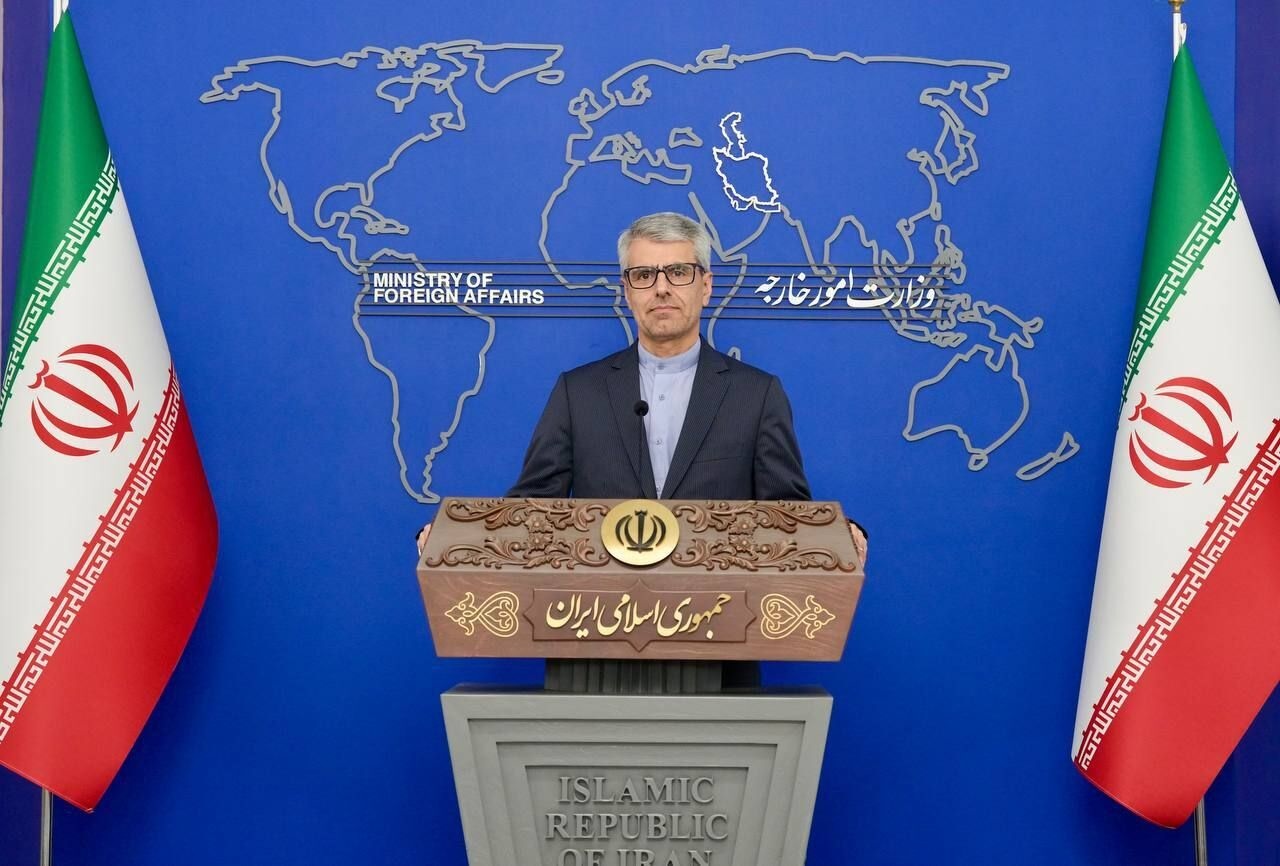
    Earlier Wednesday, Trump made an unsubstantiated claim on his social media platform Truth Social that Iran’s new radicalized president had requested a ceasefire. He wrote, “We will consider when Hormuz Strait is open, free, and clear. Until then, we are blasting Iran into oblivion or, as they say, back to the Stone Ages!!! President DJT.” Iran’s Foreign Ministry spokesperson Esmaeil Baghaei quickly rejected the claim as “false and baseless,” according to Iranian state-run English broadcaster PressTV.

    Hours before Trump’s primetime address, Iranian President Masoud Pezeshkian – who took office in 2024 – released an open letter directly to the American public, pushing back against the Trump administration’s framing of the conflict. Pezeshkian argued that the White House has lied to Americans about Iranian aggression, framing Iran’s military actions as “a measured response grounded in legitimate self-defense, and by no means an initiation of war or aggression.” He questioned the moral and strategic value of the campaign, writing, “Does the massacre of innocent children, the destruction of cancer-treatment pharmaceutical facilities, or boasting about bombing a country ‘back to the stone ages’ serve any purpose other than further damaging the United States’ global standing?” The reference was to an early U.S. missile strike that killed 168 elementary school children on the first day of the invasion. Pezeshkian also blamed Trump for his 2018 decision to withdraw the U.S. from the multinational Iran nuclear deal, noting that the Iranian people hold no inherent enmity toward the American public. Footage of Iranian lawmakers burning American flag prints and chanting anti-U.S. slogans in parliament following the 2018 withdrawal has circulated widely online.

    Longstanding tensions between the U.S. and Iran predate the 2026 conflict: the U.S. Department of Defense and U.S. intelligence agencies have linked Iran to dozens of attacks on American military bases across the Middle East over decades. Most notably, a 2020 Iranian strike on Iraq’s Ain al-Asad airbase, launched in retaliation for a U.S. drone strike that killed top Iranian commander Qassem Soleimani, caused traumatic brain injuries for more than 100 U.S. service members. During his 2024 presidential campaign, Trump dismissed these injuries as nothing more than “headaches.” Earlier this year, a federal jury convicted an Iranian Revolutionary Guard Corps operative of plotting to assassinate Trump and other high-profile U.S. political figures during the 2024 election cycle, confirming Iran’s long-standing efforts to carry out attacks on U.S. soil.

  • A look at the UK’s Royal Navy, which has faced jibe after jibe from Trump and Hegseth

    A look at the UK’s Royal Navy, which has faced jibe after jibe from Trump and Hegseth

    LONDON – A fresh wave of diplomatic tension has emerged between the United States and the United Kingdom after U.S. President Donald Trump and Defense Secretary Pete Hegseth launched sharp public criticism of the Royal Navy’s operational capabilities, remarks that cut deep for a nation with centuries of iconic maritime heritage – but which also touch on long-running debates about Britain’s eroding military standing.

    The friction between the two allies traces back to the outbreak of the Iran war on February 28, when newly installed British Prime Minister Keir Starmer rejected a U.S. request to grant American military forces access to UK military bases. While Starmer’s government has since partially reversed that decision, allowing U.S. operations from bases including the key Indian Ocean outpost Diego Garcia for limited defensive purposes, Trump has remained vocal about feeling betrayed by the UK’s initial refusal.

    In an interview with Britain’s Daily Telegraph published Wednesday, Trump went as far as dismissing the Royal Navy’s two flagship new aircraft carriers as mere “toys.” “You don’t even have a navy,” he told the newspaper. “You’re too old and had aircraft carriers that didn’t work.” Not to be outdone, Hegseth took a sarcastic shot at the service, suggesting the “big, bad Royal Navy” should step up to secure commercial shipping lanes in the Strait of Hormuz, a critical global chokepoint for energy trade.

    The two 65,000-ton carriers at the center of Trump’s attack, HMS Queen Elizabeth and HMS Prince of Wales, are the largest and most lethal warships ever built for the Royal Navy. While they are smaller and less power-projected than the U.S. Navy’s supercarriers, defense analysts widely regard them as highly capable platforms, particularly for integrated coalition operations – even if they faced well-documented technical teething problems in their early years of service.

    It is true that the Royal Navy of 2025 bears little resemblance to the globally dominant force that controlled the world’s oceans during the height of the British Empire. But experts emphasize that the service is far weaker than its Cold War peak, but not as impotent as Trump and Hegseth’s remarks portray it, holding a similar operational standing to the French Navy, its closest European peer.

    “There is a grain of truth to the critique: the Royal Navy is smaller today than it has been in hundreds of years,” explained Professor Kevin Rowlands, editor of the Royal United Services Institute (RUSI) Journal and a former Royal Navy captain. “On the other hand, the service notes it is entering its first period of sustained growth since World War II, with more new ships scheduled for construction than at any point in decades.”

    A look back at recent British naval history puts the current size of the fleet in context. As recently as 1982, the UK was able to assemble a 127-ship task force – including two aircraft carriers – to retake the Falkland Islands after Argentina’s invasion, a campaign that then-U.S. President Ronald Reagan openly opposed. That operation is now widely viewed as the final demonstration of Britain’s traditional naval dominance; no deployment of anywhere near that scale could be mounted today.

    Analysis of UK Ministry of Defence and House of Commons Library data by the Associated Press shows the steady, dramatic contraction of the Royal Navy’s combat fleet over the past 50 years. In 1975, the service counted 166 active vessels, including aircraft carriers, destroyers, frigates, and attack submarines. By 2025, that number had fallen to just 66. The UK went seven years in the 2010s without any operational aircraft carriers at all, despite today having two in service. The destroyer fleet has shrunk by half to just six vessels, while the frigate force has been cut from 60 ships to only 11.

    The delayed deployment of the destroyer HMS Dragon to the Middle East in the immediate aftermath of the Iran war outbreak became a high-profile symbol of the Royal Navy’s stretched capabilities for critics. While naval personnel worked around the clock to reconfigure the vessel for its new mission after it had been preparing for a completely different deployment, the incident reinforced widespread perceptions that British military power has dwindled significantly since the fall of the Berlin Wall in 1989.

    That decline did not happen by accident. During much of the Cold War, the UK invested between 4% and 8% of its annual gross domestic product in defense. After the collapse of the Soviet Union, that share steadily dropped to a low of 1.9% of GDP in 2018, giving ammunition to Trump’s criticisms.

    Like many Western allies, successive UK governments embraced the post-Cold War “peace dividend,” redirecting funding once allocated to the military to domestic priorities including public health and education – a shift accelerated by the Labour governments of Tony Blair and Gordon Brown. When the global financial crisis hit in 2008, Conservative-led governments introduced harsh austerity measures that froze defense spending even as Russia’s aggression began to reshape European security, most notably after its 2014 annexation of Crimea.

    Only after Russia’s full-scale invasion of Ukraine in 2022 did cross-party consensus emerge that decades of defense cuts had gone too far. The previous Conservative government began reversing the trend of declining spending, and since Labour returned to power in the 2024 general election, Starmer has moved to ramp up defense investment – a shift that has required cuts to the UK’s long-standing foreign aid budget.

    Starmer has committed to raising UK defense spending to 2.5% of GDP by 2027, with an updated target of 3.5% of GDP by 2035 to meet a NATO goal championed by Trump. That commitment translates to tens of billions of pounds in additional defense spending, which would fund a major expansion of military equipment across all three services.

    But accelerating that expansion is easier said than done. The UK’s public finances have already been strained by the economic fallout from the Iran war, leaving no clear path to find extra funding for faster military growth.

    For his part, RUSI’s Rowlands expects the U.S. criticism to continue despite its overstated claims. “We are dealing with an administration that doesn’t do nuance,” he noted.

  • Trump falling into Iran’s asymmetric resolve trap

    Trump falling into Iran’s asymmetric resolve trap

    Nearly every strategic objective the United States laid out for its current conflict against Iran has failed to materialize, according to a leading scholar of protracted US military engagements. No popular uprising has unseated Iran’s ruling establishment, hardline leadership has merely reshuffled rather than fallen, Tehran’s missile and drone capabilities continue to strike targets across the Middle East, and the closure of the Strait of Hormuz has sent global energy prices soaring. Most notably, in direct contradiction of former US President Donald Trump’s demand for unconditional surrender, Iran has outright rejected a 15-point US-backed ceasefire proposal. What has caused such a sweeping deviation from Washington’s initial war plans?

    In an analysis republished from *The Conversation*, Charles Walldorf, professor of politics and international affairs at Wake Forest University, argues the core issue is what he terms the “trap of asymmetric resolve.” This dynamic unfolds when a militarily dominant power with limited stakes in a conflict enters war against a far smaller, weaker state whose entire governing system hangs in the balance. When the weaker side possesses near-unwavering commitment to victory, overcoming that determination becomes exponentially harder – and often nearly impossible – for the stronger power.

    “For Iran, the Islamic Republic’s very existence is on the line, a stakes Washington can never match in this conflict,” Walldorf explains. “That existential threat gives Tehran overwhelming incentives to maintain resistance and deploy highly effective countermeasures to wear down US advances.”

    This pattern of asymmetric conflict has repeated throughout military history, dating back to the sixth century B.C., when a massive invasion force led by Persian Emperor Darius I was halted by a much smaller, deeply determined Scythian army. The lopsided standoff ultimately ended in a humiliating retreat for the Persian Empire. In the modern era, the United States has repeatedly fallen victim to this same trap.

    The Vietnam War stands as one of the clearest modern examples. Over eight years of brutal conflict, an estimated 1.1 million North Vietnamese fighters and civilians lost their lives, compared to 58,000 US troops. Despite this massive casualty disparity, North Vietnam’s unyielding commitment to unification ultimately overwhelmed US willingness to sustain the war. After years of costly fighting, the US withdrew, and North Vietnam secured full victory over South Vietnam in 1975.

    A near identical dynamic played out decades later in Afghanistan. The US ousted the Taliban regime in 2001, installed a Western-aligned government, and built a 300,000-strong Afghan national military backed by unlimited US firepower. Over 20 years of conflict, roughly 84,000 Taliban fighters were killed, compared to just 2,400 US service members. Yet the Taliban’s relentless commitment to retaking power eventually outlasted US political will. The US signed a withdrawal deal in 2020, pulled all remaining troops out in 2021, and the Taliban retook full control of the country within weeks.

    This pattern is not unique to the US. The Soviet Union suffered an identical humiliating defeat in its 9-year Afghanistan occupation in the 1980s, despite suffering far fewer total casualties than the Afghan resistance. Post-World War II France likewise lost protracted asymmetric conflicts in Vietnam and Algeria, despite holding massive military advantages over independence fighters.

    Today, that same asymmetry of resolve is playing out in the US-Iran war. Unlike the 12-day 2025 limited conflict that targeted only Iranian military and nuclear infrastructure, the current campaign has explicitly targeted the survival of Iran’s ruling government, with targeted assassinations of top leaders and open calls for popular uprising.

    Tehran has followed through on pre-war warnings to retaliate across the region. Iran has launched strikes against Israeli targets, US military bases across the Middle East, and aligned Arab Gulf states, while drastically cutting commercial shipping access through the Strait of Hormuz – the world’s busiest energy chokepoint. Iran has taken far heavier losses than the US in the conflict: as of mid-March, more than 5,000 Iranian military personnel and 1,500 civilians have been killed, compared to 13 US service members. Even so, Tehran has refused to back down, declaring on March 10 that “We will determine when the war ends.”

    This unyielding resistance has caught the Trump administration off guard. Before the war began, Trump openly questioned why Iran would not cave to US demands, and he has since acknowledged that regime change – a core opening war goal – is now a “very big hurdle.” This disconnect stems from misleading pre-war messaging to the American public: Secretary of State Marco Rubio claimed in January that Iran was weaker than it had ever been, with no intercontinental ballistic missiles capable of hitting the US mainland, a crippled nuclear program, and fewer regional allies than at any point in modern history. A March 6 Marist poll reflected this narrative, with 55% of Americans saying they viewed Iran as a minor or nonexistent threat.

    As Iran’s resilience has become impossible to ignore, US public opinion has turned sharply against the war. This shifting sentiment poses a unique challenge for democratic leaders, who face electoral consequences for maintaining unpopular conflicts. Today, the Iran war is among the least popular US conflicts since World War II, with consistent polling showing roughly 60% of Americans oppose continued military engagement. This mirrors the collapse of public support that drove past US withdrawals from asymmetric quagmires in Vietnam and Afghanistan.

    While pre-war Iran faced widespread domestic protests that weakened public support for the government, a combination of a brutal government crackdown and a “rally around the flag” nationalist response to foreign invasion has muted domestic discontent, eliminating the domestic pressure for compromise that Washington faces.

    Looking ahead, the Trump administration has attempted to manage the impact of asymmetric resolve by framing the operation as limited in scope and duration. To calm jittery financial markets and reassure war-weary voters, Trump has repeatedly promised a short conflict and delayed large-scale offensive strikes to make space for negotiations – claims that Iran has not corroborated.

    Walldorf notes that history offers stronger powers two clear paths forward when facing a more determined weaker adversary. The first is to give in to the hubris of military power and escalate the conflict, a path that led to decades-long quagmires in Vietnam, Iraq, and Afghanistan. The second is to wind down hostilities, accept limited gains, and seek a negotiated end to the conflict.

    Past leaders have overwhelmingly chosen escalation, convinced that a small increase in military force will tip the balance. President Barack Obama fell into this trap when he ordered a surge of 30,000 additional US troops to Afghanistan, incorrectly predicting the deployment would break the Taliban’s resistance. Despite public signals that he wants to exit the conflict, Trump could still take the same path: additional US troops are already deploying to the Persian Gulf, and B-52 bombers have begun flying combat sorties over Iranian territory for the first time in the current war.

    History shows that escalating against a determined foe like Iran will come at massive cost to the United States. But the second path – de-escalation and negotiation – remains open to Trump. The president has already chosen this route twice before: he signed the 2020 deal with the Taliban to end the Afghanistan war rather than escalating, and he walked away from the 2025 Yemen air campaign when he realized defeating the Houthi movement would require a costly ground invasion.

    Trump could choose the same exit strategy for Iran: declare that core US goals have been met, withdraw offensive forces, and enter sustained, good-faith negotiations to end the conflict. Any deal would require US concessions, such as restoring shipping access guarantees through the Strait of Hormuz or rolling back some crippling economic sanctions on Iran. While Trump may be reluctant to accept these compromises, polling shows a majority of American voters support this outcome. After decades of costly quagmires, Walldorf argues, few Americans are eager to repeat the mistakes of Vietnam and Afghanistan in the Middle East.

  • Trump threatens to hit Iran ‘extremely hard’ over next 2 to 3 weeks

    Trump threatens to hit Iran ‘extremely hard’ over next 2 to 3 weeks

    In a primetime national address delivered from the White House on April 1, 2026, U.S. President Donald Trump laid out an aggressive new timeline for the month-long conflict with Iran, threatening devastating new military strikes against the country within the next 14 to 21 days. The speech marked Trump’s first major public update on the war since it entered its fifth week, framing ongoing military operations as nearing their final phases while doubling down on hardline rhetoric against Tehran.

  • Starmer to host 35-nation talks on Strait of Hormuz – without US

    Starmer to host 35-nation talks on Strait of Hormuz – without US

    A growing transatlantic crisis has erupted over the US-led war on Iran, with major European allies rejecting Washington’s demands to join the conflict and pushing forward independent diplomatic efforts to resolve the closure of the critical Strait of Hormuz. The rift has escalated to the highest levels, with US President Donald Trump openly lambasting European allies for their refusal to back the conflict, threatening to withdraw the United States from the 75-year-old NATO alliance, while the United Kingdom has moved forward with a landmark diplomatic summit excluding the US to de-escalate the crisis.

    On Wednesday, UK Prime Minister Keir Starmer announced that London would host talks bringing together 35 nations to pursue a diplomatic solution to reopen the Strait of Hormuz, the strategic chokepoint through which roughly one-quarter of the world’s global oil supplies transit. The initiative builds on earlier joint efforts by the UK and France to secure unimpeded safe passage for commercial shipping in the waterway, which has been closed amid the ongoing conflict. Starmer emphasized that the gathered nations will collaborate to evaluate every viable diplomatic and political pathway to restore freedom of navigation, secure the release of trapped vessels and seafarers, and restart the flow of critical global commodities through the strait.

    Iran’s Islamic Revolutionary Guards Corps pushed back on the same day, reaffirming that the strait will remain closed to what it describes as the “enemies of this nation,” and asserting full, unchallenged control over the waterway. This statement contradicts repeated claims from Trump that a negotiated end to the war is imminent.

    Trump’s aggressive rhetoric toward Europe began a day earlier, when he launched a blistering tirade against European leaders who have refused to join the US-Israeli war on Iran. He called European leaders “cowards,” told them to “go get your own oil,” and warned that the US would no longer come to their defense, stating “you will have to start learning how to fight for yourselves, because the US won’t be there to help you anymore, just like you weren’t there for us.”

    These remarks came amid confirmed reports that multiple major European nations have restricted access for US military aircraft involved in the Iran campaign to their airspace and military bases. On Monday, Spanish Prime Minister Pedro Sánchez’s socialist government, which has publicly condemned the war as illegal, formally closed Spanish airspace to all US aircraft participating in operations against Iran. Italy has also followed suit, labeling the conflict illegal and denying US warplanes permission to refuel and stage from the key Sigonella air base in Sicily. France, meanwhile, issued a formal denial of Trump’s claims that it had blocked US military overflights of its territory.

    In a revealing development, The Telegraph reported Wednesday that Trump is actively considering a full US withdrawal from the North Atlantic Treaty Organization, describing the alliance as nothing more than a “paper tiger” in comments to the British outlet. Secretary of State Marco Rubio amplified this position in an interview with Fox News host Sean Hannity Tuesday evening, arguing that the alliance must be fundamentally reevaluated. “If now we have reached a point where the NATO alliance means that we can’t use those bases, that in fact we can no longer use those bases to defend America’s interests, then NATO is a one-way street,” Rubio added.

    Founded in 1949 to counter Soviet influence in Europe, NATO faces an unprecedented existential crisis from Trump’s threats. Any US withdrawal would require congressional approval, a high bar after lawmakers passed 2023 legislation explicitly requiring congressional consent for any US exit from the alliance, a measure directly drafted in response to Trump’s earlier threats to leave the pact.

    Starmer, responding to Trump’s comments on NATO, reaffirmed the UK’s unwavering commitment to the alliance during a Wednesday press conference. “NATO is the single most effective military alliance the world has ever seen,” the Labour leader said. “It has kept us safe for many decades.”

    “Whatever the pressure on me and others, whatever the noise, I’m going to act in the British national interest,” Starmer continued. “And that’s why I have been absolutely clear that this is not our war, and we’re not going to get dragged into it. But I’m equally clear that when it comes to defense and security, and our economic future, we have to have closer ties with Europe.”

    Critics have pushed back on Starmer’s claim that the UK is not a participant in the conflict, pointing out that his government continues to allow US forces to use British military bases to launch strikes against Iran. UK Green Party leader Zack Polanski has called on Starmer to demonstrate genuine leadership by ending all British involvement in the war and canceling King Charles III’s upcoming state visit to the United States.

    This is not the first time NATO has faced deep internal rifts over US military action. In 1986, France, Italy and Spain denied US overflight access for Ronald Reagan’s bombing of Libya, and a far deeper split opened in 2003 over George W. Bush’s illegal regime-change war in Iraq, which split European allies between participating and opposing nations. Anti-war critics have long argued that NATO has been obsolete since the end of the Cold War 35 years ago, and that its expansion eastward helped provoke Russia’s full-scale invasion of Ukraine, while supporters maintain the alliance has been the foundation of post-WWII European peace and prosperity.

    Starmer’s call for closer alignment with Europe comes a decade after the UK’s 2016 Brexit referendum, amid growing public regret over the decision to leave the European Union. A September 2025 poll by Best for Britain found more than 60% of respondents now view Brexit as a mistake, with only 11% calling the departure a success.

    The escalating tensions come as conflicting claims emerged this week over a potential ceasefire. Trump posted on his Truth Social platform Wednesday claiming Iran “has just asked the United States of America for a CEASEFIRE!” — a claim immediately denied by official Iranian media. Trump doubled down on his hardline position, echoing Defense Secretary Pete Hegseth’s mantra that the US is “negotiating with bombs,” stating: “We will consider [a ceasefire] when Hormuz Strait is open, free, and clear. Until then, we are blasting Iran into oblivion or, as they say, back to the Stone Ages!!!”

    The human cost of the 33-day US-Israeli bombing campaign has been steep. Iranian officials confirm nearly 2,000 Iranians have been killed. A coalition of international human rights groups reported Friday that nearly 1,500 of those killed were civilians, including 217 children. A large share of these civilian deaths came from a late February US cruise missile strike on a girls’ school in Minab that killed approximately 175 people.

  • US assures UN of support but stresses reform needed to ‘exceed’ potential

    US assures UN of support but stresses reform needed to ‘exceed’ potential

    During a Wednesday press briefing with reporters in Washington D.C., a senior Trump administration official tasked with United Nations reform laid out the White House’s stance on the global body, confirming that President Donald Trump still endorses the UN’s core founding missions while pushing for sweeping changes to help the institution exceed its long-unrealized potential.

    This positioning comes amid well-documented friction between the Trump White House and the UN, after the administration cut U.S. funding earlier this year to several UN-affiliated bodies, including the UN Register of Conventional Arms and the Global Counterterrorism Forum — initiatives that have traditionally enjoyed bipartisan support across successive U.S. administrations. The Trump administration also implemented further withdrawals from UN-led climate action programs, building on its first-term policy of pulling out of the Paris Agreement.

    Jeff Bartos, the U.S. Ambassador for UN Management and Reform — a political appointee confirmed to the post in July with no prior formal diplomatic experience — emphasized that the administration’s reform push aligns with the president’s core belief that the UN holds untapped potential. “It’s our responsibility, under the president’s leadership, to help the UN reach and exceed that potential,” Bartos told Middle East Eye in response to a question during the briefing.

    As a partial gesture of commitment to the institution, Bartos confirmed the administration has disbursed $159 million toward the UN’s regular assessed budget, alongside an additional $2 billion in pooled funding for the UN Office for the Coordination of Humanitarian Affairs. However, the full financial picture remains deeply strained: when Trump took office 15 months ago, Washington halted all scheduled payments to the UN, leaving the institution — which relies heavily on U.S. contributions to operate — facing a severe liquidity crisis with more than $3.5 billion in unpaid U.S. arrears. This backlog is not unique to the current Trump term; the prior Biden administration also accumulated significant unpaid dues during its time in office.

    UN Secretary-General António Guterres has repeatedly warned that the institution risks total financial collapse if the U.S. does not resolve its outstanding arrears.

    Bartos pushed back on criticism of the funding hold, saying his team has worked “very, very effectively” with UN leadership and other member states to advance targeted reforms within the UN Secretariat, the administrative body that oversees the institution’s daily operations. The core of the U.S. reform agenda, he argued, is refocusing the UN on its foundational mission of global peace and security, with major changes proposed for long-running peacekeeping operations.

    “The idea that missions can go on for 20, 30, 40, 50, even 70 years is unacceptable,” Bartos said. He argued all new and existing peacekeeping deployments must include clear strategic objectives, measurable performance milestones, and a predefined exit strategy to prevent open-ended, costly missions that outlive their purpose.

    One immediate cost-saving reform the administration is pushing changes the way the UN reimburses member states for peacekeeping equipment. Bartos explained the new policy would end reimbursement for unused gear, a shift projected to save the institution tens of millions of dollars annually. “We’re deeply grateful to the countries and the troops who serve in these missions, but we can’t keep paying for equipment that isn’t being used,” he noted.

    Bartos recently returned from a field visit to peacekeeping operations in the Central African Republic, Kenya, and the Democratic Republic of the Congo, where he said he was impressed by the leadership quality of on-the-ground mission command. He even raised questions about the UN’s processes for selecting senior peacekeeping leadership during the trip.

    His positive on-the-ground assessment comes amid heightened scrutiny of UN peacekeeping, however. Just days before the briefing, three UN peacekeepers were killed amid Israel’s escalating ground invasion of southern Lebanon. No group has yet claimed responsibility for the attack, but Israeli officials have repeatedly expressed open hostility toward the UN as an institution, which has repeatedly accused Israel of violating international law in multiple regional conflicts and ongoing military operations in the occupied West Bank. Israeli forces have also deliberately targeted UN facilities in Gaza during its ongoing military campaign, killing multiple UN civilian staff based in the enclave.

    When questioned about the Trump administration’s pledge to crack down on what it calls “anti-Israel bias” within the UN system, Bartos launched a sharp attack on Francesca Albanese, the UN Special Rapporteur for the Occupied Palestinian Territories, who was sanctioned by the U.S. after she labeled Israel’s military assault on Gaza a genocide and published a report naming U.S. corporations allegedly complicit in potential war crimes. Bartos did not name Albanese explicitly during his comments.

    “The UN has this remarkable global brand on the humanitarian side, but it’s doing an incredible disservice — almost like self-sabotage — to allow this type of unaccountable special rapporteur to run around wreaking havoc and spewing hatred,” Bartos said. “I strongly encourage UN leadership to finally put an end to this poison that others are injecting into what is otherwise a remarkable achievement for the institution on the humanitarian side.”

    Looking ahead to the upcoming election of a new UN Secretary-General later this year, Bartos said the U.S. is open to considering all candidate nominations, as long as they commit to implementing the broad package of reforms Washington is pushing. However, recent developments suggest one leading candidate could face a U.S. veto.

    In a letter to U.S. Secretary of State Marco Rubio obtained by development outlet Devex, Republican members of Congress urged the Trump administration to use its Security Council veto power to block the candidacy of former Chilean President Michelle Bachelet. Lawmakers cited Bachelet’s long-held pro-choice position on abortion rights and her failure to confront China over the treatment of the Uyghur minority — an issue the first Trump administration labeled a genocide in 2020. This is not the first time the U.S. and Israel have sought to block Bachelet from a senior UN role; the two countries unsuccessfully tried to block her confirmation as UN High Commissioner for Human Rights in 2018. Last month, Bachelet lost the support of her home country after Chile’s new right-wing president, José Antonio Kast — an open admirer of Trump who was endorsed by him during his election campaign — withdrew Chile’s backing for her bid.

  • Immigrants seeking asylum are ordered to countries they’ve never been to, but end up stuck in limbo

    Immigrants seeking asylum are ordered to countries they’ve never been to, but end up stuck in limbo

    Across the United States, thousands of asylum seekers who built stable lives while waiting for their claims to be adjudicated now face an unprecedented and uncertain future, after receiving sudden deportation orders to distant nations they have no connection to. From an Afghan refugee who fled Taliban rule and resettled in upstate New York to a Cuban restaurant worker in Texas arrested following a minor traffic collision, the impacted migrants come from every corner of the globe. A Mauritanian resident of Michigan was ordered to Uganda; a Venezuelan mother in Ohio faces removal to Ecuador; dozens of Bolivian, Ecuadorian, and other migrants have been sent to Honduras.

    Advocacy group Mobile Pathways, which advocates for full transparency in U.S. immigration proceedings, confirms these cases are part of a far larger policy push: more than 13,000 legally residing asylum seekers have received so-called third-country deportation orders, sending them to nations where nearly all have no familial, cultural, or social ties. Yet despite the Biden White House’s aggressive push to expand immigrant expulsions, very few of these orders have actually been carried out. Instead, thousands of migrants are trapped in a sprawling immigration limbo: they cannot argue their asylum claims in U.S. courts, have lost their legal right to work, and live in constant fear of being suddenly detained and deported to a country they have never even visited.

    Immigration rights advocates say this uncertainty is no accident. According to Cassandra Charles, senior staff attorney at the National Immigration Law Center, which has challenged the mass third-country deportation policy, the administration’s core goal is to instill widespread fear in migrant communities. The threat of removal to an unfamiliar, potentially dangerous nation, Charles argues, is designed to pressure asylum seekers to abandon their claims and voluntarily return to their home countries — even if those home countries put their lives at risk.

    In mid-March, an internal shift was revealed. An email from top Immigration and Customs Enforcement (ICE) legal leaders to Department of Homeland Security (DHS) field attorneys, obtained by The Associated Press, ordered a halt to new third-country deportation motions in asylum cases. No explanation was provided for the order, which has not been publicly released, and DHS declined repeated requests to confirm whether the pause is permanent. All existing deportation cases, however, are moving forward, leaving thousands still in legal purgatory.

    One Guatemalan asylum-seeker, speaking to reporters on condition of anonymity to avoid retaliation, described the crippling fear her case has sparked. In 2024, she crossed the U.S.-Mexico border with her 4-year-old daughter after being held captive and repeatedly sexually assaulted by gang members, later discovering she was pregnant from one of her attacks. She had regained hope after arriving in the U.S., she said — until an ICE attorney requested her deportation not to her home country of Guatemala, but to one of three distant nations: Ecuador, Honduras, or Uganda. She had never even heard of Ecuador or Uganda before her hearing, she said. “When I arrived in this country, I was filled with hope again and I thanked God for being alive,” she said, tears in her eyes. “When I think about having to go to those other countries, I panic because I hear they are violent and dangerous.”

    The third-country deportation push first launched last summer, when ICE attorneys — who act as prosecutors in the U.S. immigration court system — received instructions to file “pretermission” motions that terminate asylum claims and clear the way for removal to third nations. Sarah Mehta, an immigration policy analyst at the American Civil Liberties Union, notes that these motions do not argue that the migrant does not have a valid asylum claim — they simply seek to dismiss the entire case and remove the person to another country entirely. The pace of orders accelerated sharply in October, after a precedent-setting ruling from the Justice Department’s Board of Immigration Appeals. The three-judge panel, two of whom were appointed by former Florida Attorney General Pam Bondi and one a holdover from the first Trump administration, ruled that asylum seekers could be removed to any third nation the U.S. State Department certifies will not persecute or torture them. The ruling cleared legal barriers to the policy, and the administration rapidly expanded the practice.

    Mobile Pathways data shows more than 13,000 asylum seekers have now had their cases canceled and received third-country deportation orders. More than half of these orders target Honduras, Ecuador, or Uganda, with the remainder spread across more than 30 other nations. Theoretically, deported migrants are allowed to pursue asylum claims in the receiving third countries, though many of these nations have underfunded, barely functional asylum systems that can barely handle their own existing claims backlogs.

    Despite the thousands of orders, actual deportations have been far rarer than the administration anticipated. Rights groups Refugees International and Human Rights First’s Third Country Deportation Watch tracker estimates that fewer than 100 of the 13,000 ordered migrants have actually been deported. In a statement to the AP, a DHS spokesperson defended the policy, framing the third-country arrangements, known as Asylum Cooperative Agreements, as “lawful bilateral arrangements that allow illegal aliens seeking asylum in the United States to pursue protection in a partner country that has agreed to fairly adjudicate their claims.” The spokesperson added that DHS is “using every lawful tool available to address the backlog and abuse of the asylum system,” pointing to the roughly 2 million pending asylum cases clogging the U.S. immigration court system.

    But the policy has hit unforeseen logistical, legal, and diplomatic barriers that have slowed deportations to a crawl. For example, Mobile Pathways data shows thousands of migrants have been ordered deported to Honduras, but the bilateral agreement between Washington and Tegucigalopa only allows the Central American nation to accept 10 such deportees per month over a 24-month period. Even more striking, dozens of migrants ordered deported to Honduras do not speak Spanish — the country’s official language — with native languages ranging from English to Uzbek to French.

    Uganda, which has received hundreds of deportation orders for asylum seekers, has yet to take in a single deportee, according to a top Ugandan government official. Okello Oryem, Uganda’s minister of state for foreign affairs, told the AP that U.S. authorities have delayed deportations while conducting cost-benefit analyses, noting that small groups of one or two deportees per flight are not economically viable. “You can’t be doing one, two people at a time,” Oryem said. “Planeloads — that is the most effective way.”

    Many immigration advocates suspect the March halt to new deportation motions signals a shift in strategy, rather than an end to the policy. “Right now they haven’t been able to remove that many people,” the ACLU’s Mehta said. “I do think that will change. They’re in a hiring spree right now. They will have more planes. If they get more agreements, they’ll be able to send more people to more countries.” Until that shift, thousands of asylum seekers will remain trapped between two systems, stripped of the right to work and build lives in the U.S., with no clear timeline for when — or if — they will be sent to an unfamiliar country halfway across the world.

    The Associated Press reporting on this story included contributions from correspondents Garance Burke in San Francisco, Joshua Goodman in Miami, Rodney Muhumuza in Kampala, Uganda, Marlon González in Tegucigalpa, Honduras, and Molly A. Wallace in Chicago.

  • Israeli soldiers given Temple-themed board game ahead of Passover

    Israeli soldiers given Temple-themed board game ahead of Passover

    Against a backdrop of escalating regional conflict and growing religious nationalist rhetoric within Israeli society, a group of Israeli army reservists has independently developed and distributed a Temple-themed board game to fellow service members ahead of the 2026 Passover holiday, the Israeli military has confirmed. First reported by Israeli journalist Or Kashti in a social media post on March 31, the game, titled *From Egypt to Jerusalem*, centers on a core objective: guiding players from a starting point representing Egypt across a game board dotted with religious, national, and military imagery to reach the site of the ancient Jewish Temple in Jerusalem. The game’s instructions open by inviting players to “choose a route from Egypt” and advance along the path toward Jerusalem, closing with the traditional Passover refrain “Next year in Jerusalem” that anchors the holiday’s liturgy. Passover, one of the most sacred observances in the Jewish calendar, commemorates the biblical narrative of the Israelites’ escape from enslavement in ancient Egypt to seek freedom in the land of Israel, which this year began on the evening of Wednesday last week, coinciding with the game’s distribution. As players move across the board, they land on “revival” spaces adorned with Jewish and Israeli national symbols alongside military graphics, and can draw special cards marked “miracles and heroism.” Additional gameplay challenges included whimsical but politically charged tasks such as standing on one foot to share a positive recent event for the Israeli people, and performing a skit of a phone call between the biblical Pharaoh and Iran’s president, according to details shared in Kashti’s post. The game board also bears the logo of the Har Tzion battalion in the IDF’s Jerusalem brigade, indicating formal organizational connections between the creators and the unit. But not all spaces on the board carry positive framing: other squares depict figures labeled as historical and modern enemies of Israel, ranging from ancient adversaries like the Babylonians and Crusaders to contemporary political leaders. Those named include Turkish President Recep Tayyip Erdogan, assassinated Hezbollah secretary-general Hassan Nasrallah, a Hamas fighter, and recently killed Iranian supreme leader Ali Khamenei. The game’s text echoes another core Passover liturgical phrase: “In every generation they rise up to destroy us,” a line that has been recontextualized for modern political messaging in recent years. When contacted for comment by Middle East Eye, an Israel Defense Forces spokesperson clarified that the game was not an official military initiative. “It was created by reservists on their personal initiative,” the spokesperson said, distancing the institution from the project. The emergence of this privately made military-themed religious game comes amid a well-documented rise in religious nationalist rhetoric and symbolism across Israeli society and within the military, against the backdrop of the ongoing 2025 U.S.-Israeli military campaign against Iran. Just one month prior, during the Jewish holiday of Purim, many Israelis framed the ongoing conflict through a religious lens, drawing parallels between the war against Iran and the biblical Purim narrative of overcoming a Persian threat to Jewish communities. Israeli Prime Minister Benjamin Netanyahu has explicitly integrated Passover religious imagery into public remarks about the war against Iran. In comments last month ahead of the holiday, Netanyahu declared: “On the eve of this Festival of Freedom, Israel is stronger than ever.” He went on to rework the iconic Passover line cited in the board game: “In every generation they rise up to destroy us, and in this generation, the regime of the ayatollahs made a massive effort to annihilate us, to take over the Middle East, and to threaten the entire world,” he said, adding that the joint U.S.-Israeli assault was “crushing Iran.” He even invoked the biblical story of the ten plagues of Egypt, stating “We have dealt ten plagues upon the Axis of Evil.” At the time of reporting, the scale of the game’s distribution remains unconfirmed. The development also arrives alongside ongoing shifts in the long-standing status quo at the Al-Aqsa Mosque compound in occupied East Jerusalem, a site sacred to both Muslims (as one of Islam’s holiest sites) and Jews (who refer to it as the Temple Mount, the location of the ancient Jewish First and Second Temples). Last month, Israel extended the closure of the compound, and since far-right Israeli National Security Minister Itamar Ben Gvir took office in 2022, the site has seen a sharp increase in the number of Jewish nationalist visitors and worshippers entering the complex, a practice that violates the decades-old status quo agreement, which restricts Jewish prayer at the site to preserve Muslim administrative control. The increased prominence of religious symbolism within the Israeli military also tracks back to the start of the 2023 Gaza war, with growing reports of religious nationalist messaging among active-duty soldiers. Just last month, a CNN reporting team was detained by Israeli soldiers while covering the establishment of a new unauthorized settler outpost in the Palestinian village of Tayasir in the occupied West Bank. Footage from the encounter captured one soldier openly boasting about plans to take revenge against Palestinians, while a second soldier was seen wearing a patch referencing the Jewish Messiah on his uniform – a practice the Israeli army officially banned for all service members last year. Middle East Eye, which first published this report, provides independent on-the-ground coverage of the Middle East and North Africa region.