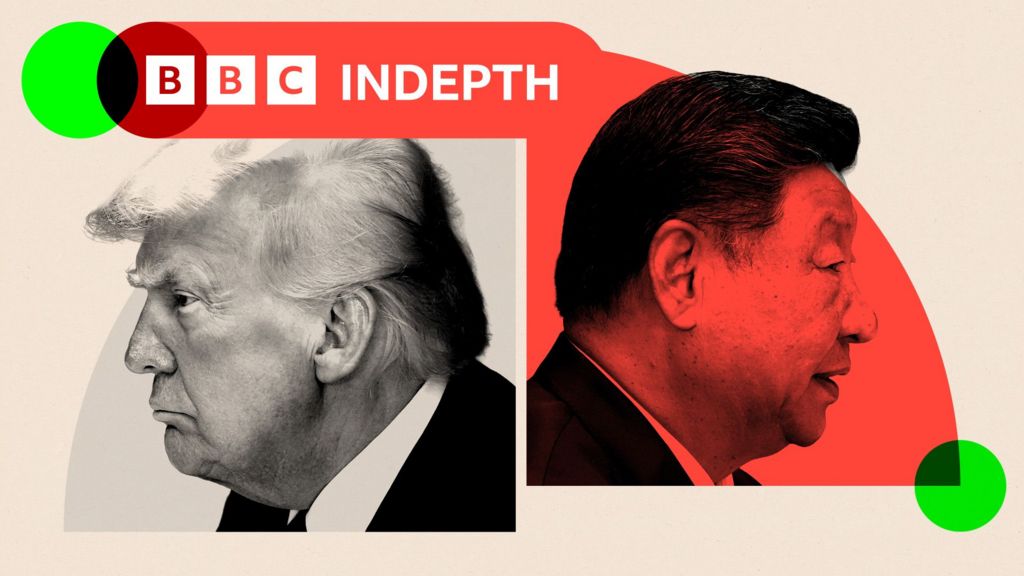
In the days leading up to US President Donald Trump’s first visit to Beijing since 2017, tightened security arrangements around Tiananmen Square have fueled widespread social media speculation of a large-scale organized welcome event, marking the buildup to what is widely regarded as one of the most consequential global leadership summits in recent years. What was once a quiet preparation process is now shaping up to be a defining meeting that could chart the course of US-China relations for the coming decade, with agendas spanning Middle East mediation, cross-strait tensions, trade disputes and cutting-edge technological competition.
For months prior to the visit, the Trump administration had sidelined US-China relations to prioritize other pressing matters: the ongoing conflict with Iran, military operations in the Western Hemisphere, and pressing domestic political and economic concerns. But this week, all attention has shifted to Beijing, where every discussion between Trump and Chinese President Xi Jinping carries global stakes.
One of the most pressing topics on the agenda is China’s emerging role as a mediator in the three-month-long US-Israel-Iran conflict. Working alongside Pakistan, Beijing put forward a five-point peace plan in March aimed at securing an immediate ceasefire and reopening the strategically critical Strait of Hormuz, with Chinese diplomats privately pushing Iranian officials to engage in diplomatic negotiations.
Beijing has strong personal incentives to end the conflict quickly. Already grappling with slowing domestic growth and rising unemployment, China’s export-reliant economy has felt acute pain from the war-driven surge in global oil prices: higher fuel costs have pushed up production costs for petrochemical-dependent sectors from textiles to plastics by as much as 20% for some domestic manufacturers. While China’s own substantial oil reserves and leading position in renewable energy and electric vehicles have buffered it from the worst of the fuel crisis, the conflict still drags on an already sluggish economy.
That said, Beijing is not offering mediation for free. US officials are well aware of China’s influence in Tehran, demonstrated by last week’s high-profile visit of Iranian Foreign Minister Abbas Araghchi to Beijing. US Secretary of State Marco Rubio has openly called on China to pressure Iran, saying: “what you are doing in the Strait is causing you to be globally isolated. You’re the bad guy in this.” Washington has also lobbied Beijing to support a new UN Security Council resolution condemning Iran’s attacks on commercial shipping transiting the Strait, after Russia vetoed an earlier draft.
Ali Wyne, Senior Research and Advocacy Advisor for US-China relations at the International Crisis Group, notes that the US has already acknowledged Beijing’s indispensable role in any long-term diplomatic resolution of the conflict: “I think if we’re going to bring Iran back to the negotiating table in an enduring way, I think that the United States recognises that China is going to play some role.” For his part, Trump has adopted a soft stance on China’s ties to Tehran, downplaying concerns even after Washington sanctioned a Chinese refinery for transporting Iranian oil. “It is what it is, right? We do things, too, against them,” he told reporters recently.
Cross-strait tensions over Taiwan will be another unavoidable core topic of the summit. Last December, the Trump administration’s $11 billion arms sales deal to Taipei drew fierce backlash from Beijing, but Trump himself has sent contradictory signals on US security commitments to the island, which China claims as an inalienable part of its territory. The US president has publicly downplayed US willingness to defend Taiwan, saying that Taiwan does not adequately compensate the US for security guarantees and even imposed a 15% tariff on Taiwanese goods last year, accusing Taipei of stealing US semiconductor manufacturing.
Rubio has confirmed that Taiwan will be on the meeting agenda, but stressed that Washington’s goal is to avoid new tensions between the two superpowers. “We don’t need any destabilising events to occur with regards to Taiwan or anywhere in the Indo-Pacific, and I think that’s to the mutual benefit of both the United States and the Chinese,” he said. For China, Taiwan is a non-negotiable red line: Foreign Minister Wang Yi recently urged the US to make the “right choice” in a call with Rubio, while Beijing has ramped up daily military patrols around the island.
Some analysts speculate that Beijing may push for a revision of the long-standing 1982 US policy wording on Taiwan, seeking to upgrade Washington’s current position of “not supporting Taiwan independence” to a clearer statement of “opposing Taiwan independence.” But John Delury, a senior fellow from the Centre on US-China Relations at the Asia Society, is skeptical of any major breakthrough: “Even if Trump says something kind of left field that looks like some capitulation on Taiwan, because he’s not so careful with his use of language, the Chinese know better than to put much stock in that, because he can reverse it with a Truth Social post a week later.”
Trade, the historic flashpoint of US-China tensions, is also back on the agenda after months of escalating friction. Throughout 2025, the world’s two largest economies teetered on the edge of a full-blown new trade war that would have shaken the global economy: Trump repeatedly adjusted tariffs on Chinese goods, at one point pushing rates above 100%, while Beijing retaliated by cutting rare earth exports to the US and suspending purchases of American agricultural goods, hitting Trump’s key support base of rural farming states.
Tensions have cooled significantly since Trump and Xi met on the sidelines of a conference in South Korea last October, and a recent US Supreme Court ruling limiting the president’s unilateral authority to impose tariffs has also curbed Trump’s more impulsive trade instincts. Still, major disagreements remain: Trump will push for increased Chinese purchases of US agricultural products, while Beijing will demand that Washington scrap a newly launched trade probe into alleged unfair Chinese business practices that would allow Trump to reimpose sweeping high tariffs.
Michael O’Hanlan, Phil Knight Chair in Defense and Strategy at the Brookings Institution, notes that this will be a tough negotiation for Washington: “It could be tough for the US to give up investigations of all unfair Chinese trade practices given how widespread and distorting the latter still are.” According to Reuters, Trump will be accompanied by CEOs from top American firms including Nvidia, Apple, Exxon and Boeing, highlighting the deep business stakes of the visit. While China is less dependent on US trade than it was during Trump’s first term, Beijing still prioritizes global economic stability as it pursues domestic growth, making a smooth meeting a key priority for Xi.
Ryan Hass, Director of the John L Thornton China Centre at the Brookings Institution, summed up the fragile dynamic ahead of the summit: “So long as the visit proceeds smoothly and Trump concludes he was treated respectfully, then the uneasy calm in the bilateral relationship will endure. If, on the other hand, Trump leaves feeling disrespected or trifled with, then he could have a change of heart.”
Beyond geopolitics and trade, the rising competition over cutting-edge technology – particularly artificial intelligence and semiconductors – will be a central theme of the talks. China is currently investing heavily in AI and humanoid robotics, core components of what Xi calls “new productive forces” that Beijing hopes will drive its next phase of economic growth. But many US policymakers accuse China of pursuing policies to co-opt or steal American technology to advance its domestic industries, leading Washington to impose sweeping restrictions on exports of the most advanced microchips to China, despite pushback from US chip manufacturers.
While the recent resolution of the TikTok ownership dispute represented a rare positive breakthrough in a tech relationship long plagued by accusation and mistrust, frictions have reemerged in the fast-growing AI sector. The White House has accused Chinese AI firms of large-scale theft of American AI models, while Beijing has reportedly blocked US firm Meta’s acquisition of Singapore-based Chinese-founded AI startup Manus. Yingyi Ma, a researcher at the John L Thornton China Centre, notes: “An opening chapter of an AI cold war is emerging. The deeper contest is not over who copies whose model, but over the talent capable of building the next generation of frontier AI.”
China has recently showcased its advanced robotic capabilities with humanoid bots performing martial arts and outrunning human runners in Beijing marathons, but analysts point out that while Chinese firms excel at building the mechanical bodies of these systems, they still rely on US-made high-end chips to power the advanced artificial intelligence that operates them. For Beijing, this creates a natural opening for a potential trade: access to China’s dominant position in rare earth minerals – which processes 90% of global supply, critical to everything from smartphones to wind turbines to jet engines – in exchange for relaxed US restrictions on high-end chip exports.
Despite the wide range of high-stakes issues on the agenda, Trump’s Beijing visit will be a condensed two-day whirlwind tour of meetings and official events, including formal talks, a state banquet and a visit to the historic Temple of Heaven. While substantive final agreements may not be reached in such a short time frame, analysts broadly agree that even this brief face-to-face meeting between the leaders of the world’s two largest powers will set the long-term trajectory for bilateral relations and global politics for years to come.