Months after a sharp diplomatic crisis triggered by former President Donald Trump’s controversial threat to take control of Greenland by force, high-level talks between the United States and Denmark are moving forward to expand Washington’s military footprint on the Arctic island, according to multiple sources familiar with the closed-door discussions.
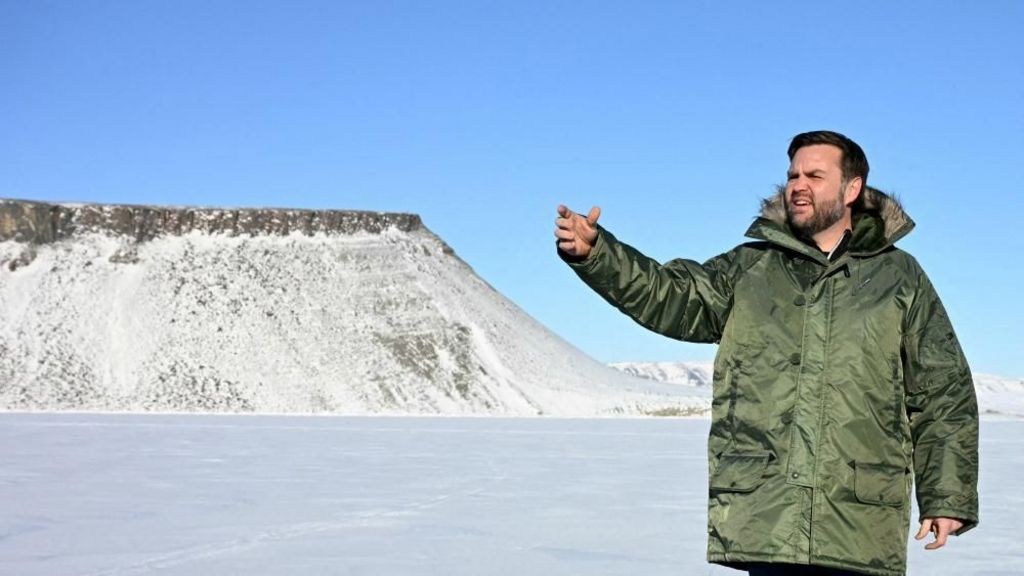
Earlier this year, U.S. Vice President JD Vance visited Pituffik Space Base, the only active U.S. military facility currently operating on Greenland’s territory, a semi-autonomous region under Danish sovereignty. In January, Trump reignited debate over U.S. policy in the Arctic by stating that the U.S. needed to “own” Greenland to block growing influence from Russia and China, adding that the acquisition could happen through the “easy way or the hard way”—language widely interpreted as a threat of forcible seizure.
The White House has confirmed that the current administration is engaged in top-tier talks with Danish and Greenlandic authorities, but has declined to disclose specific details of the negotiations. A senior White House official told the BBC that the administration remains optimistic the discussions are moving toward a mutually acceptable outcome. Denmark’s foreign ministry also acknowledged the ongoing diplomatic process, noting that “there is an ongoing diplomatic track with the United States” and declining to share further details at this stage.
Multiple U.S. officials involved in the talks have proposed a framework that would designate three planned new bases in southern Greenland as formally U.S. sovereign territory, one insider with direct knowledge of the negotiations confirmed. The proposed outposts would be positioned along the GIUK Gap—an critical strategic stretch of the North Atlantic between Greenland, Iceland, and the United Kingdom—and their core mission would be conducting enhanced surveillance of maritime activity by Russia and China in the region.
Sources emphasize that no final agreement has been reached, and the total number of new bases could shift before any deal is finalized. One of the proposed sites is already penciled in for Narsarsuaq, the location of a decommissioned U.S. military base that currently hosts a small civilian airport. Security analysts note that all planned new facilities are likely to be built on existing infrastructure, including pre-existing airfields and ports, cutting construction costs significantly compared to breaking ground on entirely new sites.
Contrary to Trump’s earlier public threats, U.S. negotiators have not raised the prospect of seizing full control of Greenland during discussions, a move that both Denmark and NATO have publicly rejected outright. Despite the initial diplomatic uproar, both sides have made consistent progress on negotiations over recent months, with talks being held by a small, low-profile working group of officials based in Washington. The quiet negotiation process has continued largely out of public view even as the administration has focused heavily on the ongoing war in Iran.
Initial broad confirmation of the push for new bases came from U.S. Northern Command chief General Gregory Guillot during congressional testimony in March, but sources with direct access to the talks have shared new details showing a consistent schedule of high-level meetings that have delivered tangible progress in recent months. Leading the sensitive diplomatic effort is Michael Needham, a senior U.S. State Department official tapped to craft a deal that meets Trump’s demands while also respecting Denmark’s non-negotiable red lines on protecting its territorial sovereignty.
“Needham is running point” on all Greenland-related negotiations, a senior diplomat with knowledge of the process confirmed. Behind the scenes, the administration has approached the talks in a “very professional” manner, the source added. Since mid-January, negotiating teams have met at least five times. Needham typically attends with one or two additional officials from the State Department or National Security Council, while the Danish side is led by Jesper Møller Sørensen, Denmark’s ambassador to the U.S., and Jacob Isbosethsen, Greenland’s top diplomatic representative in Washington.
Notably, Jeff Landry, Republican Governor of Louisiana and Trump’s appointed special envoy for Greenland, has not participated in any negotiating sessions and remains largely sidelined from the diplomatic process, three separate sources confirmed. A close ally of Landry, speaking on condition of anonymity, noted that Landry was cast as a public advocate for the idea of U.S. expansion, framing the effort as a show of American strength to take control of Greenland as a strategic security asset, but “has never been to any of the actual talks.” Landry’s office did not respond to requests for comment on his absence from negotiations.
The U.S. currently only maintains one active military facility in Greenland, a sharp drawdown from the 17 operational bases the U.S. ran here at the height of the Cold War. Pituffik Space Base, located in remote northwestern Greenland, supports NORAD’s missile monitoring mission but lacks the infrastructure and positioning to conduct large-scale maritime surveillance in the GIUK Gap, the core strategic priority driving the push for new southern bases.
Some current and former U.S. officials, as well as independent Arctic security experts, have criticized the Trump administration’s approach, arguing that Washington could have advanced its strategic goals in Greenland without issuing aggressive threats against a fellow NATO ally. “Why threaten an ally with a military operation or invasion when what you want is something that could be negotiated quite easily?” one former senior U.S. defense official asked.
Other retired defense leaders have backed the expansion effort and the ongoing cooperation between Washington and Copenhagen. Retired General Glen VanHerck, who led U.S. Northern Command and NORAD from 2020 to 2024, told the BBC that “Wherever the US and our allies leave a vacuum, that vacuum is often filled by China and Russia.”
Negotiators are currently working to craft a compromise that falls within the framework of a long-standing bilateral security agreement between the U.S. and Denmark first signed in 1951. That existing pact grants the U.S. broad latitude to expand its military operations in Greenland, requiring only formal Danish approval for any new infrastructure. Arctic security experts note that Denmark has historically supported U.S. military activity on the island and has never rejected a U.S. request to expand its presence.
Representatives of the Greenlandic government in Washington and the U.S. State Department both declined to comment on the record about the ongoing talks. Trump first raised interest in expanded U.S. access to Greenland during his first presidential term, and his renewed public push earlier this year exposed open tensions between the administration and other NATO alliance members amid the initial diplomatic crisis.