分类: environment

  • France and Spain race to contain fires before new heatwave

    France and Spain race to contain fires before new heatwave

    As the peak of the European summer travel season arrives, France and Spain are locked in an urgent battle against raging wildfires that have already caused catastrophic damage, displacing hundreds of thousands of people and leaving vast swathes of landscape in ashes. With a new searing heatwave looming on the horizon, emergency crews are racing to get blazes under control before rising temperatures and dry winds rekindle and expand existing infernos.

    For days, uncontrollable flames have carved destruction through southwest France and the region west of Madrid, Spain’s capital. By Monday, the scale of displacement had reached staggering levels: around 60,000 people in Spain and 220,000 in France have been forced to flee their homes and campsites, many with only minutes to evacuate. Some survivors were forced to leave beloved pets and critical medication behind as they ran for safety. At a temporary evacuation shelter set up in a sports hall just outside Madrid, disoriented displaced residents rested on camp beds, waited anxiously for updates on their properties, and comforted animals that had escaped the flames with them. Maria Angeles Canete, a campsite owner near the hard-hit town of Navaluenga, described the total destruction of her two properties through tears, saying simply, “We lost everything.”

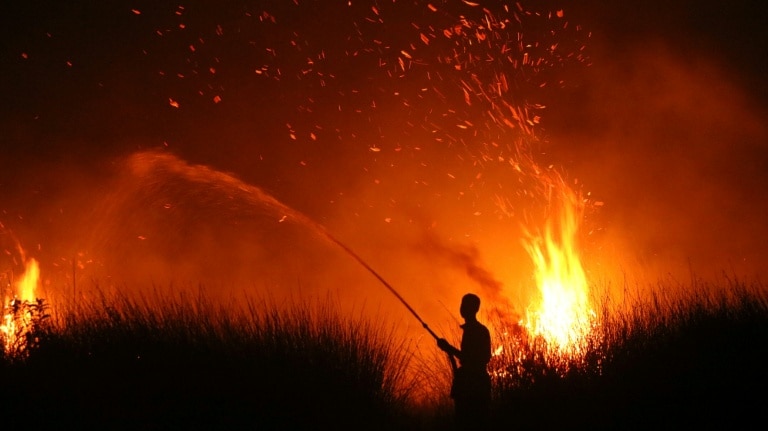
    On-the-ground reporting from AFP reveals the full scope of the devastation across the worst-hit regions. Blackened pine tree trunks smolder across charred forest landscapes, while destroyed homes and vehicles are left as nothing more than burnt-out husks, with the acrid smell of smoke hanging thick in the air. Karim Benali, a 39-year-old volunteer firefighter working near Navaluenga, said roughly 48 local homes had been completely consumed by the fire. Since last Wednesday alone, wildfires near Bordeaux in southwest France have ravaged 42,000 hectares of forest – an area larger than the entire U.S. city of Detroit. In Spain, the current wildfires have already destroyed 77,000 hectares of land, an area nearly matching the size of New York City. Across both countries, the cumulative damage for 2024 is even greater: 150,000 hectares burned in Spain and 115,000 hectares in France. This wave of fires comes just weeks after a wildfire in southwestern Spain killed 13 people, and another blaze tore through the UNESCO-listed Fontainebleau forest south of Paris.

    For many residents who returned to their properties after initial evacuation, the discovery of total loss has been devastating. David Sanchez, a 48-year-old painter and decorator in Cebreros, returned to find his small olive and pistachio grove completely turned to ash. Standing in choking, eye-stinging smoke, he acknowledged the bleak future ahead: “Now it’s time to clean up and plant again and that’s it. It’s crap, to be honest. And the fire has flared up again down there.”

    Despite the overwhelming damage, communities have rallied to support emergency efforts. Near Bordeaux, local residents including farmers, loggers and hunters have joined the response, bringing tractors fitted with land-clearing blades, private trucks carrying water tanks, and other equipment to support professional fire crews. Christopher Bonnefond, a 25-year-old farmer and wood transporter in the Gironde region village of Marcheprime, explained his motivation to help: “I’m a hunter and I want nature to stay like it is.”

    Spanish Interior Minister Fernando Grande-Marlaska warned that the immediate hours ahead would be “absolutely decisive” to bring the blazes west of Madrid under control before the new heatwave hits. Responding to the crisis, the European Union has mobilized additional water-bombing aircraft to France, supplementing the planes already deployed to Spain. However, EU commissioner Hadja Lahbib told AFP that the bloc’s firefighting fleet is already stretched perilously thin, with new extreme heat and fire risk expected to spread across central Europe in the coming days. “Extreme conditions are looming for Hungary, Slovakia and the Czech Republic, in addition to France, the Iberian Peninsula… where the situation is expected to worsen, including in Portugal starting today,” Lahbib said.

    Spanish Prime Minister Pedro Sanchez has framed the ongoing wildfire crisis as “the most painful expression of a climate emergency” – a catastrophe driven by prolonged drought that has turned vegetation into tinder-dry fuel, paired with a repeated cycle of record-breaking heatwaves. In France, the large blaze near Bordeaux has already spawned rare pyrocumulonimbus clouds, massive fire-generated storm systems that create their own wind patterns, carry lightning, and can even spawn tornadoes that spark new fires across wider areas.

    Meteorological agencies across both countries have confirmed that a new wave of extreme heat is already on track to hit this week. Spain’s state weather service AEMET confirmed the heatwave will run from Wednesday through the end of the week, with forecast temperatures hitting 42°C in northeastern regions and 39°C in central Spain. “The wildfire danger level will continue to increase, reaching extreme levels and making firefighting efforts more difficult due to high temperatures, locally gusty southerly winds and widespread low humidity,” AEMET said in an official statement. France’s national weather service MeteoFrance has also forecast temperatures rising as high as 40°C starting Tuesday, paired with persistently dry winds. Philippe de Gonneville, mayor of the Atlantic coastal village Lege-Cap-Ferret, summed up the widespread concern: “All the conditions are in place for the fire to start up again.”

  • Devastating European wildfires in maps – and how they’re being tackled

    Devastating European wildfires in maps – and how they’re being tackled

    A catastrophic wave of unprecedented wildfires is sweeping across large swathes of France and Spain, triggering mass evacuation orders for more than 300,000 residents as climate-fueled heatwaves create extreme, fire-friendly conditions across Southern Europe.

    In France, the country is facing its most destructive wildfire season in 22 years, with the southwestern Gironde region surrounding Bordeaux bearing the brunt of the destruction. More than 200,000 local residents have already been forced to flee their homes, as flames have consumed more than 420 square kilometers of land—an area four times the size of the French capital—in less than four days. The fire line currently sits just 15 kilometers from the southern edge of Bordeaux, advancing rapidly through the country’s iconic wine-growing region, destroying forests, agricultural land and threatening critical infrastructure along the way.

    The blazes have even put sensitive military and industrial sites at risk, including facilities involved in ballistic missile development, rocket motor production and hazardous chemical processing. Satellite imagery captured over Gironde reveals a vast, scorched black landscape, with plumes of thick smoke drifting hundreds of kilometers inland. Most alarmingly, the extreme intensity of the fires has spawned a rare fire-generated thunderstorm, a meteorological phenomenon that occurs when intense wildfire heat pulls smoke, ash and water vapor rapidly into the upper atmosphere. As the heated air cools, it forms cumulonimbus thunderclouds capable of producing lightning that can ignite new blazes, alongside unpredictable hail and rain outbreaks. These erratic conditions have made containing the fires far more challenging for emergency crews.

    To the west, in the mountainous region surrounding the Spanish capital Madrid, three separate large wildfires have burned roughly 770 square kilometers of land, with regional officials labeling the event the worst wildfire disaster in the region’s recorded history.

    Thousands of emergency responders have been deployed across both countries to combat the spreading blazes. In Gironde alone, the response effort includes 2,500 firefighters, 1,500 military personnel and 1,200 police officers and gendarmes. Aerial firefighting assets, including Canadair water-bomber aircraft capable of scooping 6,000 liters of water from nearby lakes or the Atlantic Ocean in just 12 seconds, have conducted continuous shuttle missions to drop water and fire retardant along fire perimeters. Near the coastal town of Lacanau, heavy construction equipment has been used to carve 100-meter-wide firebreaks, stripping all vegetation from strips of land to starve advancing flames of fuel. Spanish emergency teams have deployed similar tactics to contain their blazes.

    This year’s extreme wildfire season comes on the heels of a record-breaking sweltering summer across Europe, where widespread heatwaves have pushed temperatures above 40°C (104°F) across much of the continent. Climate scientists and on-the-ground officials warn that rising global temperatures driven by climate change have created the hotter, drier conditions that allow wildfires to spread faster and burn with far greater intensity. With forecasts calling for sustained high pressure that will bring continued dry, rising temperatures across the region over the coming week, officials and residents in both countries are bracing for worsening conditions as emergency crews work around the clock to contain the unprecedented disaster.

  • French wildfire created a monster cloud, unleashing lightning that ignited more fires

    French wildfire created a monster cloud, unleashing lightning that ignited more fires

    In a groundbreaking and alarming development that underscores the growing risk of extreme wildfire behavior linked to climate change, French officials have confirmed that an out-of-control wildfire in southwest France grew powerful enough to spawn its own thunderstorm — a rare weather event never before recorded in the nation’s history.

    The massive blaze, which ignited near the commune of Saumos in the Gironde region on July 22, has already carved a devastating path across the region. As of official updates, it has consumed more than 420 square kilometers of protected forest and dry scrubland, ruined or completely destroyed over 240 residential structures, and forced an unprecedented 220,000 local residents to flee their homes to escape the advancing flames.

    Two days after the fire first broke out, at approximately 6:20 p.m. local time on Friday, Gironde’s departmental fire and rescue service confirmed the formation of a pyrocumulonimbus, or pyroCb — an enormous, storm-forming cloud generated entirely by the extreme heat of an intense wildfire. The cloud weakened temporarily overnight as atmospheric humidity climbed, but reformed repeatedly in subsequent days as the inferno continued to rage.

    Unlike ordinary thunderstorms that form from atmospheric heat exchange, a pyrocumulonimbus is born directly from the extreme heat of a large wildfire. Theodore M. Giannaros, a fire meteorologist at the National Observatory of Athens, explains the phenomenon simply: it is what happens when a wildfire grows so large and hot that the smoke and hot air rising from its flames condense into a full-fledged storm cloud.

    The conditions required to spawn a pyroCb are very specific. There is no set threshold temperature for formation, but the atmosphere must match the structure that breeds dry thunderstorms: extremely hot, parched air close to the ground, capped by a layer of cooler, more moisture-rich air higher in the atmosphere. As superheated air loaded with smoke, ash and water vapor surges upward from the wildfire, it cools as it climbs, and water vapor condenses around tiny ash particles. Above the freezing altitude, these condensing droplets turn to ice crystals, whose collisions separate electrical charges just as they do in a regular thunderstorm.

    The result is an electrified black storm cloud that generates lightning, erratic winds and unpredictable fire behavior. Unlike a normal storm that forms independent of a fire, this storm system amplifies the disaster that created it. Rising air pulls powerful gusts of wind straight toward the heart of the blaze, while cold downdrafts hurl strong gusts back to the surface across the surrounding landscape. These sudden wind shifts can redirect the fire’s path, split it into multiple separate fire fronts, or send flames racing into untouched areas that were previously considered safe.

    Giannaros notes that this is a self-reinforcing feedback loop, not a one-sided side effect of the fire. “Once it forms, the cloud becomes its own weather system, sitting on top of the fire and making it harder to predict,” he explained. In the most extreme cases, these systems can even spawn rotating fire columns called fire whirls — essentially fire-fueled devils that move across the landscape spreading destruction. True fire tornadoes are far rarer, but one such event hit Redding, California during the 2018 Carr Fire, packing EF-3 equivalent winds and killing a fire inspector.

    For frontline firefighting crews, the formation of a pyroCb creates unprecedented danger. Escape routes can be cut off without warning when lightning sparks new wildfires far beyond the reach of deployed crews and equipment. Direct attacks on the main blaze become impossible, forcing teams to abandon containment efforts and retreat to defend populated communities at risk. The biggest threat, Giannaros emphasized, is that the fire can spread faster than emergency managers can organize evacuation orders for at-risk populations.

    Until this event, pyrocumulonimbus events were almost exclusively documented in North America and Australia, where they only form over the most extreme large-scale wildfires. Canada alone recorded a staggering record 142 pyroCb events in 2023. In Europe, the phenomenon has been extremely rare: only one confirmed event was recorded in Portugal during the catastrophic 2017 wildfire season. France’s 2022 Gironde fire marks the first confirmed pyroCb in the nation’s recorded history, according to the French National Firefighters Federation.

    The emergence of this rare extreme fire event in France aligns with broader climate trends across the European continent. Data from the EU’s Copernicus Climate Change Service and the World Meteorological Organization shows that Europe has been warming faster than any other continent on Earth — at roughly twice the global average rate since the 1980s. As a result, heat waves have grown far more frequent and severe, widespread drought has parched much of southern Europe, and dense forests have dried out into ideal wildfire fuel.

    Giannaros explained that hotter, drier conditions create far more opportunities for the extreme wildfires that can spawn pyroCbs, but the scientific community still lacks sufficient long-term data to confirm a clear upward trend in these events across Europe. The European research project ROSETTA is currently working to close this knowledge gap, to help emergency managers better prepare for and respond to these extreme events in the future.

    Giannaros added that one of the most common public misunderstandings about pyrocumulonimbus is that the storm cloud is just an inconsequential side effect of a large fire. In reality, for as long as the storm sits above the flames, it actively shapes the fire’s future path and intensity, turning a predictable blaze into an unpredictable, deadly disaster.

  • Spain races to contain blazes before new heatwave

    Spain races to contain blazes before new heatwave

    As Spain braces for the fourth extreme heatwave of the 2026 summer, emergency authorities have warned the country has just 48 decisive hours to bring widespread active wildfires under control before dangerous weather conditions escalate the crisis. Prime Minister Pedro Sanchez has urged the entire population to adopt maximum precautionary measures as the fast-moving blazes, already one of the worst environmental disasters of the decade for the country, have displaced tens of thousands of residents and scorched hundreds of thousands of hectares of land.

  • What to know about the historic wildfires in France and Spain

    What to know about the historic wildfires in France and Spain

    PARIS — Unrelenting heat waves and months of deficient rainfall across Western Europe have sparked catastrophic, historic wildfires that have driven hundreds of thousands of people from their homes, marking one of the largest mass evacuation efforts on the continent since World War II. Forecasts of even higher temperatures later this week threaten to hinder containment efforts, as blazes have already scorched an area four times the size of Paris across southwestern France and continue to burn dangerously close to Spain’s capital, Madrid.

    Decades of climate data confirm that Europe is warming faster than most other regions on the planet, and 2025 has already seen multiple extreme heat events that have primed the landscape for uncontrollable wildfire. While Spanish firefighters have described the current blazes as too intense for direct frontal attacks, officials in France reported a small but hopeful development on Monday: the rapid spread of the massive Gironde region fire appears to be slowing for the first time.

    A core driver of this disaster is the rising heat and dryness amplified by human-caused climate change. Prolonged above-average temperatures starting with a record-breaking June heat wave created widespread drought conditions across the region. Extreme heat saps moisture from vegetation, turning even normally damp brush and trees into perfectly flammable fuel that allows flames to spread much faster and burn with far greater intensity than historic wildfires. This summer’s extreme heat was effectively impossible without the influence of climate change, according to a June analysis from the international research collective World Weather Attribution.

    French national meteorological service Météo-France confirmed that June 2025 was the hottest ever recorded in the country, with average temperatures 3.8 degrees Celsius (6.8 degrees Fahrenheit) higher than long-term norms, while total rainfall dropped to nearly half the average for the month. Spain, which already faces regular summer wildfire season, has seen conditions grow far more dangerous as climate change pushes summer temperatures higher and extends dry periods. Compounding this risk is the decades-long decline of traditional farming and forest industries that once cleared overgrown vegetation, leaving large swathes of unmanaged wilderness primed to ignite like a tinderbox.

    This year’s wildfire season has already shattered all previous European records. Data from the European Union’s European Forest Fire Information System shows more than 300,000 hectares (3,000 square kilometers, or 1,160 square miles) have burned across France and Spain alone to date. France’s Interior Ministry reports that 115,000 hectares (1,150 square kilometers, 444 square miles) have burned in the country since January – the highest annual total recorded in France’s modern history, surpassing all previous full-year wildfire damage.

    In Spain, the total burned area so far this year has reached 153,000 hectares (1,530 square kilometers, 591 square miles), six times the total area burned in the first half of 2024, according to Ecological Transition Minister Sara Aagesen. Just over a week ago, the country saw its second largest and third largest wildfires on record burn simultaneously. One blaze in rural Avila, located west of Madrid, alone consumed more than 50,000 hectares of land. Earlier this month, 13 people died in a wildfire in southeastern Almeria, marking Spain’s deadliest wildfire event in recent memory.

    To date, more than 300,000 people have been displaced from their homes across the two countries, an event the European Union described Monday as one of the largest evacuation operations in modern European history. In France alone, more than 250,000 people have been evacuated, 220,000 of them from the southwestern Gironde region. As France prepares to enter its peak August tourist season, Gironde officials have implemented strict emergency measures, closing popular holiday destinations and banning holiday camps for children and people with disabilities to avoid putting more lives at risk. In Spain, the government confirmed 76,000 people have been evacuated, while an additional 30,000 remain confined to their homes as fires advance near their communities.

    European countries have rallied to support the affected nations through cross-border emergency aid. European Commissioner for crisis management Hadja Lahbib announced Monday that the EU has coordinated the deployment of seven firefighting aircraft and four helicopters from Czechia, Croatia, Germany, Portugal, Slovakia, Sweden and Turkey to France, while an additional six planes from Greece, Italy and Turkey have been sent to Spain. “No country should ever have to face a disaster of this scale alone,” Lahbib said in a statement. “To the people of France and Spain: Europe will stand with you until the fires are out.” The EU’s Copernicus satellite program is also providing emergency responders with real-time, updated maps of fire risk to support containment efforts.

    Reporting contributions from Gabor Szalai in Budapest, Hungary, Joseph Wilson in Barcelona, Spain, and Sam McNeil in Brussels.

  • Pakistan monsoon death toll tops 100 in a month as more heavy rain forecast

    Pakistan monsoon death toll tops 100 in a month as more heavy rain forecast

    One month into Pakistan’s 2024 monsoon season, the human cost of persistent rain and sudden flash flooding has climbed past 100 fatalities, with national forecasters issuing fresh alerts that more severe downpours are set to sweep across the country later this week.

    As of Monday, Pakistan’s National Disaster Management Authority (NDMA) confirmed that 109 people have lost their lives to weather-related incidents since monsoon rains began on June 26. The majority of fatalities stem from collapsing homes and failing building roofs, a common hazard when saturated structures buckle under relentless rainfall. Nearly half of all reported deaths have been concentrated in northwestern Khyber Pakhtunkhwa province, a rugged border region that shares a frontier with Afghanistan.

    The latest fatality update was released just 24 hours after NDMA officials wrapped up a nationwide review of flood preparedness protocols. During the assessment meeting, leadership prioritized improving early warning outreach to vulnerable communities located along major river basins, with plans to enable either voluntary relocation or mandatory evacuation before floodwaters can submerge residential areas.

    Last week’s intense downpour event already tested the country’s response capacity, when heavy storms battered multiple regions including Lahore, Pakistan’s bustling cultural capital. Several residential neighborhoods in the city were left submerged under floodwaters, forcing daily commuters to navigate long, unplanned detours to reach their destinations. Viral social media footage captured local residents wading through waist-deep floodwaters to move around the city, sparking widespread public criticism from Lahore residents who have questioned the government’s level of preparation and emergency response to extreme weather events.

    In the months leading up to this year’s monsoon, national authorities have repeatedly warned that the country cannot dismiss the risk of a repeat of the catastrophic 2022 flood disaster. That unprecedented extreme weather event submerged roughly one-third of Pakistan’s total land area, claimed the lives of 1,737 people, and displaced millions of residents from their homes, leaving a lasting mark on the country’s infrastructure and economic stability.

  • Why are thousands of mosquitoes being released in Washington DC?

    Why are thousands of mosquitoes being released in Washington DC?

    To many residents of Washington D.C., the idea of intentionally releasing thousands of mosquitoes into the capital’s urban landscape sounds like the start of a summer nightmare. However, this counterintuitive initiative is actually a carefully designed pest management strategy aimed at curbing problematic mosquito populations that carry disease and disrupt daily life.

    The program focuses exclusively on releasing male mosquitoes, a detail that sets this approach apart from traditional chemical-based pest control. Unlike female mosquitoes, which require blood meals to develop their eggs and are the only ones that bite humans and animals, male mosquitoes feed solely on nectar and plant juices, posing no direct threat to people.

    This method works by leveraging a naturally occurring bacteria called *Wolbachia*, which is carried by the released male mosquitoes. When these modified males mate with wild female mosquitoes that do not carry the same bacteria strain, the eggs produced from these unions do not hatch, preventing the next generation of biting females from emerging. Over time, this suppresses the overall mosquito population without the widespread use of insecticides that can harm beneficial pollinators like bees and butterflies, or leave chemical residues in the environment.

    Local environmental and public health officials have emphasized that this targeted approach aligns with growing efforts to shift toward more sustainable, eco-friendly pest management practices in urban areas. By reducing reliance on chemical treatments, the initiative not only addresses nuisance mosquito populations but also supports broader biodiversity goals in the nation’s capital. While the concept may seem surprising at first glance, it represents a growing trend of using natural biological solutions to tackle common urban pest challenges.

  • How ‘fire-generated thunderstorms’ make wildfires more deadly

    How ‘fire-generated thunderstorms’ make wildfires more deadly

    As record-breaking heatwaves parched much of Western Europe this summer, France is confronting a new, unprecedented threat linked to its raging wildfires: the formation of pyrocumulonimbus clouds, rare fire-generated thunderstorms that have never before been documented in the country.

    Tens of thousands of residents have already been evacuated from the Gironde region surrounding Bordeaux, as authorities battle blazes supercharged by this extreme meteorological phenomenon. Scientists explain that pyrocumulonimbus clouds form when the intense heat from large wildfires forces hot air, filled with smoke, ash and water vapor, to surge rapidly into the upper atmosphere. As this rising air cools, water vapor condenses, and if the wildfire is powerful enough and atmospheric conditions are unstable, the formation grows into a towering cumulonimbus cloud — the same storm structure that produces ordinary thunderstorms.

    Unlike regular thunderstorms, these fire-generated storms make containing wildfires far more dangerous and unpredictable. Turbulent winds whipped up by the clouds hurl embers dozens of kilometers ahead of the main fire line, sparking new blazes in untouched areas. Lightning strikes from the clouds also ignite secondary fires, creating multiple fronts that stretch firefighting resources dangerously thin.

    This extreme event comes amid a summer of climate-fueled extreme heat across the continent. Unprecedented high temperatures and near-total lack of rainfall have left vast swathes of France, Spain and the United Kingdom tinder-dry, primed for destructive wildfires. As of Monday, local authorities in Gironde reported that the fire situation had stabilized overnight, but new threats loom on the horizon: a second heatwave, with forecasted highs reaching 40 degrees Celsius (104 degrees Fahrenheit), is expected to hit France later this week. A senior French response official has warned that the Gironde blazes will likely continue burning for “many weeks,” and could take months to fully extinguish.

    Pyrocumulonimbus clouds form most often under the exact dangerous conditions amplified by human-caused climate change: extreme heat, strong winds, and near-zero soil moisture. Climate scientists have long warned that rising global temperatures will make these rare extreme events far more common. While pyrocumulonimbus were once considered uncommon, major fire events around the world in recent years have already proven this prediction correct.

    The most prominent previous example occurred during Australia’s catastrophic 2019–2020 Black Summer bushfires, when dozens of pyrocumulonimbus clouds formed, creating self-sustaining “firestorms” that generated their own weather systems. That fire season remains one of the most destructive in Australia’s recorded history: it killed at least 33 people, including four firefighters, and burned more than 11 million hectares of land, an area roughly the size of Portugal. Fire officials in New South Wales recorded embers from the firestorms landing as far as 30 kilometers (18 miles) ahead of the main fire front — three times the typical spread distance for regular wildfires. NASA once nicknamed pyrocumulonimbus “the fire-breathing dragon of clouds,” noting that they act as chimneys that funnel massive amounts of smoke high into the stratosphere, while unleashing lightning, destructive winds and sporadic rain.

    Just a year later, extreme wildfires across the western U.S. state of California also generated multiple pyrocumulonimbus events in summer 2021, with smoky storm clouds towering more than 1.6 kilometers (a mile) above active blaze lines. That season, more than 7,300 wildfires burned 1 million hectares of land across California, killing at least three firefighters.

  • France, Spain race to contain ‘monster’ fires ahead of new heatwave

    France, Spain race to contain ‘monster’ fires ahead of new heatwave

    As emergency shelters across France and Spain hit overflow capacity on Monday, thousands of exhausted local residents and summer tourists face displacement from some of the most devastating wildfires the region has seen in decades — blazes so extreme they are generating their own weather patterns, with a new record-breaking heatwave already forecast to arrive in the coming days.

    The infernos are tearing through parched forest landscapes: one in southwest France surrounding Bordeaux’s world-famous wine-growing region, and a second cluster burning across central Spain near the capital Madrid. The outbreak has struck at the peak of the Northern Hemisphere summer travel season, upending hundreds of thousands of lives and devastating vast swathes of protected woodland.

    To date, more than 325,000 people have been forced to evacuate their homes and vacation accommodations. The fires spread rapidly fueled by vegetation left tinder-dry by back-to-back heatwaves and near-total lack of rainfall across the region since May.

    Speaking from a closed highway in the Madrid region, 50-year-old Olga Congacha, a resident of the locked-down village of Robledo de Chavela, described the chaotic evacuation. “Everyone had to get out of the village quickly — it was a critical situation and people were scared. My husband and I left with all that we could grab: our important documents and some clothes,” she told Agence France-Presse.

    In France, the scale of the blazes has spawned an unprecedented meteorological phenomenon for the country: pyrocumulonimbus clouds, giant fire-generated storm clouds that produce their own powerful winds, lightning strikes, and in some cases tornadoes, all of which can spark new secondary blazes. Eric Brocardi, spokesperson for France’s National Firefighters Federation, called the battle a classic “David-versus-Goliath” scenario, adding that crews were working to identify a vulnerable weak point in the fire’s perimeter to launch a coordinated counterattack.

    Thousands of frontline firefighters, supported by a fleet of specialized water-bombing aircraft, have been working around the clock to contain the flames and clear toxic smoke that has blanketed residential and tourist areas. French President Emmanuel Macron convened an emergency crisis cabinet meeting on Monday to coordinate the national response, while Spanish Prime Minister Pedro Sánchez traveled to a newly burned area in eastern Spain’s Valencia region, where crews are battling a fresh outbreak.

    Spain’s civil protection chief, Virginia Barcones, described the massive wildfire burning near Avila as a “monster” in comments Sunday to state broadcaster TVE. “We are dealing with a perimeter of 280 kilometres encompassing 77,000 hectares (190,000 acres),” she said.

    Climate scientists have long warned that human-caused climate change is increasing both the frequency and intensity of extreme heat events and wildfire risk across southern Europe. In France’s Gironde department, the epicenter of the country’s blazes, regional prefects have urged all non-resident tourists to avoid the area entirely and seek alternate summer destinations. “The wind is changing so much, it’s really the fire calling the shots,” one frontline firefighter told reporters.

    Since Wednesday alone, the Gironde fire has ravaged more than 42,000 hectares of land — an area seven times larger than the island of Manhattan. Around 220,000 people have been evacuated from the region, 45 seasonal campsites have been forced to close, and an estimated 40,000 summer tourists have had their vacation plans ruined. An additional 30,000 people have been displaced by blazes in other French regions. As of early Monday, local Gironde authorities reported the fire remained “broadly stable” after overnight containment efforts.

    In Saint-Jean-d’Illac, one of the villages at the edge of the fire zone, Georges Clivaz refused to evacuate despite an official evacuation order issued Friday. Holding a garden hose to spray down the perimeter of his property a few kilometers from the active blaze, Clivaz said he and his family were staying to protect their home. “We’re doing this to slow down the fire’s advance; we want to save our homes,” he told AFP. “But the firefighters are telling us that in two or three hours the fire will be here.”

    Weather forecasters have confirmed a new heatwave will descend on parts of France starting Tuesday, with temperatures forecast to hit 40 degrees Celsius (104 degrees Fahrenheit) in some affected areas. Across Spain, a total of 75,000 residents have been evacuated across the Madrid region, Avila, Toledo, and Castellon in eastern Valencia. On Monday, authorities reported the main fire was still “not yet under control,” but noted enough progress had been made to reopen one evacuated campsite that held 4,500 people and allow elderly residents to return to their homes in another low-risk area, should conditions hold.

    Officials added that shifting winds were currently pushing wildfires near Madrid southward, away from the capital, but the blaze’s path has forced additional evacuations of small villages in its trajectory. To date, the blazes have claimed three lives: one civilian fatality near Valencia on Saturday, and two French firefighters killed near Bordeaux earlier this week.

  • Military unit fights intense flames west of Madrid

    Military unit fights intense flames west of Madrid

    A rapidly spreading wildfire is currently raging across the western region of Madrid, Spain, prompting emergency authorities to deploy military units to contain the intense blaze. As the situation remains fluid and continues to develop, news outlets are providing real-time live updates to keep the public informed of changing conditions, evacuation orders, and containment efforts. The wildfire, which has already consumed large swathes of vegetation, is fanned by high temperatures and dry winds that are common in Spain’s summer fire season, creating significant challenges for first responders. This ongoing emergency adds to a growing pattern of more intense and frequent wildfires across the Mediterranean region, linked to rising global temperatures and prolonged drought conditions. Local authorities have urged residents in affected and at-risk zones to follow all official safety guidance and remain vigilant as fire crews work to stop the fire’s advance. As this story continues to evolve, new details on containment progress, structural damage, and community impacts are being released continually through live update channels.