On August 26, 2026, a sudden glacier collapse unleashed a devastating surge of floodwater and mud across communities along the Nepal-China Himalayan border, triggering one of the region’s deadliest climate-linked disasters in recent years. By the following day, rescue teams had launched large-scale search operations for more than 1,300 unaccounted-for people, with official counts confirming at least 168 fatalities and hundreds displaced across the high-altitude Himalayan zone. The disaster included foreign travelers and religious pilgrims among its victims, and drone footage captured on Thursday laid bare the staggering scale of destruction across Nepal’s hard-hit Nuwakot district.
Survivor accounts and disaster imagery paint a grim picture of the catastrophe. Steep Himalayan valleys, which serve as critical economic and travel corridors for local populations, became death traps when the muddy surge hit, leaving almost no time for residents and visitors to evacuate. The entire village of Soley, home to roughly 25 households, was nearly erased from the map. Nirajan Paudyal, a Kathmandu-based journalist with family and relatives in Soley, traveled to the disaster zone Thursday in search of information, describing the agonizing uncertainty: “There is no update till now. I fear there won’t be any update.”
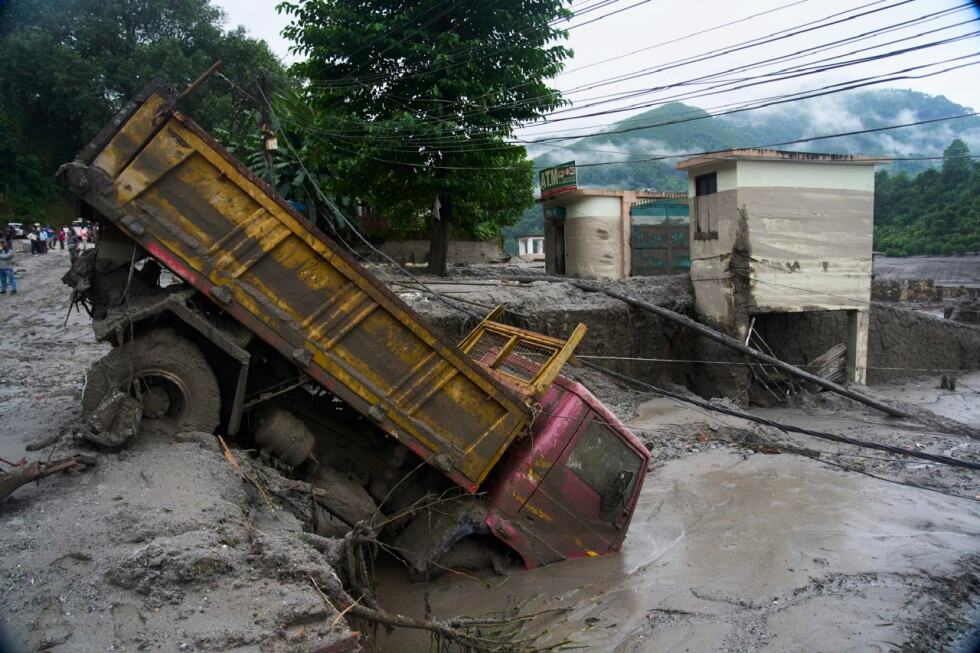
After the flood passed, second floors of remaining buildings were caked in thick mud, debris was tangled in tree branches and power lines, and entire vehicles were buried under silt. Travel across multiple affected areas was brought to a complete halt, with stunned survivors covered in mud wandering the wreckage in search of lost loved ones.
Official casualty breakdowns confirm the cross-border scope of the tragedy: Nepal has recorded 165 deaths and 826 missing people, while Tibet reports 3 deaths and 558 unaccounted-for individuals. Dozens of bridges were destroyed and close to 25 miles of roadway sustained damage, severely complicating rescue access to remote affected areas. The Nepalese Army deployed helicopter operations on Thursday morning, evacuating more than 100 trapped people, including eight foreign nationals airlifted to Kathmandu for treatment. Army teams also rescued personnel stranded at facilities linked to the Trishuli hydropower project. As of Thursday, dozens of injured people had been transferred to Kathmandu for advanced medical care, and recovery teams have already recovered bodies hundreds of kilometers downstream in Nepal’s Chitwan district. The Nepal Red Cross Society has announced it is shifting its focus from active rescue to large-scale relief operations, with roughly 1,200 people displaced across three hard-hit villages.
In Tibet’s Gyirong Port border crossing, the mudslide left an average of 5 feet of mud across surrounding areas, with some road sections buried under more than 6 feet of silt. All access roads to the port were damaged, and authorities have warned that ongoing rain raises the risk of secondary landslides and collapses. Chinese authorities dispatched a large military transport plane to ferry rescue teams to the region, and Chinese Premier Li Qiang traveled to Gyirong on Thursday to oversee search and relief efforts. Officials also warned that a newly formed barrier lake at the confluence of the Tsogyal River and Purupqiangzangbu is already overflowing and at risk of bursting.
Hundreds of the missing are foreign nationals, many of whom were traveling on pilgrimage to Mount Kailash, a sacred site for Hindu and Buddhist pilgrims that draws visitors from across the globe. Nepal’s Tourism Board reports that 517 of the country’s missing are foreigners, including 178 from India, more than 60 from the United States, and people from 30 other nations ranging from the United Kingdom and Ukraine to South Africa and Japan. Indian spiritual leader Sadhguru Jaggi Vasudev, head of the Isha Foundation, confirmed that 77 people from one of his organization’s Mount Kailash pilgrimage groups were caught in the flood at the Nepal-China border immigration office. In an emotional video statement posted to X, Sadhguru noted the group included citizens of multiple countries, including 22 U.S. nationals, and that no official information on their whereabouts has emerged: “Looking at the scale of destruction, it looks bad. The same building where we were for the immigration just a week ago, that entire building is washed away.” On the Chinese side, officials confirmed that nearly 100 Chinese citizens are missing on the Nepal side of the border, while 260 foreigners are unaccounted for in Tibet.
Analysis from scientific bodies has confirmed that the disaster was triggered by a glacier collapse, not an earthquake as initially reported. The U.S. Geological Survey first recorded a seismic event 41 miles north of Kathmandu early Wednesday, later updating its assessment to confirm the signal came from a magnitude 5.2 glacier collapse that sent a massive debris flow downstream, rather than a tectonic earthquake. Experts from the Kathmandu-based International Centre for Integrated Mountain Development note that a glacial avalanche sparked the flash flood, adding that hydrological data shows the flood wave moved at an extraordinary speed: Water levels on the Trishuli River rose as much as 27 feet in just 30 minutes, with the worst flooding recorded on the Lhende Khola River, a tributary of the Bhotekoshi.
This disaster is directly linked to accelerating glacial melt driven by human-caused climate change, experts emphasize. The Hindu Kush Himalaya region holds some of the world’s highest peaks and largest remaining glacial systems, but its steep slopes and low-lying valleys are uniquely vulnerable to glacial outburst floods and landslides. Research published earlier this year by Kathmandu-based scientists found that glaciers across the region are melting at an accelerating rate, with ice loss rates doubling since 2000. This is not an isolated event: In August 2025, high temperatures triggered a glacial lake outburst flood in Tibet that killed nine people and damaged critical cross-border infrastructure between Nepal and China. Today, the region’s increasingly unstable glacial systems pose a growing threat to communities, critical infrastructure, and freshwater supplies across one of the most densely populated regions on Earth.