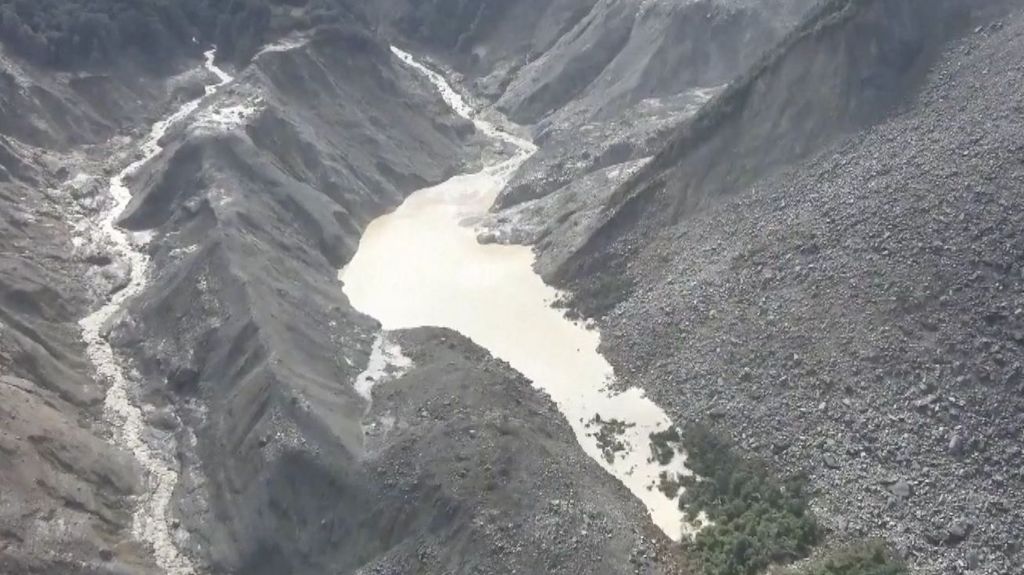
A new and urgent threat has emerged along the Nepal-Tibet border just days after a catastrophic glacial collapse triggered a deadly flash flood, with Chinese authorities warning that a newly formed barrier lake faces a “high risk” of bursting its natural debris dam and unleashing a second catastrophic downstream deluge. The new water body formed upstream from the site of Wednesday’s deadly flood, which glaciologists and disaster researchers confirm was sparked when a large section of a mountain glacier near Langtang Lirung peak broke free and crashed into a river below.
As of Friday morning, state broadcaster CCTV reports that approximately 2.5 million cubic meters of water have already collected behind the debris dam that created the barrier lake – a natural water formation that occurs when landslide or glacial debris blocks a river channel. Officials added that an additional 3 million cubic meters of water is projected to flow into the lake between Thursday and the end of the weekend, pushing the structure far past its capacity and creating extreme conditions for a potential breach. The Chinese Ministry of Water Resources confirmed that the lake, located at the intersection of the Chhochen Khola and Purepu Tsangpo rivers, has already begun overflowing its dam, and the region has been battered by unseasonably heavy rainfall that is worsening the already unstable situation.
In response to the unfolding emergency, authorities have deployed specialized engineering teams to conduct round-the-clock monitoring of water levels, geological stability, and local atmospheric conditions. However, access to the high-risk site remains severely limited. Friday morning’s CCTV report noted that the bulk of Chinese emergency response teams are currently stranded roughly seven kilometers from Gyirong Port, the critical overland border crossing between China and Nepal that was heavily damaged in Wednesday’s flood. The ongoing non-stop overflow of the barrier lake has created immediate risks of new flash floods and debris flows, forcing officials to temporarily pause all search and rescue operations for victims of the initial disaster across the border region.
The barrier lake sits in the same high-altitude region as Langtang Lirung, the mountain where the original glacial collapse originated, and is located several kilometers upstream from the damaged Gyirong Port. In a separate warning issued in Kathmandu, Nepali authorities have also flagged growing risks of additional flooding along the Bhote Koshi and Trishuli rivers, where new debris blockages could form and trigger sudden surges. Officials have urged all residents and visitors in river basins across the region to stay clear of waterways until further official notice that the threat has passed.
The initial flash flood on Wednesday has already left a devastating toll across the region. Hundreds of people have been confirmed dead in Nepal, with hundreds more still unaccounted for. On the Tibetan side of the border alone, more than 550 people remain missing, nearly half of whom are foreign nationals. Scientists have emphasized that the glacial collapse that triggered this disaster is consistent with growing risks of glacial outburst floods across the Himalayan region, as rising global temperatures destabilize high-altitude ice formations. Chinese state media has also released aerial footage of the newly formed barrier lake to document the ongoing emergency for the public.