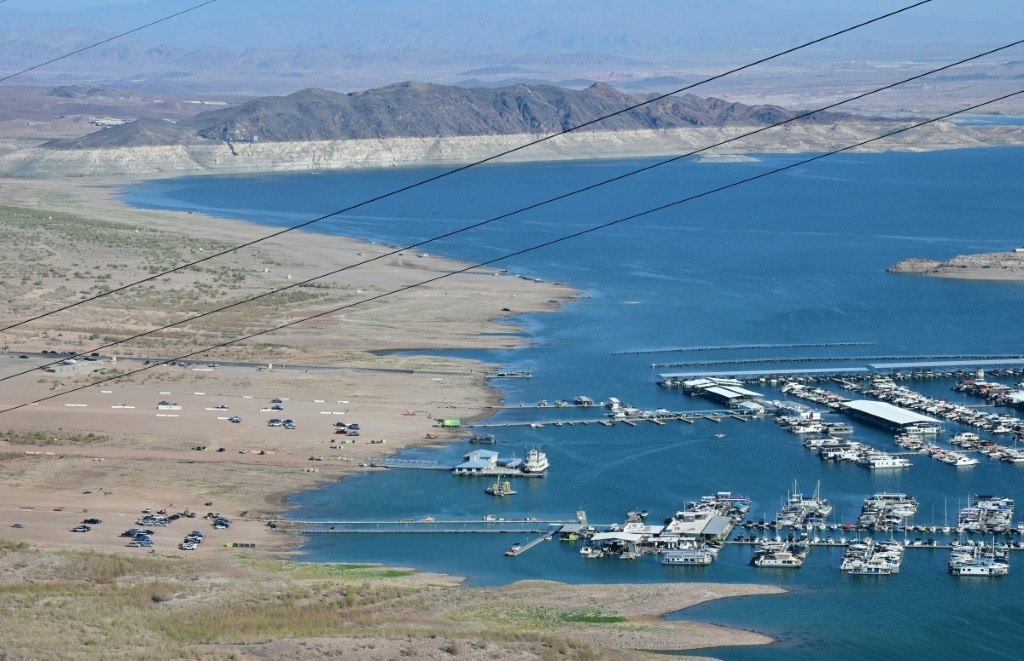
Perched high on the sunbaked hills surrounding Las Vegas, French tourist Choune Osterero stares out at a stark, unavoidable marker of human-caused climate change: a thick, pale band of mineral-encrusted rock that circles the entire basin of Lake Mead, the United States’ largest man-made reservoir. Known locally as the “bathtub ring,” this chalky line sits 186 feet (57 meters) above the reservoir’s current water surface, a 25-year record of relentless drought that has drained the lake to historic lows. For Osterero, the unmissable geologic clue makes abstract climate talk tangible. “You can see the effects of climate change with the naked eye,” she told Agence France-Presse during her visit. “It’s truly striking; it really makes you wonder.”
The retreating waters of Lake Mead have exposed hidden relics long swallowed by the lake: sunken boat wrecks, and even scattered human remains, including the body of a man believed to be a victim of 20th-century Las Vegas organized crime. But far beyond these macabre discoveries, the shrinking reservoir threatens the foundational infrastructure that powers and sustains the entire American West.
The modern development of iconic desert metropolises — from Las Vegas to Los Angeles and Phoenix — was only made possible by an extensive water distribution system tapping the Colorado River. The river, which originates from snowmelt in the Rocky Mountains and flows south through the U.S. Southwest into Mexico, provides drinking and irrigation water to more than 40 million people across seven U.S. states. Two massive hydroelectric dams, built 300 miles apart along the river’s course, created the country’s two largest reservoirs: Lake Mead and Lake Powell. These basins store snowmelt to ensure year-round water access, while the dams’ turbines generate carbon-free electricity for hundreds of thousands of households across the region.
Today, that entire system is teetering on the edge of crisis. The roots of the vulnerability stretch back a century: the 1922 interstate agreement governing Colorado River water allocations assigned more annual water to the seven basin states than the river actually carries on average. But human-caused climate change has drastically worsened this systemic flaw, altering regional precipitation patterns, extending extreme heat and drought events, and amplifying precipitation volatility across the continent.
Against a backdrop of global record-breaking temperatures in 2026, the Colorado River system is facing dual pressures that have pushed reservoirs to unprecedented lows, explains David Kreamer, a hydrology professor at the University of Las Vegas. An unusually dry winter left the Rocky Mountains with far less snowpack than average — the primary source of the river’s annual flow. At the same time, the record-hot July the U.S. experienced this year has accelerated evaporation from the open surfaces of Lake Mead and Lake Powell, draining stored water even faster.
“As climate change is affecting things, and it gets more intense, the challenges become greater,” Kreamer noted. Currently, Lake Mead holds only 25% of its total capacity, while Lake Powell dropped to an all-time historic low in August. Both reservoirs are now perilously close to the critical threshold where dam operations for electricity generation become impossible. A further decline could push the system into “deadpool” — a state where water levels drop too low to flow through the dam’s intake structures, cutting off water access for millions across the Southwest. The catastrophic consequences would reach far beyond the region’s big cities.
“The majority of the winter vegetables in the United States are grown in California, and so if the irrigation systems in Southern California are impacted, it would impact people beyond just the Colorado River Basin, but throughout the United States,” Kreamer explained.
In response to the deepening crisis, the Trump administration — which has repeatedly questioned the scientific consensus around human-caused climate change — released a 10-year management plan this month that imposes deep water use cuts on three lower basin states: California, Arizona, and Nevada. The three states are required to reduce their collective annual water withdrawals by 3.7 billion cubic meters — a volume equal to 1.5 million Olympic-sized swimming pools — while upper basin states including Colorado, Utah, Wyoming, and New Mexico face no mandatory cuts. The unequal burden of the plan prompted Nevada to file a lawsuit against the federal government on Monday challenging the policy.
The divisive cuts have laid bare long-simmering tensions between water users across the basin, with many pointing the finger at other regions and industries for overconsumption. Bruce Nelson, whose family has owned a marina on Lake Mead for nearly 70 years, argues that Las Vegas has already done more than its share to cut use: over the past two decades, the city has reduced its total water consumption by a third through aggressive wastewater recycling programs, restrictions on lawn watering, and limits on new residential swimming pool sizes. He argues that the burden falls disproportionately on southern Nevada, while other states continue to waste water.
“Las Vegas has done a phenomenal job in preserving and reclaiming water,” Nelson said. In contrast, he noted, neighboring Utah recycles very little of its wastewater and continues to approve large, water-intensive recreational projects inland, including artificial surf parks in fast-growing cities like St. George. “Maybe they need to think about how they’re conserving water,” he added.
Waterskiing enthusiast Brian Essex, who was visiting the lake, echoed that frustration. “It’s not our problem, really,” he said. He pointed to two major drivers of unsustainable water use: unregulated rapid real estate development in Phoenix, which is constantly expanding into the desert, and the massive water consumption of California’s alfalfa industry. Alfalfa, a lucrative forage crop for livestock, is one of the most water-intensive crops grown in the Southwest.
“What do you want to do?” Essex asked. “Do you want to build houses or do you want to sell alfalfa? You can’t do both.”