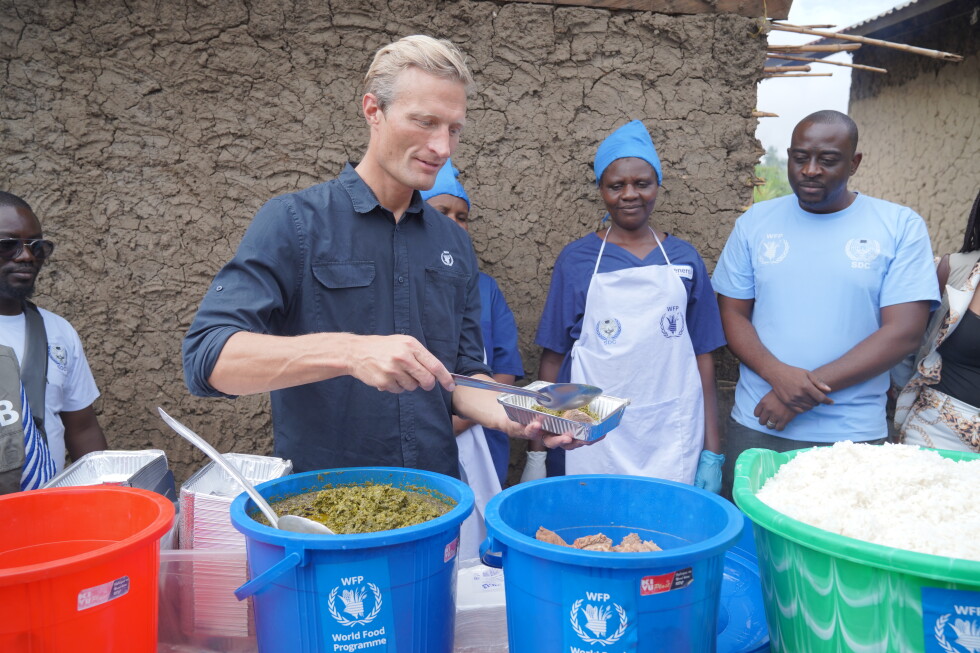
During an official visit to conflict-ravaged Ituri Province — the epicenter of the most rapidly expanding Ebola outbreak in recorded history — the acting executive director of the United Nations World Food Program (WFP), Carl Skau, sounded an urgent alarm this week over a cascading humanitarian catastrophe that is pushing thousands more Congolese people into acute food insecurity.
Eastern Congo has long been a region mired in persistent armed conflict and violent competition over valuable mineral deposits. Long before the first Ebola case was confirmed, millions of residents already faced catastrophic levels of hunger. Today, Skau framed the current crisis as a ‘crisis on top of a crisis’ that has drastically worsened already untenable living conditions. According to WFP data, the years-long violence across eastern Congo has forced nearly 10 million people into crisis or emergency-level hunger. Ituri alone accounts for 1.9 million food-insecure residents, out of more than 5 million people across the country already facing emergency food insecurity before the outbreak began.
Declared in mid-May, this outbreak has already outpaced every previous Ebola event in its speed of spread. It took just over two months for the death toll to hit 1,000 — a milestone that took roughly eight months to reach during the 2014–2016 West Africa outbreak, long considered the worst in global history. As of the latest official update, the outbreak has recorded 3,360 confirmed cases and 1,487 total deaths, with 50 new fatalities reported in the 24-hour period before Skau’s briefing.
Combatting the outbreak has been made uniquely challenging by the strain of virus responsible: the Bundibugyo virus, which has no approved vaccines or specific antiviral treatments, unlike strains involved in most of Congo’s previous Ebola outbreaks. While clinical vaccine trials are currently ongoing, UN senior Ebola coordinator Julien Harneis, who accompanied Skau on the Ituri visit, confirmed that a widely deployable vaccine is still months away from reaching affected communities. The UN and Congolese government are currently working with local community leaders to build public trust and encourage people with early symptoms to seek care quickly — a step Harneis says drastically improves a patient’s chance of survival.
Public health measures implemented to slow transmission, including localized movement restrictions, border closures and bans on large public gatherings, have had severe unintended consequences for local livelihoods. Markets have been disrupted, key supply routes have been cut off, and food and fuel prices have spiked sharply across affected regions. For mining and farming communities that rely on daily informal work to feed their families, these restrictions have pushed already vulnerable households over the edge. In Mongbwalu, a mining town 43 miles from Ituri’s capital Bunia, local residents described how the crisis has made it nearly impossible for many families to feed their children. Forty-year-old mother of six Kahambu Deborah told reporters she had already been blocked from accessing her farmland by rebel violence, and Ebola-related restrictions have made her family’s food insecurity even more desperate. ‘Sometimes, because of the insecurity, we can’t even go to our fields, and our children are suffering as a result,’ she said.
Across 48 affected health zones, WFP data shows more than 2.7 million people now face acute food insecurity, including 628,000 people in the most severe emergency category. Local hospital leadership confirms rising rates of malnutrition across the region, even among patients receiving Ebola treatment. ‘We are seeing more malnutrition cases in the region, compared to before the outbreak, even at the Ebola treatment center,’ said Dr. Richard Lokudu, director-general of Mongbwalu General Hospital. WFP’s targeted food aid has already helped reduce unnecessary population movement as people search for food, which in turn helps slow Ebola transmission, according to agency staff. The organization has so far delivered more than 160,000 hot meals to patients, contact tracing teams and frontline health workers across 17 treatment and isolation centers.
But chronic underfunding has forced the agency to drastically scale back its reach in Congo. Skau confirmed that WFP has cut the number of people it assists from 3 million in 2023 to just 1 million this year. The overall $2.1 billion UN humanitarian appeal for Congo is only 45% funded, Harneis added, and the separate Ebola response appeal is being revised upward to cover four affected provinces — double the original number the appeal was designed to support.
Speaking to UN correspondents during a video press briefing after his visit, Skau emphasized that the rapidly escalating crisis demands far greater global attention and immediate financial support. ‘My number one message is that this situation requires much, much more attention,’ he said. ‘This is the fastest growing Ebola crisis ever.’ Calling on international donors to step up, Skau added: ‘The World Food Program needs resources (and) donors to step up so that we can do more, to alleviate the pressures on the people here in Ituri.’