A wave of reciprocal military strikes between the United States and Iran escalated across the Middle East throughout Sunday, triggering responses from regional allies and urgent calls for de-escalation from global watchdog bodies. The flare-up stems from a deadly drone attack on a US base in Jordan last Friday that claimed the lives of two American service members, a strike Washington directly attributes to Iranian-backed militant groups.
On the diplomatic front, US Secretary of State Marco Rubio hosted Lebanese President Joseph Aoun in Washington DC this week. A State Department spokesperson confirmed that Rubio praised Aoun for his administration’s ongoing work to restore full Lebanese government sovereignty across the country, disarm the Iran-aligned militant group Hezbollah, dismantle Hezbollah’s terrorist networks, and advance cross-border stability with neighboring Israel.
The International Atomic Energy Agency (IAEA), the United Nations’ leading nuclear oversight body, stepped in to issue a call for maximum restraint from all parties after Iranian officials confirmed a US strike targeted an under-construction nuclear power plant in Darkhovin, a site in southwestern Iran. IAEA Director General Rafael Grossi clarified in a public statement posted to X that no nuclear fuel or radioactive material had yet been placed at the facility, and the attack does not currently create any public radiological hazard for the surrounding region.
Tensions spilled further as Israeli authorities issued a stark warning to Tehran Sunday, following a joint interception operation with Jordanian forces that took down an Iranian missile targeting the Jordanian Red Sea port city of Aqaba. Israeli Defense Minister Israel Katz reiterated that his country would not tolerate unprovoked attacks, stating that any direct Iranian missile strike on Israeli territory would be met with an overwhelming, full-scale military response. While Israeli military confirmed the joint interception of an incoming projectile near the Israeli resort city of Eilat, adjacent to Aqaba, Jordanian military officials later adjusted the account, confirming they had downed three Iranian missiles aimed at Jordanian sovereign territory, though they did not specify exact impact or launch sites.
Two Gulf Arab states have also come forward to accuse Iran of targeted attacks on critical civilian infrastructure over the past 48 hours. Kuwaiti authorities confirmed that an Iranian strike hit a combined power and water treatment plant, sparking a large fire at the facility. This marks the third attack on Kuwaiti energy and water infrastructure in as many days, with officials adding that an oil storage facility was also struck Saturday. Bahrain similarly confirmed that Iranian forces targeted civilian infrastructure within its borders over the weekend.
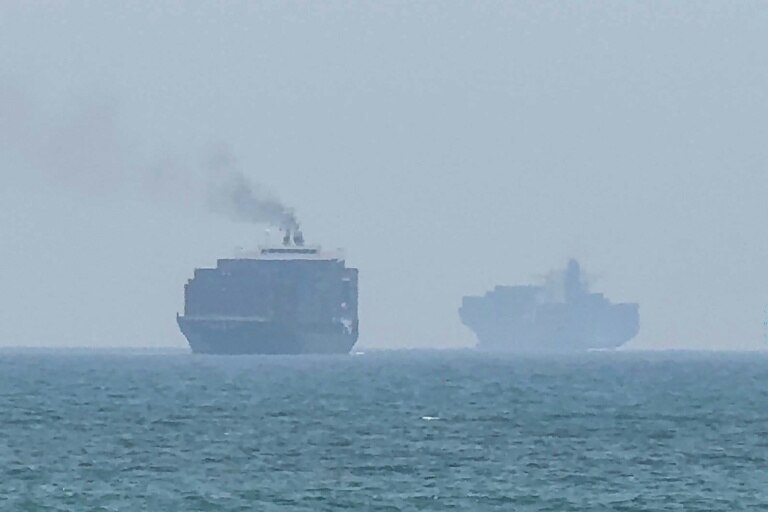
In a separate development in the strategically vital Strait of Hormuz, Iran’s Islamic Revolutionary Guard Corps announced it had intercepted commercial vessels that attempted to transit the waterway without obtaining prior authorization from Iranian authorities. The Guards confirmed two of the four vessels experienced incidents during the interception and were detained, while the remaining two abandoned their planned transit through the strait, a critical chokepoint through which roughly 20% of the world’s daily oil supplies pass.
US Central Command (CENTCOM), the US military command overseeing operations in the Middle East, confirmed that its latest round of strikes against Iranian targets serves two core purposes: first, to deliver punitive action against Tehran for the fatal Jordan base attack that killed two US soldiers and left a third unaccounted for, and second, to weaken Iran’s capacity to disrupt and threaten international commercial shipping passing through the Strait of Hormuz.