In the days leading up to one of the most anticipated FIFA World Cup finals in recent hosting history, thousands of boisterous Argentine supporters have turned the heart of New York City back into a vibrant World Cup carnival, breathing new life into flagging local excitement ahead of Sunday’s blockbuster showdown with Spain at MetLife Stadium.
Local enthusiasm for the co-hosted tournament had slumped sharply after the United States men’s national team was eliminated from competition by Belgium on July 6. Compounding that dip in interest were a series of disruptive external challenges: a deadly Legionnaires’ disease outbreak, extreme volatile weather including fierce storms, widespread flooding, and poor air quality driven by smoke drifting from Canadian wildfires. Even the structure of the tournament contributed to waning buzz: as nations with large diaspora communities in New York, such as Mexico and Egypt, were knocked out round after round, casual local engagement faded steadily. Many native New Yorkers also left the city for summer weekend getaways ahead of the final, and the historic sky-high ticket prices for the match have put attendance out of reach for most fans. Secondary ticketing platform TickPick reports the average final ticket resells for $11,325, making it the most expensive single sporting event in U.S. history.
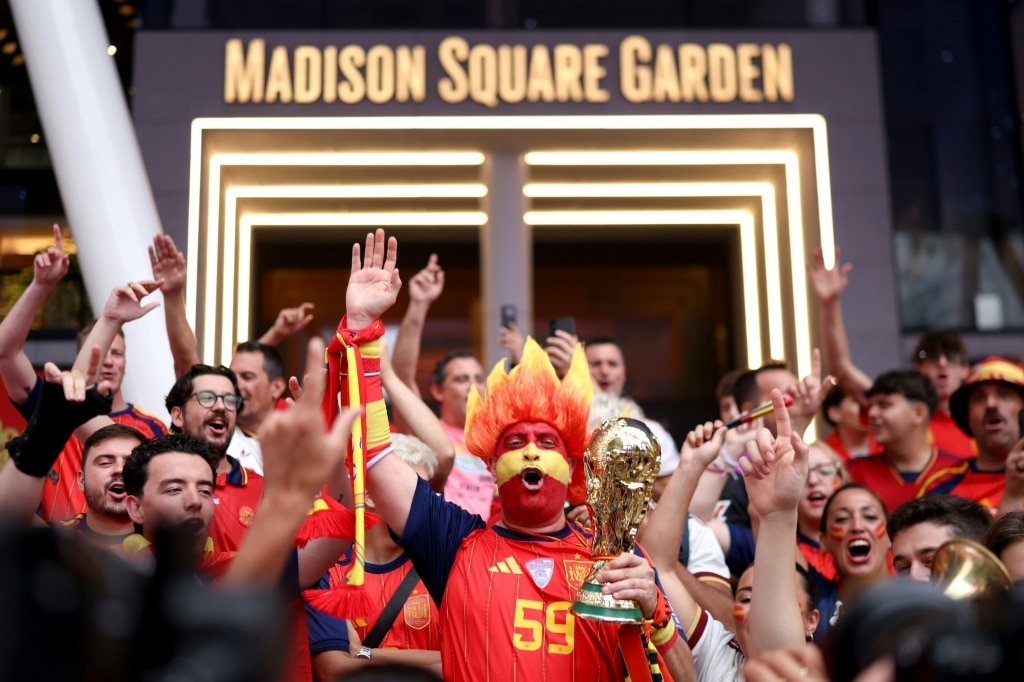
Despite these headwinds, the sea of blue and white striped Argentine jerseys that have flooded Manhattan’s tourist hubs, Penn Station, and the city’s unofficial World Cup gathering spot at Times Square have rekindled the global soccer spectacle’s energy in the Big Apple. Even two four-legged fans got in on the action, decked out in Argentina’s iconic national kit. Across midtown, Spanish supporters gathered in their own pockets around Madison Square Garden, one fan clutching a replica World Cup trophy in anticipation of kickoff.
Florencia Luzinin, a 30-year-old Argentine dentist who traveled to be part of the final buildup, summed up the emotion surrounding the match for many fans, noting this is widely expected to be Lionel Messi’s final World Cup appearance. “I’m very nervous because I love Argentina. It’s the final. It’s probably the last of Messi. So maybe it’s our day. I don’t know. We came across a few Spaniards but I don’t look at them,” she said.
Alessandra Pichler, a 27-year-old Spanish supporter, predicted a 3-1 win for her side and praised the U.S. hosting effort. “I think the US has done a great job hosting all the games I’ve been to. I’ve been very impressed,” she added.
Chip Parham, a New York-based film festival organizer who was gearing up to watch the match, said the drop-off in local interest after the U.S. exit followed a familiar pattern for international sporting events held on American soil. “I think that a reaction for people to lose interest in the World Cup when their country is eliminated is the same as any sporting event. In any city there is a decline in interest for any sporting event that doesn’t feature a local team. With the exception of the Super Bowl,” he explained.
Howie Ray, a 42-year-old New Yorker who shifted his support to England after the U.S. elimination, echoed that observation, noting that even with both finalists in place, local engagement remained muted outside of concentrated fan pockets in Midtown. “It’s been slightly overshadowed. I think there was fatigue after all the games of the group stage and then the US getting eliminated. Spain and Argentina also have relatively small immigrant populations in the city,” Ray said. “A lot of my friends have felt disconnected the entire tournament due to the tickets being unaffordable.”
For the thousands of fans who cannot secure or afford tickets to the 82,500-capacity MetLife Stadium in East Rutherford, New Jersey, a wide range of alternative watch party options have popped up across the city. Global Citizen is hosting an all-star live concert in Central Park that will run simultaneously with the final, while the American Museum of Natural History is offering fans the unique chance to watch Messi’s bid for a fourth Argentine World Cup title alongside the institution’s iconic dinosaur exhibits.
Even with tepid widespread engagement outside of Midtown, the 2026 co-hosted World Cup has left a measurable mark on New York’s sporting landscape. New York City Comptroller Mark Levine confirmed that Gotham FC, the city’s professional women’s soccer team, recently drew the largest crowd ever recorded for a women’s sporting event in New York history, a bump organizers attribute to broader World Cup-fueled interest in soccer. New York Mayor Zohran Mamdani also made headlines ahead of the final for watching England’s quarterfinal exit to Argentina with incarcerated people at the city’s Rikers Island jail facility.
Ahead of kickoff, city officials reaffirmed their commitment to making the World Cup accessible to all New Yorkers. “We said from the beginning that the World Cup belongs to New Yorkers. This summer, we proved it,” Mamdani said. As of Saturday, air quality at MetLife Stadium had returned to normal, clearing the final hurdle for Sunday’s historic showdown.