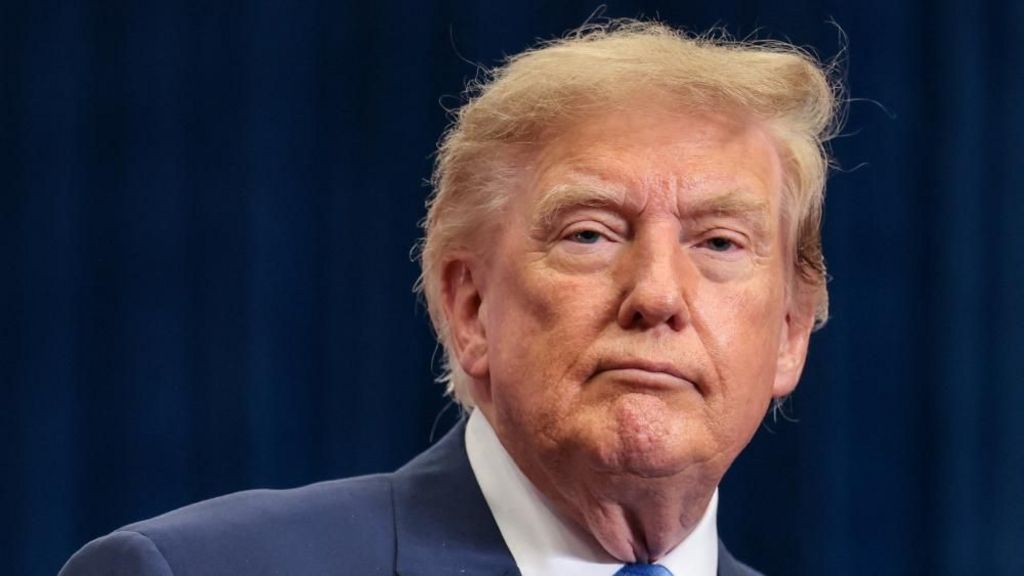
In a development that has sparked cross-party friction in British politics, former U.S. President Donald Trump has confirmed that the United States’ longstanding ambiguous stance on the Falkland Islands sovereignty dispute is “one of many” international positions currently under formal review, as the U.S. presses the United Kingdom to accelerate its planned increases to NATO-aligned defence spending.
The confirmation follows a weeks-old report from The Daily Telegraph, which first revealed that senior U.S. defence officials were drafting a set of proposals designed to pressure NATO allies into meeting their mandatory 2% of GDP defence spending commitments. Among the leverage options reportedly under consideration was a U.S. shift away from its longstanding neutrality on the Falklands dispute, which could see Washington oppose London’s long-held sovereignty claim over the South Atlantic territory.
The Falkland Islands, located 300 miles off the southern coast of Argentina, have been the site of a bitter sovereignty dispute between London and Buenos Aires for nearly two centuries. The dispute boiled over into open conflict in 1982, when Argentine military forces invaded the islands to stake the South American nation’s territorial claim. A 74-day British military campaign retook control of the territory, but the conflict left more than 900 people dead – 255 British service members, three civilian islanders, and 649 Argentine military personnel. For decades, successive U.S. administrations have formally recognized the UK’s de facto governance of the islands, but have declined to take an official position on the underlying sovereignty question.
During a press briefing with reporters on Monday, BBC correspondents asked Trump directly whether his administration was actively reviewing the U.S.’s longstanding position on the dispute. Trump responded simply: “I always review every position. That’s just one of many.” He added that the UK “has got some problems, but they’ll get solved” when pressed for further comment on the link between the review and British defence spending targets.
Trump’s remarks drew immediate pushback from senior British political figures. Dame Emily Thornberry, the Labour Member of Parliament who chairs the House of Commons Foreign Affairs Committee, dismissed the comments as “nonsense” and called on the UK government to issue an immediate, formal response to the threat from Washington. Responding to the call during Tuesday’s parliamentary session, Foreign Office Minister Uma Kumaran reaffirmed London’s unwavering position on the dispute, telling MPs: “The UK has no doubt about its sovereignty over the Falkland Islands. They are and will always remain a British overseas territory in line with the wishes of the Falkland islanders. The UK is steadfast in our support for the islanders’ rights of self-determination. Our position remains unchanged.” A UK government spokesperson added in a separate statement: “Falkland islanders are British with a right to determine their own future. The islanders have repeatedly expressed their wish to remain a British overseas territory and our commitment to them is unwavering.”
The current debate around the Falklands is not the first time a potential review of U.S. policy has emerged. Earlier this year, an internal Pentagon email obtained by Reuters revealed the U.S. was considering a range of punitive options against NATO allies that it deemed insufficiently supportive of its military operations in Iran. The Falklands sovereignty position was one of the potential leverage tools listed in that internal correspondence, and the proposal has reemerged in recent reporting tied to the Trump administration’s pressure on NATO members to increase defence spending.
The row over the Falklands comes as the UK’s new ruling administration works to lock in commitments to raise defence spending in line with NATO demands. New Prime Minister Andy Burnham has pledged to honour a commitment made by his predecessor, former Prime Minister Keir Starmer, to hit a target of 3.5% of GDP for core defence spending by 2035. On Tuesday, Chancellor John Healey told The Times that he would outline a clear, binding timeline to meet that 3.5% target during the next government spending review, scheduled for spring 2026. Healey added that the plan will also include an explicit target date for reaching an interim 3% of GDP spending target. Healey, who served as defence secretary under Starmer, resigned from the previous cabinet in June over a public dispute about military spending timelines, saying in his resignation letter that he was frustrated by the lack of a clear plan to hit the 3% target by 2030, his preferred timeline.
Beyond the Falklands dispute, the Burnham administration is also facing ongoing political pressure over a stalled plan to transfer sovereignty of the Chagos Islands to Mauritius. The 2024 agreement, reached under Starmer, would have seen London hand over control of the Indian Ocean archipelago in exchange for a long-term lease to retain the joint US-UK military base on Diego Garcia, a key strategic logistics hub for U.S. and British military operations across the Middle East and Africa. In April, the deal was paused indefinitely after Trump withdrew U.S. support for the agreement, throwing the entire process into doubt.
Appearing before the Commons on Tuesday, Kumaran reaffirmed that maintaining long-term operational control and security of the Diego Garcia base remains the UK government’s top priority, and that this goal is the entire foundation of the ongoing negotiations with Mauritius. She added that any funding tied to a final agreement would be covered within existing spending allocations for the Foreign, Commonwealth and Development Office and the Ministry of Defence. But the minister’s comments drew fierce criticism from the opposition Conservative Party. James Cartlidge, the Conservative shadow defence secretary, called the existing Chagos agreement “crazy” and said it “belongs on the ash heap of history.” He called on Burnham to “show some backbone” and scrap the deal entirely, reallocating any planned funding for the transfer to the armed forces. Conservative shadow Foreign Office minister Wendy Morton also pressed the government for clarity, noting that the Starmer administration acknowledged in April that the treaty had become “impossible to agree at political level” and asking what had changed to justify continuing negotiations. In response, Kumaran said the Burnham government would “continue to work with the US and Mauritius to find a way forward that is in the UK’s best interests and protects our national security.”