标签: Asia

亚洲

  • China’s domestic service sector embraces robots, AI

    China’s domestic service sector embraces robots, AI

    Against the backdrop of shifting demographics and rising consumer demand for professional household care, China’s vast, traditionally labor-heavy domestic service industry is undergoing a rapid digital transformation, with artificial intelligence and robotics becoming core tools to reshape service delivery and matching efficiency. A groundbreaking example of this tech integration can be found in Hefei, the capital of Anhui province, where a smart diaper sensor developed through a partnership between local domestic service provider Wansao and an AI startup is redefining infant care. The wearable device, fitted with high-sensitivity odor and humidity detectors, automatically tracks a newborn’s physical condition, logs real-time digestive data, and sends instant alerts to caregivers’ wearable wristbands when a diaper change or attention for an upset stomach is needed. This data is then synced with a cloud-based digital platform alongside caregiver-kept feeding records to build a personalized health profile, enabling nannies and parents to monitor infant development with far greater precision than traditional manual care. The developers have already outlined plans to adapt the technology for use with frail, elderly care recipients who require round-the-clock monitoring, expanding its impact beyond childcare. This smart device is just one of dozens of technology trials transforming China’s domestic service sector, which already hit a market value of 1.2 trillion yuan ($174 billion) and employed more than 30 million workers nationwide in 2024. Beyond sensor-based monitoring solutions, AI-powered digital platforms are overhauling the outdated worker-client matching process. Wansao president Ding Xiaomei explained that the company is building large language model-powered platforms trained on years of aggregated domestic service industry data and private industry knowledge bases. These platforms do not only address common questions from both families and domestic workers, but also generate detailed digital work profiles for service providers, allowing the system to quickly match households with candidates that fit their specific needs from a database of tens of thousands of workers. Robotics is also carving out a key space in the market, particularly in the fast-growing eldercare segment. Across multiple Chinese cities, companion robot Xiaoli, developed by Beijing-based Seelink Technology, is already deployed in nursing homes and private family homes. The robot conducts routine health checks including blood pressure and blood oxygen monitoring, sends automatic alerts to family members when abnormal health indicators are detected, and provides conversational companionship to socially isolated elderly residents. Li Yang, a representative of Seelink Technology, noted that the company has launched two tailored versions of Xiaoli — one for institutional eldercare facilities and another for home-based care — and plans to continuously expand the robot’s service capabilities to meet evolving needs. Two major forces are driving this rapid tech adoption in the domestic service space: surging consumer demand and targeted government policy support. Demographic change has been the core demand driver: by the end of 2024, China was home to more than 310 million people aged 60 and above, accounting for roughly 22 percent of the total population. Combined with shrinking average household sizes that leave fewer family members available to provide informal care, demand for both professional childcare and eldercare domestic services has skyrocketed. Industry data from Chinese research firm Zero Power Intelligence Group shows that China’s eldercare robot market already surpassed 30 billion yuan in 2024, with projections to hit 50 billion yuan by 2025. Li Yang noted that just a few years ago, only a small number of companies were developing intelligent companion robots for eldercare, but today, new market entrants are increasing rapidly, making the sector increasingly dynamic. Policy support has also acted as a key catalyst for transformation. In April 2025, China’s Ministry of Commerce joined eight other central government departments to release a policy guideline supporting the upgrading of household service consumption. The guideline explicitly called for accelerating the sector’s digital transformation, and encouraging the adoption of emerging technologies to expand innovative application scenarios across all segments of household services. Despite the clear growth trajectory and promising potential, industry insiders point out that the sector still faces tangible practical barriers to widespread adoption. For one, current robotics solutions remain prohibitively expensive for most average households. Additionally, most existing smart machines can only perform narrow, simple tasks, as navigating the unstructured, complex environment of a typical household requires far more advanced perception and mechanical dexterity than current commercial technologies offer. Data security and standardization also remain major sticking points: domestic work inherently involves processing highly sensitive personal information, and the absence of unified industry-wide data standards makes secure, efficient data sharing and processing far more complicated. Still, industry observers remain optimistic about the long-term future of tech integration in the space. As Yang noted, the development trajectory is clear and manageable, and smart technologies will likely evolve from serving as specialized assistants in commercial care settings to becoming reliable, everyday companions in ordinary households across China.

  • Bridging China-US divide, one wish at a time

    Bridging China-US divide, one wish at a time

    Against a backdrop of often tense and headline-dominating high-level geopolitical discussions between China and the United States, a quiet, people-centered initiative is anchoring the bilateral relationship in mutual understanding and friendship, one handwritten wish at a time.

    This past March, between the 14th and 22nd, 100 student delegates from the U.S. state of Iowa embarked on a multi-city tour of China, stopping in Beijing, Shanghai, and Shijiazhuang, the capital of China’s Hebei province. At Shijiazhuang Foreign Language School, alongside their Chinese peers, the visiting students tied handwritten red wish cards to the budding branches of a ginkgo tree, filling each small note with hopes for peace, shared prosperity, and lasting friendship between the two nations. This collective act was the core of the China-U.S. Friendship Tree — Ginkgo Project, an initiative designed to carry forward the decades-old sister-state relationship between Hebei and Iowa.

    The exchange is part of the transformative “50,000 in Five Years” youth exchange program, first announced by Chinese President Xi Jinping during his 2023 visit to San Francisco, with the goal of expanding and deepening people-to-people connections between the youth of both countries.

    The Ginkgo Project, founded by Luca Berrone, a board member of Iowa Sister States, draws on long-standing cultural symbolism of the ginkgo tree: a species renowned for its resilience, longevity, and ability to form enduring, deep roots over centuries. The initiative invites participants from both China and the United States to express their hopes for bilateral relations through writing or art, tying those aspirations to the tree as a permanent, visible testament to shared goodwill.

    While the project itself centers on the simple, intimate act of exchanging wish cards, its origins stretch back more than 40 years, to 1983, when Hebei and Iowa formally established their sister-state relationship. What began as a formal intergovernmental agreement has grown over decades into a critical lifeline for sub-national diplomacy, serving as a stable counterweight to shifts in top-level geopolitical dialogue. As Berrone emphasizes, the most enduring bilateral bonds are almost always built from the bottom up, one personal connection at a time.

    During their 9-day tour, the Iowa students experienced the full breadth of Chinese life, from exploring iconic historical landmarks including Beijing’s Palace Museum to engaging with hands-on traditional cultural activities such as Chinese knot weaving and martial arts training. They competed in friendly sports matches with local Chinese youth, toured university and high school campuses, and for many delegates, the trip included the deeply personal experience of staying with local Chinese families, bringing them face to face with the warmth and hospitality of ordinary Chinese people.

    For Berrone, the project and the 2026 student exchange hold deeply personal meaning. His own connection to China dates back to 1985, when as a young county official in Iowa, he helped coordinate then-visit of a Chinese delegation led by Xi Jinping, and traveled alongside the group across the state. He still recalls Xi as a sharp, curious, and inherently warm person, a memory that has shaped his decades-long commitment to building cross-Pacific friendship.

    That long history of connection led Berrone and other Iowa friends of China to send New Year greetings to President Xi earlier this year, affirming their commitment to growing people-to-people ties. On February 16, President Xi responded with a personal Chinese New Year card, recalling the warm welcome he received in Iowa 41 years earlier. In his reply, Xi emphasized that the future of China-U.S. relations rests with the people, its foundation lies in grassroots connections, its growth depends on youth engagement, and its vitality comes from sub-national exchanges.

    For Berrone, the reply was a moving confirmation of what the Ginkgo Project has worked to prove: that ordinary people’s connections remain the most important ballast for the bilateral relationship, even during periods of uncertainty. Sarah Lande, another long-time Iowa friend of China who has nurtured cross-Pacific ties for decades, echoed that sentiment in a pre-recorded video message delivered at an icebreaking event for Chinese and American students. Recalling her own friendship with Xi dating back to his 1985 visit, Lande described that connection as “a living testament to how genuine human connections can bridge differences and build lasting bonds of understanding and respect.”

    “Real diplomacy is rooted in people-to-people ties, in shared laughter, shared experiences and mutual respect,” Lande told the assembled students, noting that the young participants themselves are not just beneficiaries of this long history, but active ambassadors of friendship, peace, and mutual understanding between the two countries.

    For many of the visiting Iowa students, the trip reshaped their understanding of China far beyond what they had seen in media or learned in classrooms. What had once felt like a distant, unfamiliar nation quickly became a place of familiar human connection, where shared hopes and kindness transcended political differences — one handwritten wish on a ginkgo tree branch at a time.

  • Chinese vice-premier stresses modernization of water networks, safeguarding rivers

    Chinese vice-premier stresses modernization of water networks, safeguarding rivers

    In a working inspection tour of eastern China’s Zhejiang Province and southeastern China’s Jiangxi Province held between Monday and Thursday, Chinese Vice-Premier Liu Guozhong, who also serves as a member of the Political Bureau of the Communist Party of China Central Committee, has laid out clear priorities for advancing the country’s water management infrastructure and ecological conservation efforts, calling for accelerated construction of a modern national water network and strengthened, comprehensive protection of the nation’s river systems. The ultimate goal of these efforts, Liu emphasized, is to steadily boost China’s capacity to safeguard long-term water security.

    During the site visits, Liu conducted in-depth, on-the-ground reviews of key water conservancy projects across both provinces, covering critical infrastructure ranging from reservoirs, river channels, and embankments to large-scale irrigation districts and rural drinking water supply systems. He also received detailed briefings on ongoing conservation and management work for two major water bodies in the region: the Xin’an River and Poyang Lake.

    Liu stressed that advancing the core framework of the national water network must remain a top near-term priority. He called for coordinated planning and execution of water conservancy projects at all administrative levels, paired with targeted improvements to how the country allocates its freshwater resources across different regions and use cases.

    Beyond infrastructure development, Liu called for elevated standards for the protection and governance of all rivers and lakes across the country. He highlighted the urgent need to scale up adoption of water-saving irrigation technologies to maximize water use efficiency in the agricultural sector, while also reinforcing the safety and reliability of drinking water supplies for rural communities.

    During a stop to review flood prevention infrastructure and national hydrological forecasting systems, Liu pushed for full and thorough implementation of pre-disaster preparedness measures. This includes completing comprehensive screening and rectification of all known hidden safety hazards, he said, to effectively raise the country’s ability to prevent and mitigate damage from floods and waterlogging, which pose recurring seasonal risks to many Chinese regions.

    The inspection tour also included stops to review early rice seedling cultivation and rapeseed farming operations, tying agricultural water management priorities to broader national food security goals.

  • HKSAR govt files application with court to forfeit Jimmy Lai’s offense-related properties

    HKSAR govt files application with court to forfeit Jimmy Lai’s offense-related properties

    HONG KONG – On April 3, 2026, the Government of the Hong Kong Special Administrative Region (HKSAR) announced it had submitted a formal application to the High Court’s Court of First Instance seeking the forfeiture of assets linked to Jimmy Lai that are connected to his national security offenses. The legal move is framed as a critical step to disrupt and deter activities that threaten the stability and sovereignty of China’s national security.

    This application follows due legal process, brought in full compliance with the Law of the People’s Republic of China on Safeguarding National Security in the Hong Kong Special Administrative Region (Hong Kong National Security Law) and its associated Implementation Rules for Article 43.

    The legal action comes after Lai was previously found guilty by the Court of First Instance on three counts of national security-endangering offenses. Court documents confirmed Lai acted as the mastermind and primary driving force behind a sustained campaign of illegal activity. He deliberately leveraged the now-shuttered *Apple Daily* media outlet and his own personal influence to systematically undermine the legitimacy and authority of the Central People’s Government of China and the HKSAR Government, as well as their respective institutions. His actions also eroded public trust between the Hong Kong public and the two levels of government, activity that the court ruled far exceeded the bounds of legally protected expression. Additionally, Lai was found to have repeatedly colluded with foreign forces, openly calling for external sanctions against China and the HKSAR and carrying out coordinated hostile actions against both governments. For these offenses, the court ultimately sentenced Lai to 20 years in prison.

    Under Article 32 of the Hong Kong National Security Law, any proceeds derived from national security offenses – including financial support, illicit gains, rewards, and any funds or tools used or intended for use in committing these offenses – are subject to seizure and confiscation. Per the legislation, the Court of First Instance may only issue a forfeiture order after an application is submitted by the Secretary for Justice, and only after the court confirms the targeted property meets all legally defined criteria for forfeiture, in line with strict requirements laid out in Schedule 3 of the Implementation Rules.

    In a statement accompanying the application, an HKSAR Government spokesperson emphasized that Hong Kong is a society founded on the rule of law, and has long upheld the core principle that laws must be respected and violations must result in accountability. The spokesperson noted that seeking court-approved forfeiture orders is a widely recognized global legal mechanism to combat serious crime and protect broad public interest, including in jurisdictions around the world.

    By targeting assets tied to national security offenses, the forfeiture order is designed to prevent Lai, his co-conspirators and associates from continuing to use these resources to plan and carry out activities that endanger national security. The move explicitly aims to cut off the financial supply chains that support national security offenses and reduce the operational capacity of groups and individuals seeking to harm China’s national interests, the spokesperson added.

  • Myanmar’s coup leader who set off a brutal civil war becomes president

    Myanmar’s coup leader who set off a brutal civil war becomes president

    On February 1, 2021, Myanmar’s top military leader Min Aung Hlaing ousted the elected government led by Aung San Suu Kyi, promising to transfer power to a civilian government through new elections within 12 months. Five years later, he has finally kept that promise in name only. Last week, the newly convened parliament, stacked entirely with his political allies, selected him as Myanmar’s next president, and he stepped down from his post as armed forces commander to meet constitutional requirements for the office.

    This so-called return to civilian rule is little more than a political reshuffle designed to consolidate military power under a civilian facade. Under Myanmar’s constitution, the military is guaranteed 25% of all parliamentary seats, and the military-aligned Union Solidarity and Development Party (USDP) claimed nearly 80% of the remaining seats in an election widely criticized as heavily rigged in its favor. The final outcome was never in doubt, making the process more of a coronation than a democratic exercise. When the new cabinet is formed, current and former military officials are expected to hold nearly all key portfolios.

    To ensure his influence remains unchallenged even after leaving uniform, Min Aung Hlaing has placed a close, hardline ally, General Ye Win Oo — who has a documented reputation for brutal crackdowns on opposition — in his former role as commander-in-chief. He has also established a new top-level consultative council that will hold supreme authority over all civilian and military matters, effectively guaranteeing he retains full control of the state despite his new civilian title.

    For millions of ordinary Myanmar citizens, this political transition will bring little to no change to the daily chaos and suffering that has defined life since the 2021 coup. For young opposition activist Kyaw Win (a pseudonym to protect his safety), the outcome has extinguished any immediate hope of political change. Arrested in 2022 for joining a flash mob protest against the junta, he spent years in prison, where he describes being systematically tortured: guards beat him with iron rods, burned his skin with cigarettes, slashed his thigh with a knife and sexually assaulted him during interrogations. Recently released from prison, Kyaw Win says his commitment to the pro-democracy movement remains intact, but he can no longer safely organize inside the country and plans to flee abroad to find work.

    The five years since the coup have been an unmitigated catastrophe for Myanmar. Min Aung Hlaing severely miscalculated the level of public outrage that would follow his power grab, which came just as parliament was set to confirm a new term for Aung San Suu Kyi’s National League for Democracy following its landslide victory in the 2020 general election. His decision to deploy lethal force against nationwide peaceful protests ignited a widespread civil conflict that has killed thousands of people, displaced nearly 4 million more, and gutted the country’s once-growing economy.

    Resistance groups now control large swathes of territory across the country, and the junta has responded with indiscriminate air strikes and scorched-earth campaigns against civilian communities in opposition-held areas, using a longstanding counterinsurgency doctrine known as “the four cuts” that aims to cut off rebel groups from access to food, funds, information and new recruits by destroying supporting communities. With military support from China and Russia, the junta has reclaimed some territory lost over the past two years, but the conflict remains deadlocked.

    Earlier this month, Min Aung Hlaing presided over his final annual military parade as commander-in-chief in the capital Nay Pyi Taw, a tradition the junta has maintained every year even as the civil war has raged. BBC correspondents who attended the event listened closely for any hint of regret or reflection over the devastation caused by the coup, but none came. Instead, Min Aung Hlaing repeated his longstanding unapologetic justifications for the 2021 power grab, claiming the military held a constitutional mandate to intervene in national politics to “uphold multi-party democracy”, and labeling all opponents of military rule “armed terrorist factions” backed by foreign enemies and opportunistic politicians. His speech made clear that a civilian title would not lead to any shift in how the country is governed.

    Su Mon, a senior analyst at the Armed Conflict Location & Event Data Project (ACLED), warns that the conflict will only continue unchanged under the new administration. “The new commander-in-chief is a hardline loyalist with deep personal and family ties to Min Aung Hlaing, so he will continue the existing strategy above all else: retake all lost territory from resistance groups,” she explained. With resistance groups still controlling around 90 towns across the country, that means more indiscriminate air and drone strikes on civilian areas, and more devastating scorched-earth campaigns.

    The National Unity Government (NUG), the shadow administration formed by politicians ousted in the 2021 coup and based out of resistance-held territory along the Thai border, rejects the legitimacy of the new presidency, the recent election and the new parliament entirely. While the NUG has struggled to unify the dozens of disparate armed resistance groups operating across the country, it remains firm in its commitment to continue fighting to remove the military from political power entirely and draft a new federal constitution.

    “This is not the time for compromise,” NUG spokesman Nay Phone Latt said. “If the military will not accept our objectives, our revolution will go on. We have to keep going; if we give up now, our people and the next generation will only suffer more.”

    Five years of continuous conflict have left the Myanmar public exhausted, and the country’s economy on the brink of collapse. The United Nations estimates that more than 16 million people — nearly a third of the country’s population — currently need life-saving humanitarian assistance. Runaway inflation has collapsed living standards for most households, and the crisis has been made worse by growing fuel shortages driven by regional export restrictions and the ongoing conflict in the Middle East.

    Myanmar relies on imports for 90% of its oil and petroleum products, and most of those imports come from neighboring countries that have recently cut exports to address their own domestic shortages. Fuel is now strictly rationed, and prices have spiked sharply, far exceeding costs in neighboring Thailand. For most businesses, the situation is even more dire: the national electricity grid only provides a few hours of power per day even in major cities like Yangon, forcing almost all businesses and many households to rely on expensive diesel generators.

    Tin Oo, a motorbike taxi driver working in Yangon’s industrial Hlaing Tharyar district, says daily life has become unrecognizable from a decade ago. “Today, we can’t even earn enough to cover rent and food,” he explained. Like many ordinary Myanmar people, he has no faith that the new civilian-backed military government will improve conditions. “They don’t care about us. We still have to fend for ourselves. These days, it’s almost impossible to survive if you try to make an honest living, but corrupt people get rich.”

    Into this bleak political stalemate, Mya Aye — a veteran pro-democracy activist who has spent decades imprisoned by Myanmar’s military — has emerged this week with a rare call for dialogue and compromise, arguing that the only way to avoid total state collapse is to negotiate a settlement between the military and its opposition. He has launched a new cross-party council to bring together supporters of dialogue, calling for immediate talks and the release of all political prisoners. While only a handful of prominent political figures have publicly joined the initiative, Mya Aye says many more are holding confidential discussions with the group.

    “This election is not a solution. It’s just a political game that Min Aung Hlaing is playing to solidify his control,” Mya Aye said. “The current constitution also can’t get us out of this crisis. But the public is exhausted. If we can’t find a compromise, the country will collapse — and in many ways, it already has.” Mya Aye argues that if the junta releases Aung San Suu Kyi, who remains under house arrest at the age of 80, she could play a decisive role in brokering a widely accepted peace deal. There has been widespread speculation that Min Aung Hlaing may release her later this year, now that he has secured the presidency — the long-held ambition that many analysts say was a core motivation for the 2021 coup.

    While a narrow path to peace may exist in theory, for now, Myanmar’s military leaders show no inclination to walk it, leaving the country stuck in a devastating cycle of conflict and hardship with no clear end in sight.

  • French and South Korean leaders say they’ll work together on the Strait of Hormuz

    French and South Korean leaders say they’ll work together on the Strait of Hormuz

    During an unprecedented Seoul summit held on Friday, French President Emmanuel Macron and South Korean President Lee Jae Myung announced a shared commitment to collaborative diplomatic action aimed at reopening the Strait of Hormuz and easing cascading global economic turbulence sparked by ongoing Middle East conflict. The meeting marked Macron’s first visit to South Korea since he assumed office in 2017, wrapping up the East Asian leg of a regional tour that already included a stop in neighboring Japan. It also unfolded against a backdrop of growing public friction between U.S. President Donald Trump and U.S. global allies, with Trump repeatedly lashing out at partners for failing to back Washington and Israel in their campaign against Iran.

    Opening the bilateral talks, Macron emphasized that both middle-power nations France and South Korea hold unique influence to help de-escalate tensions across the Middle East, particularly around the Strait of Hormuz, where Iran’s control of the strategic waterway has sent major shocks through global energy markets. In a subsequent joint televised briefing to the public, Macron reiterated that coordinated action between Paris and Seoul was critical to clearing the waterway for commercial transit and rolling back rising hostilities across the region. Lee echoed this commitment, confirming the two leaders had “affirmed their resolves to cooperate to secure the safe shipping route in the Strait of Hormuz.”

    Notably, the two leaders did not take questions from reporters, nor did they lay out specific operational details for how their cooperation would unfold to reopen the strait. The 21-mile waterway, wedged between Iran and Oman, typically carries roughly one-fifth of the world’s daily oil supplies, making its disruption a critical threat to global energy and economic stability.

    “We need to clearly define, at the international level, the conditions for a process to ease the crisis and conflict in the Middle East,” Macron stated during the briefing. “We need to ensure that the Strait of Hormuz is reopened.” The French leader has previously ruled out a unilateral military operation to reopen the waterway, calling that approach unrealistic.

    Beyond their Middle East diplomacy, the two leaders also used the summit to advance deepened bilateral cooperation across technology, energy, and critical resource sectors. Officials from both countries signed three landmark agreements covering collaboration on nuclear fuel supply chains, joint investment in a large-scale offshore wind project off southern South Korea, and partnership on critical minerals development. For South Korea, these agreements align with ongoing domestic energy policy shifts: President Lee has prioritized ramping up output at existing nuclear reactors to ease ongoing energy shortages, and accelerated the transition to renewable energy, noting the Middle East conflict has laid bare the country’s dangerous overreliance on imported fossil fuels.

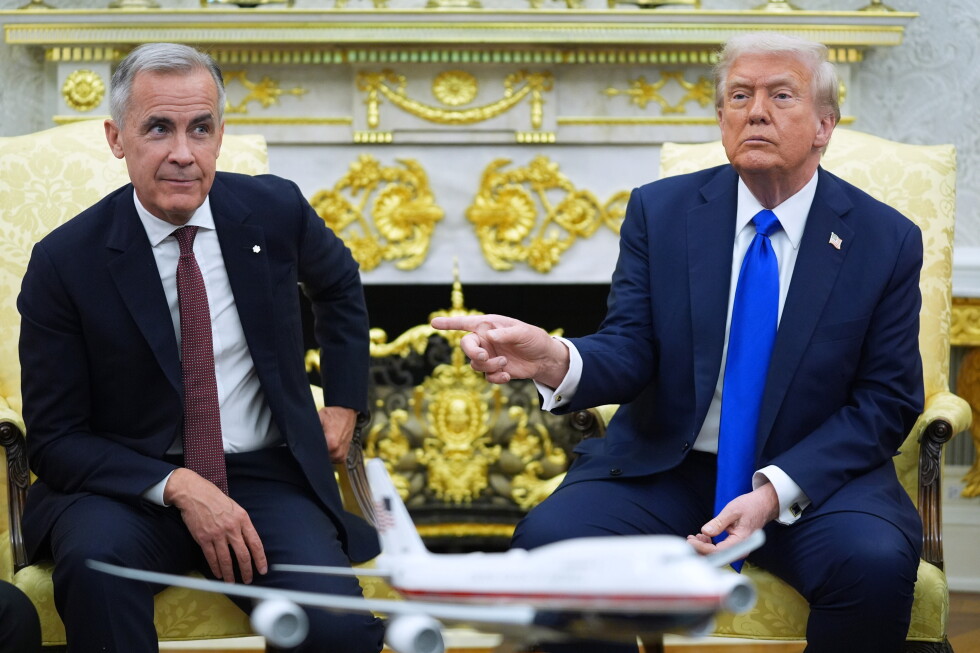
    Macron’s Asian tour comes as Trump has stepped up public criticism of U.S. allies over their lack of engagement on the Hormuz issue. During a speech Wednesday, Trump claimed the United States “doesn’t need” the strait, and argued that other major economies that depend on the waterway “must grab it and cherish it.” At an earlier Easter event at the White House, Trump explicitly called on U.S. Asian allies and China to take the lead on reopening the waterway. “Let South Korea, you know, we only have 45,000 soldiers in harm’s way over there, right next to a nuclear force — let South Korea do it,” Trump said. “Let Japan do it. They get 90% of their oil from the strait. Let China do it.” Official U.S. deployment data contradicts Trump’s claim: roughly 28,000 U.S. troops are stationed in South Korea, a deployment meant to deter potential aggression from North Korea, not for Middle East operations. South Korean officials have confirmed they are in ongoing communication with Washington about the Hormuz issue, but have ruled out the option of paying transit fees to Iran to secure South Korean fuel shipments through the waterway.

  • Myanmar’s parliament elects ruling general as president, keeping the army in charge

    Myanmar’s parliament elects ruling general as president, keeping the army in charge

    In a widely anticipated move that has renewed global scrutiny of Myanmar’s military-backed political order, the country’s rubber-stamp parliament voted Friday to install Min Aung Hlaing, the senior general who seized power from Aung San Suu Kyi’s democratically elected civilian government in a 2021 coup, as the nation’s new president. The vote caps a years-long push by the military to cement its control behind a veneer of civilian rule, even as a brutal civil war rages across large swathes of the country and international powers reject the process as illegitimate.

    Min Aung Hlaing was one of three handpicked nominees for the presidency, and his lopsided victory was never in doubt: lawmakers from military-aligned parties and directly appointed military representatives hold an unassailable majority in the new assembly. Held in Naypyitaw’s newly earthquake-repaired parliament building, the final vote count gave the coup leader 429 of 584 total cast ballots. His two competitors will take vice presidential posts: Nyo Saw, a retired general and long-time Min Aung Hlaing adviser, and Nan Ni Ni Aye, an ethnic Karen politician from the pro-military Union Solidarity and Development Party, who will become Myanmar’s first female vice president. All three are scheduled to be inaugurated next week.

    Consistent with constitutional requirements that bar the president from holding the top military command post, Min Aung Hlaing stepped down as commander-in-chief earlier this week, handing the powerful role to close ally Gen. Ye Win Oo, a move that leaves the military’s core leadership structure unchanged despite the nominal transition to civilian government.

    The military frames the new government as a return to democratic governance after four years of direct military rule following the 2021 coup. But independent observers and political opponents universally dismiss the process as a sham, designed only to legitimize the military’s hold on power after a national election the junta organized last December and January. Major opposition parties, including Suu Kyi’s former ruling National League for Democracy (NLD), were either barred from participating or refused to contest the vote over pre-determined unfair rules. Widespread armed conflict also prevented voting from being held in nearly a third of the country’s 330 townships, due to persistent security risks for election organizers.

    For the country’s main opposition, the National Unity Government (NUG), which claims to be Myanmar’s legitimate elected administration, Min Aung Hlaing’s elevation only confirms that the military has no intention of ceding power to a genuinely popular government. “Min Aung Hlaing is responsible for countless war crimes, and his easy ascent to the presidency proves the nominal political change some foreign actors hoped for will never come to pass,” NUG spokesperson Nay Phone Latt told the Associated Press. “The people of Myanmar do not accept this outcome. Our revolution will continue with undiminished momentum.”

    Myanmar’s modern political history has been defined by military dominance: the armed forces ruled the country directly from 1962 until 2016, when the NLD won a landslide election victory that ended decades of direct military rule. The party secured an even larger mandate in 2020, but the military refused to accept the result, launching a coup days before the new parliament was scheduled to convene. Suu Kyi, now 80 years old, has been detained ever since, serving a 27-year prison sentence on charges widely condemned as politically motivated.

    Peaceful mass protests against the coup were crushed with lethal force by the junta, pushing pro-democracy activists to launch an armed resistance movement that allied with long-running ethnic minority insurgencies fighting for greater regional autonomy. That conflict has since escalated into a full-scale civil war that has killed thousands and displaced millions.

    Independent human rights monitors have documented widespread atrocities committed by junta forces since the 2021 takeover. The Assistance Association for Political Prisoners, an independent watchdog that tracks rights violations in Myanmar, confirms that nearly 8,000 civilians and activists have been killed, and more than 22,870 political prisoners remain detained as of 2025. The U.S.-based Armed Conflict Location & Event Data Project reports that junta warplanes carried out 1,140 airstrikes across the country in 2025 alone, a tactic that has killed hundreds of civilian non-combatants.

    International rights groups warn that Min Aung Hlaing’s new civilian title does not grant him immunity from prosecution for widespread violations of international law. “If Min Aung Hlaing believes that holding an official civilian presidency will protect him from accountability for the grave crimes he is accused of overseeing as military chief, that is not how international justice works,” said Joe Freeman, Myanmar researcher for Amnesty International, in a public statement.

    The senior general already faces international legal action over the military’s persecution of the Rohingya Muslim minority. In 2024, the International Criminal Court launched an investigation into crimes against humanity, after the chief prosecutor requested an arrest warrant for Min Aung Hlaing over the mass atrocities committed against the Rohingya starting in 2017. Earlier this year, the International Court of Justice held long-delayed public hearings in the genocide case brought against Myanmar by Gambia, which first accused the country of orchestrating a campaign of genocide against the Rohingya in 2019.

    The nominal transition to civilian rule is widely viewed as a strategic move by the junta to repair strained relations with some Southeast Asian neighbors and shore up international legitimacy, after the 2021 coup left the regime diplomatically isolated. The military government has retained steady backing from major powers China and Russia throughout the post-coup period, while Western governments have imposed harsh economic sanctions on junta leaders and institutions.

  • Wall Street closed for Good Friday, but US futures inch lower following strong March jobs report

    Wall Street closed for Good Friday, but US futures inch lower following strong March jobs report

    Early trading on Good Friday saw U.S. equity futures edge lower, triggered by unexpectedly robust monthly employment data from the U.S. federal government. While traditional equities markets were shuttered for the Easter holiday, futures trading continued through Friday morning in a muted, low-volume session. The S&P 500 futures contract dropped 0.3%, Dow Jones Industrial Average futures retreated 0.2%, and Nasdaq futures slid 0.4% by early morning.

    The Labor Department’s latest jobs report delivered a far stronger reading than most analysts projected: U.S. employers added 178,000 new positions in March, bouncing back sharply from February’s revised 133,000 job loss. The national unemployment rate also ticked down to 4.3% from 4.4% the prior month, marking a surprise improvement in labor market conditions.

    Meanwhile, global energy markets were also closed for the Good Friday holiday, a day after dramatic price spikes driven by growing fears that the ongoing conflict between the U.S. and Iran will be prolonged. On Thursday, the U.S. benchmark West Texas Intermediate crude surged 11.4% to settle at $111.54 per barrel, while global benchmark Brent crude jumped 7.8% to close at $109.03 per barrel.

    The uncertainty around the conflict stems from remarks made by U.S. President Donald Trump late Wednesday, when he pledged that the U.S. would continue military operations against Iran and declined to provide a clear timeline for withdrawing forces or ending the Middle East conflict. Analysts at BMI, a division of Fitch Solutions, warned that a drawn-out conflict would carry significant risks for global energy supplies. “A more extended conflict raises the threat to physical infrastructure, extends disruptions through the Strait of Hormuz, and will entail a longer postwar recovery period, with price impacts spilling over later into the year,” the BMI report noted.

    Even though the U.S. only sources a small share of its imported oil from the Persian Gulf, global oil pricing operates as a single interconnected market, meaning any disruption to regional supplies pushes up prices for consumers and businesses worldwide. The dynamic is far more acute for Asian economies: Japan, for example, depends on the Strait of Hormuz for the majority of its oil imports, and would need to secure alternative supply routes if transit through the key chokepoint is blocked long-term. Still, some analysts note that many Asian nations are currently negotiating contingency agreements with Iran to keep fuel shipments moving through the strait even amid the conflict.

    Across major European markets, trading was also closed for Good Friday, with sessions suspended in France, Germany and the United Kingdom. In the Asia-Pacific region, market activity was mixed as most major exchanges stayed closed for the holiday. Japan’s Nikkei 225 benchmark gained 1.3% to close at 53,123.49, while South Korea’s Kospi index jumped 2.7% to finish at 5,377.30. The only major open mainland Chinese market, the Shanghai Composite, fell 1.0% to end the session at 3,880.10. Exchanges in Hong Kong, Singapore, Australia, New Zealand, the Philippines, Indonesia and India were all closed for the holiday.

  • China imports US oil for Asian fuel markets amid Hormuz crisis

    China imports US oil for Asian fuel markets amid Hormuz crisis

    Against a backdrop of crippling Middle East energy supply disruptions and tightening fuel markets across the Asia-Pacific, China has announced a major strategic shift, resuming large-scale purchases of United States liquefied natural gas (LNG) and crude oil after nearly a year and a half of suspended trade tied to escalating bilateral trade tensions.

    The pivot comes in the wake of U.S.-Israeli military operations against Iran launched on February 28, which have sent shockwaves through global energy markets. Heightened risks of drone and missile attacks have caused a sharp drop in tanker traffic through the Strait of Hormuz, the world’s busiest chokepoint for crude oil and LNG exports, triggering cascading supply shortages across Asia. By early March, the crisis had forced Thailand to suspend fuel exports on March 6, with China following just five days later when the National Development and Reform Commission (NDRC) ordered a full halt to gasoline, diesel, and aviation fuel shipments to overseas markets.

    According to tanker tracking data cited by Nikkei Asia, approximately 600,000 barrels per day of American crude are scheduled for loading in April, marking the formal resumption of bilateral energy trade after purchases were halted in early 2025 amid new U.S. tariffs imposed by the Trump administration. Some international observers have framed the move as a major concession from Beijing, or even a strategic goodwill gesture ahead of a scheduled May summit between U.S. President Donald Trump and Chinese President Xi Jinping, set for May 13-14 in China.

    Unlike the full halt to domestic refined fuel exports, China has moved to implement a system of targeted exemptions for the April export ban, as confirmed by industry sources speaking to Reuters. The curbs are expected to be extended through the month, with only small volumes of gasoline, diesel, and jet fuel approved for shipment to Southeast Asian nations facing acute supply crunches. Total April export quotas are projected to land between 150,000 and 300,000 metric tons, with shipments earmarked for Bangladesh, Myanmar, Sri Lanka, the Maldives, and Vietnam. This targeted easing, analysts note, allows Beijing to preserve tight domestic fuel supplies while retaining critical market share and expanding political influence across the region at a moment of widespread energy insecurity.

    Chinese officials and commentators have rejected the framing of the energy import pivot as a concession, instead positioning the move as a major competitive victory over U.S. ally Japan in securing access to American energy supplies. Writing in a recent op-ed, Sichuan-based columnist Liang Mi noted that Japanese Prime Minister Sanae Takaichi returned from a high-profile trip to Washington with only symbolic alliance commitments, while China quickly locked in the large-volume energy shipments that Tokyo had spent months negotiating.

    “Japan’s refiners only booked around 3 million barrels of U.S. crude for April – that is just equal to five days of China’s planned purchases,” Liang explained. At current market prices, China’s 18 million barrels of monthly U.S. crude imports are worth close to $10 billion, a scale that Tokyo could not match. Liang added that the United States prioritizes its own commercial interests over alliance commitments, noting that “as the world’s largest energy importer, China has strong, stable demand for crude and natural gas – and larger buyers naturally get higher priority.” He also noted that the resumption of purchases helps build a constructive atmosphere ahead of the May high-level summit between the two global powers.

    The resumption of U.S. energy purchases also reflects constrained strategic options for Beijing, analysts outside of China point out, as existing supply disruptions from Venezuela and the Middle East have limited alternative sources for China’s growing energy demand. But Chinese commentators emphasize that the country’s robust domestic energy infrastructure and strategic reserves leave it well-positioned to navigate the global crisis. Fujian-based commentator Chenkai noted that China produces roughly 200 million tonnes of domestic crude annually, and holds 270 million tonnes in strategic reserves – well above the International Energy Agency’s 90-day safety benchmark. “China could sustain itself for more than a year even if all imports were cut off,” Chenkai wrote.

    By pausing refined fuel exports, China has effectively withdrawn millions of tonnes of product from the global market, putting immediate pressure on net importers like Japan and South Korea, and even leaving the U.S. vulnerable if the crisis escalates, Chenkai argued. “This policy reflects preparation for worst-case scenarios and a reassessment of China’s role in the global energy chain. China is not only a buyer but also a major refiner and exporter. In critical moments, we can flex our muscle by restricting fuel exports,” he added.

    The current energy crisis has already had severe impacts across Asia. In Southeast Asia, more than 40 percent of gas stations in Laos have closed due to supply shortfalls, while Cambodia and Thailand have been forced to implement fuel rationing and price controls. Vietnam has canceled hundreds of domestic and international flights after running low on aviation fuel following China’s export ban. In South Asia, India, Pakistan, and Bangladesh have seen fuel prices skyrocket and have been forced to implement emergency conservation measures, while even Japan and South Korea, which hold significant strategic reserves, remain exposed to further disruptions through the Strait of Hormuz.

    Chinese Foreign Ministry spokesperson Mao Ning framed the global energy crisis as a direct consequence of U.S. military action in the region. “The root cause of the fuel shortages facing the global energy market lies in the tense situation in the Middle East,” Mao Ning said Thursday. “The pressing task is to put an end to U.S. military operations at once and prevent the turmoil in the Middle East from further impacting the global economy.”

    Beyond the resumption of U.S. crude imports, China has emerged as a critical swing supplier of LNG across Asia amid the crisis. Data from energy analysts ICIS, Kpler, and Vortexa shows that China re-exported a record 8 to 10 LNG cargoes in March, bringing year-to-date resales to 1.31 million tonnes across 19 shipments, mostly to South Korea and Thailand, with additional cargoes going to Japan, India, and the Philippines. Chinese firms have been able to capitalize on sky-high regional spot prices, offloading excess cargoes at a premium while domestic demand has softened.

    While the NDRC ordered a full halt to refined fuel exports in March, exports have not stopped entirely, with targeted exemptions granted to key regional partners facing emergency shortages. When the Philippines declared a national energy emergency in late March, reporting less than 10 days of diesel reserves remaining, China dispatched two tankers carrying more than 260,000 barrels of diesel to the country. China now supplies more than half of the Philippines’ total diesel imports, making it a core pillar of the country’s energy security. China also sent a 100,000-barrel diesel tanker to Vietnam to address acute shortages there.

    One Sichuan-based military affairs commentator noted that these targeted shipments send a clear political and economic message to the region. “Cutting supply is easy, but the consequences are far-reaching: disruptions could halt flights, logistics, and power generation across the region. By continuing shipments to key partners, China signals that while differences remain, it will still meet essential needs, underscoring its influence in regional energy markets,” he wrote. Politically, he added, the actions make clear which countries neighboring nations can rely on when energy crises hit.

    For his part, U.S. President Donald Trump claimed in a national address Wednesday that American military operations have “decimated” Iran both militarily and economically, and called on nations dependent on Strait of Hormuz oil shipments to take primary responsibility for safeguarding the critical shipping route. Trump said Washington would offer support, but shifted the burden of security to regional energy importers, leaving a power gap that China has moved quickly to fill through its targeted energy policies.

  • An ancient oracle warned that invading Persia would backfire

    An ancient oracle warned that invading Persia would backfire

    For millennia, launching an invasion of the Persian plateau – the historic heart of modern-day Iran – has proven to be one of the most catastrophic miscalculations a regional power can make. From the early era of Achaemenid expansion to the height of Roman imperial ambition, a consistent pattern has repeated itself: aggressors who enter Persian territory rarely walk away with the gains they predicted, and more often leave their own empires broken or humiliated. Today, as the United States navigates heightened tensions with Iran, ancient history offers a stark lesson about the unique risks of military conflict in this strategic corner of the world. The patterns of the past hold clear warnings for modern policymakers.

    The first recorded example of this fateful pattern dates back to 546 BCE, when Croesus, the fabled wealthy king of Lydia (a kingdom in modern-day western Turkey), set out to stop the rising Achaemenid Persian Empire’s westward expansion. Croesus, uncertain of victory, turned to the renowned Oracle of Delphi in Greece for a prophecy. As ancient historian Herodotus recorded, the oracle delivered an ambiguous warning: if Croesus marched against Persia, he would destroy a great empire. Confident the prophecy referred to his enemy, Croesus invaded. The result was his own total defeat at the hands of Persian king Cyrus the Great, and the annihilation of Croesus’ own Lydian Empire. The oracle was correct – just not in the way Croesus had hoped.

    By the 4th century BCE, the Achaemenid Persian Empire stretched across a massive swath of Eurasia, encompassing modern Iran, Iraq, Turkey, the Persian Gulf, and parts of dozens of neighboring countries. It would fall eventually to Alexander the Great of Macedon, who invaded in 334 BCE and won a string of stunning military victories that ended Achaemenid rule by 330 BCE. But victory proved fleeting. Alexander died suddenly in Babylon just seven years after his invasion, leaving a chaotic patchwork of temporary arrangements to govern the vast territory he had seized. His successors were never able to permanently hold the conquered Persian lands, and within decades, local Iranian rule reemerged. To this day, Alexander is remembered in Iranian history not as a conquering hero, but as a destructive invader held in contempt.

    Seventy years after Alexander’s death, the Arsacid Parthian dynasty rose to power in Iran, controlling most of the former Achaemenid territory for centuries. As Roman power expanded eastward from the 1st century BCE onward, the Parthians became Rome’s most persistent and dangerous eastern rival. The first major Roman invasion of Parthia ended in unmitigated disaster. In 53 BCE, Roman general Crassus led a large army into Parthian territory in southern Turkey, only to be utterly annihilated by Parthian forces near the city of Carrhae. Some 20,000 Roman troops died, including Crassus and his son, and another 10,000 were captured. The defeat haunted Roman collective memory for centuries.

    Even when Roman emperors managed to gain territory in Parthia, the gains proved hollow. In 116 and 117 CE, Emperor Trajan pushed Roman forces all the way to the Persian Gulf, but could not solidify control over any of the land he had seized. A century later, Emperor Septimius Severus seized new territory in Mesopotamia, but contemporary Roman writer Cassius Dio noted that the conquest brought only endless conflict and crippling expense to Rome. “Emperor Septimius Severus used to declare that he had added a vast territory to the empire and had made it a bulwark of Syria,” Dio wrote. “On the contrary, it is shown by the facts themselves that this conquest has been a source of constant wars and great expense to us.”

    In the 3rd century CE, the Sasanian dynasty overthrew the Parthians and took control of Iran and Mesopotamia, and they would inflict even greater humiliations on invading Roman forces. In 244 CE, Emperor Gordian III led a massive invasion of Sasanian territory, aiming to capture the Persian capital of Seleucia-Ctesiphon. He died on the battlefield before he could reach the city, and his successor Philip I was forced to sign a deeply humiliating peace treaty to ransom the remnants of the defeated Roman army.

    The ultimate humiliation came in 260 CE, when Emperor Valerian was captured alive by Sasanian king Shapur I after an invasion attempt. Legend holds that Valerian was forced to serve as a human footstool for Shapur whenever the king mounted his horse. To this day, rock reliefs carved in 3rd-century Iran still depict Valerian and Philip I kneeling in submission to Shapur, a permanent monument to defeated invasion. A century later, Emperor Julian led a 60,000-strong army into Persian territory, only to be killed in battle north of Seleucia-Ctesiphon. The peace treaty that followed forced Rome to cede key strongholds and territory in northern Mesopotamia, a loss the empire took more than a century to recover from.

    Throughout ancient history, two key factors made invasion of Persia uniquely dangerous for aggressors. First, the region’s vast, varied, and often unforgiving geography created massive logistical challenges that stretched even the most well-organized armies to breaking point. Second, Persian dynasties consistently maintained strong national resolve and formidable military preparedness that turned campaigns into costly quagmires. While modern conflict between the United States, its allies, and Iran differs in countless ways from the ancient wars of the Achaemenid, Parthian, and Sasanian eras, those 3rd-century rock reliefs of defeated Roman emperors stand as an enduring reminder of how badly military gambits against Persian powers can go wrong.

    This analysis is by Peter Edwell, associate professor of ancient history at Macquarie University, republished with permission under a Creative Commons license.