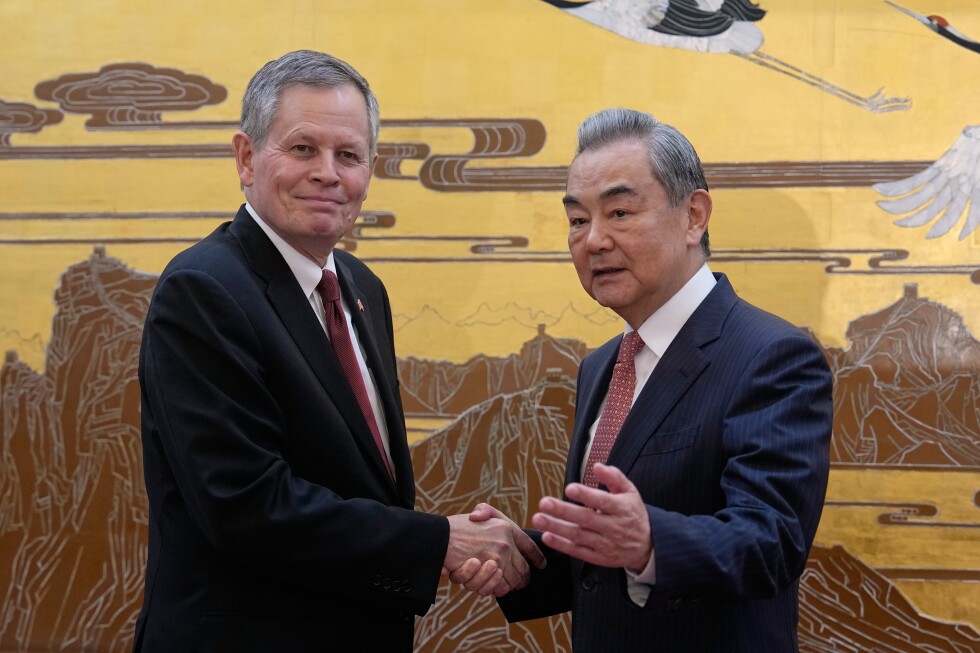
BEIJING – One week ahead of a highly anticipated bilateral summit between U.S. President Donald Trump and Chinese President Xi Jinping, senior diplomatic and political leaders from both nations have issued public statements emphasizing a commitment to preserving overall stable bilateral relations, even amid acknowledged ongoing disruptions. On Thursday, Chinese Foreign Minister Wang Yi, China’s highest-ranking diplomatic official, addressed a visiting bipartisan U.S. congressional delegation led by Senate Foreign Relations Committee member Steve Daines, a Montana Republican and prominent ally of President Trump.
Wang opened the discussion by framing the trajectory of China-U.S. ties over the preceding year, noting that while the relationship has navigated significant twists and unplanned disruptions, it has remained anchored in overall stability. He specifically credited both President Xi Jinping and President Trump for providing critical directional guidance to the bilateral relationship at key inflection points, and called on both nations to collaborate on a shared path forward that advances global peace and security.
Senator Daines echoed Wang’s call for stability, reiterating that Washington’s priority lies in de-escalating existing tensions rather than pursuing full economic decoupling from the world’s second-largest economy. “I strongly believe that we want to de-escalate, not decouple. We want stability, we want mutual respect,” Daines stated during the meeting.
The Republican senator also highlighted economic opportunities that could emerge from next week’s summit, suggesting that a successful meeting could clear the way for additional Chinese purchases of Boeing commercial aircraft, a outcome that would benefit the U.S. aviation manufacturing sector. Beyond trade and economic cooperation, Daines praised China’s recent diplomatic efforts to ease rising tensions in the Middle East, particularly its work to facilitate the reopening of the Strait of Hormuz — a strategic chokepoint through which 20% of the world’s global oil supplies transits. He pointed to Wang Yi’s Wednesday meeting with Iranian Foreign Minister Abbas Araghchi as tangible evidence of China’s constructive diplomatic engagement in the region. This aligns with longstanding U.S. pressure on Beijing to leverage its economic and political influence with Iran to keep the critical waterway open, ahead of Trump’s scheduled May 14-15 visit to China.
This trip marks Daines’ second visit to China since President Trump took office, following an earlier trip in March 2025. That earlier visit took place at a moment of heightened bilateral friction, with both sides locked in disagreements over trade tariffs and cooperation to curb the illegal cross-border fentanyl trade.