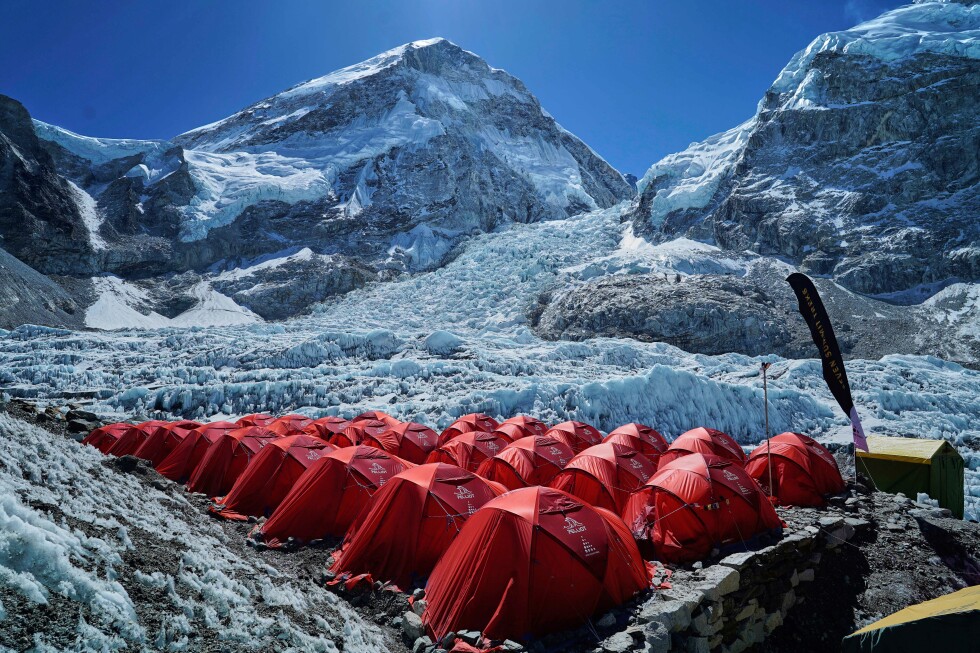
Every spring, Mount Everest draws hundreds of ambitious mountaineers to its slopes, drawn by the challenge of conquering the world’s highest peak. This year is no exception: even with a looming threat of a collapsing massive ice block, soaring expedition expenses and increased government permit fees, around 820 total climbers and experienced Nepali Sherpa guides are gathered at Everest’s 5,300-meter base camp, preparing for their ascent during the narrow annual window of favorable spring weather.
Climbers began arriving at base camp last month, but progress up the mountain stalled for more than two weeks due to a giant unstable ice formation, called a serac, that hangs directly over the Khumbu Icefall — the treacherous first section of the route to the summit, located just above base camp. This constantly shifting glacier is widely regarded as one of the most dangerous segments of any Everest ascent, dotted with deep hidden crevasses and massive overhanging ice blocks that can reach the size of 10-story buildings.
Each year, a specialized team of veteran Nepali guides known as “icefall doctors” — deployed by the Sagarmatha Pollution Control Committee (SPCC) — clears and secures the route, installing fixed ropes and aluminum ladders across gaping crevasses. The team typically completes this critical work by mid-April, but unpredictable glacial shifts this year delayed the route opening until April 29. Even after opening the path, SPCC issued an urgent warning to all climbing teams: the oversized serac carries multiple deep cracks and could collapse at any moment, requiring extreme caution from all who pass. The newly carved route still passes directly beneath the unstable ice formation, as the serac is too large to avoid entirely.
Veteran mountain guide Lukas Furtenbach, who is leading an expedition of 40 international climbers supported by 101 guides and Sherpas, called the serac a tangible, unavoidable danger. “Anyone who says they’re not concerned is either inexperienced or not paying attention,” Furtenbach told reporters from base camp. He noted that this year’s route is more technically complex and more exposed to falling ice than the 2023 path, with glacial melt forcing the trail into a precarious alignment directly under unstable glacial features. To mitigate risk, Furtenbach’s team has cut the weight each climber carries through the icefall, limited the time climbers spend in the hazard zone, restricted crossings to carefully timed windows, and delegated risk assessment only to the most seasoned Sherpa guides.
Other leading expedition operators echo the call for caution. Ang Tshering Sherpa, a senior leader of Kathmandu-based Asian Trekking, explained that timing crossings reduces risk: early morning travel is safer because freezing temperatures lock the ice in place, while warmer afternoon temperatures increase melt and the risk of falling ice debris. “It is very necessary to be cautious this year,” he emphasized.
The hazard comes amid a grim history of deadly serac accidents on the Khumbu Icefall: a collapsing serac triggered a massive avalanche in 2014 that killed 16 Nepali climbing guides and support workers. The increased glacial instability this year aligns with broader scientific warnings about accelerating Himalayan glacial melt driven by climate change. In 2023, United Nations Secretary-General António Guterres visited Nepal’s glacial mountains and warned that Himalayan glaciers are melting at a devastating, unprecedented rate that poses severe risks to mountain communities and mountaineers alike.
Despite the multiple risks and growing costs, climber turnout remains strong this spring climbing season. Ang Tshering Sherpa noted that while conflicts including the Iran war and rising global travel prices have reduced the number of climbers from Western nations such as the U.S. and Western Europe, this drop has been offset by a sharp increase in climbing participation from Asian mountaineers. This season also sees all climbing attempts concentrated on Nepal’s southern side of the mountain: Everest straddles the Nepal-China border, but China has closed its northern route to foreign climbers for 2024, directing all summit attempts to Nepal.
Since the first recorded successful ascent by New Zealander Edmund Hillary and Nepali Sherpa Tenzing Norgay on May 29, 1953, thousands of mountaineers have reached Everest’s 8,849-meter summit, and the draw of the world’s highest peak remains undiminished, even in the face of growing climate-driven risks.