Three and a half decades of explosive growth have reshaped Pudong, turning what was once a low-key, underdeveloped riverside district on the banks of the Huangpu River into one of the world’s most dynamic financial centers and global innovation hubs. To capture this extraordinary evolution in a refreshing, approachable way, a new creative video project frames Pudong’s 36-year journey through the whimsical perspective of an adventurous, curious kitten. This feline guide embarks on a magical time-travel trip, stepping across different eras of the district’s development to show audiences the dramatic shift from dusty early construction sites to the cutting-edge connected metropolis that stands today. Along the journey, the kitten visits landmark milestones that have become synonymous with Pudong’s rise: from the groundbreaking construction of the iconic Oriental Pearl Tower, the first major skyline-defining structure that signaled Pudong’s opening-up to the world, to the modern-day expansion of high-tech digital infrastructure that has turned the district into a leading model for smart and sustainable urban development. Seen through the playful, wide-eyed lens of this time-traveling kitten, Pudong’s decades-long transformation does not just tell a local success story — it mirrors the broader, rapid evolution of Shanghai across key sectors, including global finance, cutting-edge technological innovation, and forward-thinking sustainable urban planning. For viewers curious to trace the steps of this unique tour and see how Pudong continues to grow and adapt to new global challenges, the full video is available to watch online, offering a lighthearted yet compelling look at one of the most famous urban development success stories in modern history.
标签: Asia
亚洲
-

Iran’s supreme leader says navy ready to inflict ‘new bitter defeats’ on enemies
TEHRAN – On Iran’s annual Army Day, April 18, Supreme Leader Mojtaba Khamenei delivered a stark message warning the United States and Israel that the Islamic Republic’s naval forces are fully prepared to deliver crippling new defeats to the nation’s adversaries, according to Iran’s official state news agency IRNA.
In his public address marking the holiday, Khamenei heaped praise on Iran’s military for its persistent resistance against what the regime frames as hostile foreign powers, specifically highlighting the military’s successful drone operations targeting U.S. and Israeli-linked assets as a demonstration of the country’s growing defensive and offensive capabilities.
The comments come amid long-running regional tensions that have kept relations between Iran, the U.S. and Israel at historically low levels, with heightened military posturing across the Persian Gulf and wider Middle East in recent years. Already, the Strait of Hormuz, a critical global energy chokepoint that accounts for roughly a fifth of the world’s oil shipments, has emerged as a frequent flashpoint between Iran and Western powers, with a U.S. blockade on the waterway contributing to heightened frictions. Khamenei’s remarks mark the latest high-profile escalation of rhetoric between Tehran and its Western and regional foes, underscoring the Iranian leadership’s commitment to maintaining a robust military deterrent in the face of sustained external pressure.
-

Iran signals re-closure of Hormuz as it rejects uranium transfer abroad
A fresh standoff between the United States and Iran has thrown the strategically critical Strait of Hormuz back into crisis, as Tehran rejected Washington’s unsubstantiated claims of a planned enriched uranium transfer and threatened to reclose the global energy chokepoint if the U.S. naval blockade on Iranian ports remains in place. The escalation unfolded Saturday even as a small group of commercial vessels began transiting the waterway, marking days of fragile progress that has been put at sudden risk.
The chain of tensions traces back to a U.S.-brokered 10-day ceasefire that halted Israel’s ongoing war in Lebanon, which prompted Iran to end its initial closure of the Strait of Hormuz this past Thursday. But just one day later, U.S. President Donald Trump announced that the American naval blockade imposed on Iranian ports earlier this week would remain in force until a comprehensive final agreement is reached between the two nations.
In the wake of Trump’s announcement, Iran quickly reversed its earlier stance on opening the strait. Parliamentary Speaker Mohammad Bagher Ghalibaf emphasized in a post on X that the waterway would not stay open as long as the U.S. blockade remains in place. “What they call a naval blockade will definitely be met with an appropriate response from Iran,” Ghalibaf wrote. As of overnight, U.S. Central Command confirmed it had ordered at least 21 ships to turn away from the region since the blockade was first implemented.
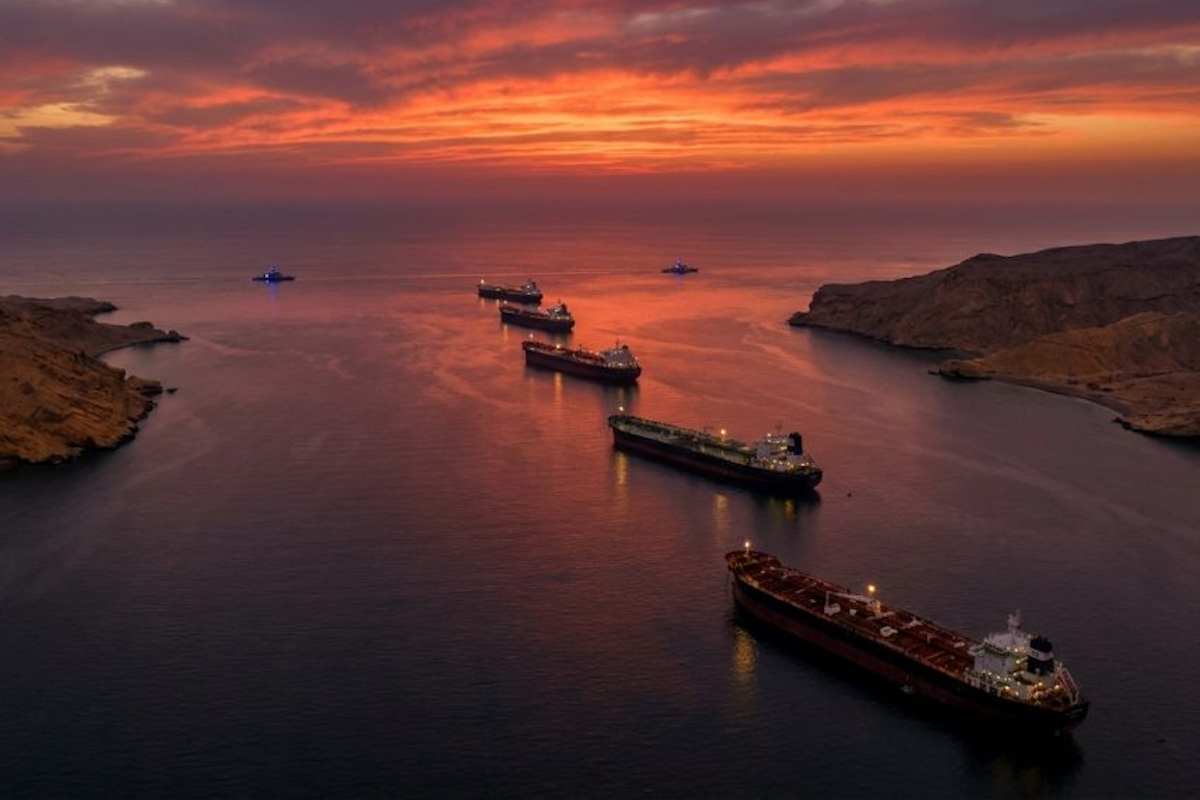
Hours before Iran issued its new threat, a convoy of eight commercial vessels — including one very large crude carrier (VLCC), oil product tankers, chemical carriers, and liquefied petroleum gas (LPG) carriers — was observed transiting Iranian waters south of Larak Island on Saturday morning, with additional vessels anchored in the Gulf preparing to follow the convoy. A spokesperson for Iran’s Islamic Revolutionary Guard Corps had previously stated that the limited passage was permitted under temporary negotiation terms, though it remains uncertain whether the initial convoy will be allowed to complete its full transit.
The Strait of Hormuz is widely recognized as the world’s most important energy chokepoint, carrying roughly one-fifth of the global supply of crude oil and liquefied natural gas. The International Energy Agency has already warned that any extended closure would trigger the largest global energy supply disruption in history: cutting more than 10 million barrels of daily oil output and reducing global LNG supplies by 20 percent.
Beyond the strait standoff, Tehran has issued a firm denial of a separate claim made by Trump Friday, in which the U.S. president stated that Iran had agreed to transfer its stockpile of enriched uranium to the United States. Trump told supporters at an Arizona rally that the U.S. would “very soon” retrieve what he called “nuclear dust” remaining from U.S.-Israeli strikes on Iranian nuclear sites in June 2024. “We’re going to get it together. We’re going to go in with Iran, at a nice leisurely pace, and go down and start excavating with big machinery… We’ll bring it back to the United States,” Trump said.
Iran’s foreign ministry spokesperson Esmaeil Baghaei rejected the claim outright in comments to state television, saying: “Iran’s enriched uranium is not going to be transferred anywhere. Transferring uranium to the United States has not been an option for us.” Currently, Iran is estimated to hold more than 900 pounds of uranium enriched to 60 percent purity, just a step away from weapons-grade material. The Trump administration has repeatedly listed preventing Iran from developing a nuclear weapon as a core war goal, while Iran has consistently maintained its uranium enrichment program is exclusively for peaceful civilian energy and medical purposes.
Negotiations between the two sides have also hit snags over other key sticking points, including the unfreezing of billions of dollars in Iranian assets held abroad. A senior Iranian official told Reuters that a preliminary agreement had been reached on the issue, but Trump denied any such deal Friday, saying “no money will exchange hands in any way, shape or form.” On nuclear terms, Washington has proposed a 20-year full suspension of all Iranian nuclear enrichment activity, while Tehran has countered with an offer of a three to five-year pause, according to anonymous sources familiar with the talks cited by Reuters. Two Iranian sources have noted preliminary signals of a possible compromise that would see part of Iran’s uranium stockpile removed, but no formal deal has been announced.
The broader conflict that sparked this crisis began on February 28, when the U.S. and Israel launched a massive coordinated barrage of strikes on Iranian targets across the Islamic Republic. Tehran responded with its own strikes against Israeli and Gulf targets, and the initial closure of the Strait of Hormuz. Days after the conflict began, Israel launched a ground invasion of Lebanon, which has killed more than 2,000 Lebanese people to date.
As tensions spike again, regional powers are ramping up diplomatic efforts to de-escalate. Pakistan concluded two parallel high-level diplomatic visits Saturday aimed at securing a permanent end to the conflict. Pakistani Army Chief Asim Munir completed a three-day visit to Tehran, where he held meetings with Iran’s president, foreign minister, parliament speaker, and top military commanders, according to an official statement from the Pakistani military. Separately, Pakistani Prime Minister Shehbaz Sharif wrapped up a three-day tour of Saudi Arabia, Qatar, and Turkey focused on building regional consensus for a peace deal.
A second round of direct high-level talks between the U.S. and Iranian delegations is scheduled to take place in Islamabad next week. The first round, held last week, marked the highest-level face-to-face diplomatic engagement between the two nations in decades, with Ghalibaf and Iranian Foreign Minister Abbas Araghchi leading the Iranian delegation to the Pakistani capital.
-

Around 600 delegates attend opening ceremony of 2026 Henan Entrepreneurs Convention
China’s central Henan province launched its 2026 Henan Entrepreneurs Convention on Saturday, with an opening ceremony held in the provincial capital Zhengzhou that brought together nearly 600 industry leaders and business representatives from across the country and beyond. Centered on the official theme “New Development of Henan, New Opportunities”, the annual gathering is designed to highlight the province’s evolving economic landscape and unlock new collaborative growth opportunities for domestic and international stakeholders.
Attendees at the opening ceremony included top representatives from China’s Fortune 500 enterprises, leading sector entrepreneurs, and senior figures from national and global investment institutions, all gathering to explore partnership prospects and gain insight into Henan’s latest policy and market developments.
In a keynote address delivered at the opening ceremony, Liu Ning, Secretary of the Communist Party of China Henan Provincial Committee, outlined Henan’s strategic progress in integrating into regional and global economic cooperation frameworks. Liu noted that the province has embedded itself deeply into both the Belt and Road Initiative and Regional Comprehensive Economic Partnership (RCEP) cooperation mechanisms, developing a coordinated multimodal transport network that links air, land, and maritime Silk Road routes. This interconnected infrastructure has empowered local and foreign enterprises operating in Henan to access global markets more efficiently and secure stable positions in international industrial and supply chains, ultimately realizing the goal of “buy globally, sell globally” for businesses based in the region.
Beyond infrastructure and global connectivity, Liu emphasized that Henan’s provincial government has made continuous, targeted efforts to upgrade the province’s business environment, rolling out a series of supportive policies designed to foster the sustainable long-term growth of Henan-based merchants and enterprises. The convention is expected to serve as a key platform to showcase these improvements, attract new investment, and strengthen ties between Henan and business communities nationwide.
-

Hormuz standoff sets a tense tone for Trump-Xi meet
The Persian Gulf has been pushed into uncharted, high-risk territory following the Trump administration’s decision to impose a naval blockade on the Strait of Hormuz, a strategic chokepoint that carries roughly one-fifth of the world’s daily oil shipments. The controversial measure was announced by former President Donald Trump after ceasefire negotiations with Iran collapsed on April 11, with the breakdown rooted in Iran’s refusal to relinquish its claimed control over the strait. Washington’s blockade is explicitly framed to counter two Iranian moves: Tehran’s plan to block passage for vessels it considers hostile, and its proposal to implement a new transit toll system for all commercial ships passing through the waterway.
Beyond its stated goal of countering Iran, the blockade marks a deliberate show of force by the Trump administration that directly challenges Beijing. In recent years, China has emerged as the largest buyer of Iranian crude oil, and it is one of the only countries whose commercial shipping has been able to transit the strait without interference from regional forces. This special status was put to an early test on April 14, when the Rich Starry, a Chinese-owned and operated tanker already under US sanctions for carrying Iranian oil, prepared to make the passage. While many observers expected a direct confrontation between the tanker and US naval forces deployed to the region, the vessel ultimately reversed course in the Gulf of Oman and turned back. US officials have since confirmed that six vessels attempting to transit the strait have been turned away under the blockade.
The Rich Starry’s decision to avoid confrontation has been widely interpreted as a signal that Beijing is not yet willing to directly challenge Washington’s stated red lines in the region, particularly ahead of a planned US presidential state visit to China scheduled for next month — a trip that was originally postponed from March 31 amid escalating tensions with Iran. Beijing has already publicly condemned the US blockade, labeling it a “dangerous and irresponsible act” that threatens global energy security. Even so, the decision to step back from a direct clash may be read by Washington as a sign of Chinese reluctance to escalate, a perception that analysts warn could embolden the Trump administration to take more aggressive action against Chinese shipping in the region going forward.
Any attempt by the US to seize a Chinese-flagged or Chinese-owned tanker carries severe escalation risks. If Washington moves to seize a vessel, Beijing could easily characterize the action as an act of war, framing it as a deliberate attempt to disrupt the Chinese economy by cutting off critical energy supplies. While a direct armed confrontation between the United States and China in the Persian Gulf remains unlikely at this stage, the crisis has already spurred speculation that Beijing could deploy its 48th Escort Group, based at its military facility in Djibouti, to the region. The unit has long conducted anti-piracy patrols and escort missions for Chinese commercial ships in the Gulf, and its deployment would raise a pressing new question: would Washington be willing to open fire on Chinese naval vessels to enforce its blockade?
Beyond direct naval confrontation, China has multiple indirect options to respond to the US move. One widely discussed path is increased military support for Iran. Unconfirmed intelligence reporting from The New York Times has alleged that Beijing has already shipped shoulder-launched anti-aircraft missiles to Tehran, a claim that Chinese officials have repeatedly and forcefully denied. China’s Beidou satellite navigation system is already known to provide positioning support for Iran’s existing missile arsenal, which is targeted at US and Israeli assets in the region. Additional transfers of advanced weapons, including long-range missiles and attack drones, would allow Beijing to counter the US blockade without direct engagement.
Alternative, Beijing could choose to retaliate against US interests outside the Middle East, targeting American economic and strategic assets in the Asia-Pacific. The current context plays into this possibility: the US has already redeployed key missile defense systems from South Korea to the Middle East, leaving American allies in the Asia-Pacific more exposed. At the same time, fuel shortages sparked by strait disruptions have already put additional economic strain on regional powers, creating more openings for Chinese action if Beijing chooses to escalate.
Despite Beijing’s stated preference for a stable Middle East and open global trade — a status quo from which China has benefited enormously from decades of globalization — the crisis also creates unique strategic and economic opportunities for China to advance its long-term goals. One of the most significant is the expansion of the renminbi’s role in global energy markets. Iran already conducts nearly all of its oil trade transactions in renminbi, accelerating the rise of the so-called petroyuan as a challenger to the decades-long dominance of the petrodollar in global energy trade. Combined with China’s position as the leading supplier of aviation fuel across the Asia-Pacific, the current crisis has already cemented China’s larger role in the global energy economy.
Another potential beneficiary of prolonged energy market disruption is China’s electric vehicle (EV) industry. A sustained oil shortage would likely push more consumers and governments to accelerate the transition to EVs, a market where Chinese manufacturers like BYD already hold a dominant global market share. Analysts draw a parallel to the 1970s OPEC oil crisis, when fuel-efficient Japanese vehicles outcompeted larger, less efficient American and European models, capturing massive global market share. A prolonged oil crisis today could similarly turn Chinese EV brands into global household names, expanding the global influence of “Brand China.”
Finally, the crisis reinforces China’s ongoing narrative that it is a more reliable and stable global partner than the United States, amid widespread perceptions of unpredictability from the Trump administration over the past 15 months. China already holds a more favorable global public image than the US in most international polling, and a wider regional conflict stemming from the blockade would likely widen that gap further. In the end, the course taken by the Rich Starry may end up charting the future trajectory of US-China great power competition, and the shape of the global order that competition will produce.
-

China-US youth mark 55th anniversary of ‘ping-pong diplomacy’
Fifty-five years after a historic table tennis exchange broke decades of ice between China and the United States, young players from both nations gathered in Yinchuan, the capital city of northwest China’s Ningxia Hui Autonomous Region, on Thursday to honor the legacy of what is now widely known as “ping-pong diplomacy”.
Organized around the shared passion for table tennis that first connected the two peoples half a century ago, the commemorative event brought together young collegiate table tennis athletes from Northwestern United States and eight elite young players from China. Rather than sticking to rigid, country-versus-country competition formats, organizers reimagined the tournament to reflect the core values of the original diplomatic breakthrough: connection and mutual understanding.
All players were split into two mixed transnational squads, named “Peace” and “Friendship”. In a symbolic twist that embodied the event’s spirit of cooperation alongside friendly competition, athletes paired with cross-national partners for doubles matches, and faced off against peers from the other country in singles rounds. This structure encouraged collaboration even as it highlighted the players’ sharp competitive skills.
Throughout the day, participants displayed remarkable technical proficiency and exemplary sportsmanship, drawing warm, sustained applause from the local audience that turned out to watch the historic commemoration. Moving away from traditional hierarchical medal ceremonies that prioritize winning above all else, every athlete at the event received a custom commemorative medal in recognition of their role in advancing people-to-people exchange.
Beyond the confines of the competition court, the gathering functioned as an informal platform for deep cultural exchange. Players discussed table tennis technique, swapped recommendations for favorite films, and shared personal stories, small interactions that helped bridge lingering cultural gaps and build new personal connections between the younger generations of both nations. Organizers noted that the event echoes the original 1971 ping-pong diplomacy, which proved that people-to-people exchange can lay the groundwork for greater mutual understanding between nations, even when official relations face challenges.
-

Strait of Hormuz ‘open to commercial vessels’
A 10-day ceasefire between Israel and Hezbollah entered into force on Friday, April 17, 2026, spurring tentative de-escalation efforts across the Middle East that have already cleared the way for the full reopening of the strategically critical Strait of Hormuz to global commercial shipping. The breakthrough, brokered through behind-the-scenes diplomacy between the United States and Iran with Pakistan serving as a neutral mediator, has offered a glimmer of hope to thousands of displaced Lebanese residents, though deep divisions and unresolved core issues leave the truce highly vulnerable to collapse.
Within hours of the ceasefire taking hold, both Washington and Tehran confirmed that the Strait of Hormuz — a chokepoint through which roughly 20% of the world’s global oil supplies transit daily — is now fully accessible for commercial vessel passage. In a post on Truth Social, U.S. President Donald Trump confirmed the reopening, emphasizing that the American military’s unilateral naval blockade on Iranian cargo will remain in place until a final bilateral agreement between the two nations is fully finalized. “The Strait of Hormuz is completely open and ready for business and full passage, but the naval blockade will remain in full force and effect as it pertains to Iran, only, until such time as our transaction with Iran is 100 percent complete,” Trump wrote in all caps.
Iranian Foreign Minister Abbas Araghchi mirrored the announcement just minutes before Trump’s post, sharing on X that the waterway’s opening aligned with the new Lebanon ceasefire and would remain in effect for the full duration of the truce. Hezbollah lawmaker Ibrahim al-Moussawi later reinforced the link between the two developments, noting that the ceasefire would not have been possible without Iranian diplomatic pressure on Lebanon’s behalf, and that Tehran views the truce as equivalent to the decision to reopen the strait.
On the ground in Lebanon, celebratory gunfire rang out across Beirut’s southern suburbs, Hezbollah’s traditional stronghold, as displaced families packed their belongings and began the journey back to their war-ravaged homes in southern Lebanon. For many returnees, the joy of the ceasefire was tempered by the scale of destruction left by weeks of fighting. “There’s destruction and it’s unlivable. We’re taking our things and leaving again,” Fadel Badreddine, who returned to survey his home with his wife and young son, told Reuters. “May God grant us relief and end this whole thing permanently.”
Despite the initial calm, the ceasefire remains extraordinarily fragile. The Israeli military confirmed it had struck more than 380 Hezbollah targets across southern Lebanon in the lead-up to the truce, and remains on high alert to resume offensive operations at a moment’s notice. Israeli Prime Minister Benjamin Netanyahu has ruled out any withdrawal of Israeli troops from southern Lebanon, stating that the full disarmament of Hezbollah is a non-negotiable precondition for any long-term “historic peace agreement” between Israel and the Lebanese state. Al-Moussawi responded that Hezbollah will uphold its end of the truce so long as Israel halts all offensive attacks.
Multiple regional and global stakeholders have welcomed the ceasefire, including Saudi Arabia and Oman, two key Gulf states with deep interests in regional stability. Riyadh has reaffirmed its unwavering support for Lebanese territorial integrity and national sovereignty, while Muscat has called on all parties to exercise restraint and avoid any actions that would violate the truce terms. Iran’s foreign ministry framed the ceasefire as a first step toward a broader regional de-escalation pact reached with the U.S. via Pakistani mediation.
The conflict between Israel and Hezbollah, which erupted on March 2, has already claimed more than 2,000 lives to date, displacing hundreds of thousands of people on both sides of the border. Political analysts warn that a path to lasting peace remains elusive. Abed Abou Shhadeh, a Jaffa-based Israeli political commentator, noted that Israel has failed to achieve its core goal of disarming Hezbollah, and lacks a clear political roadmap for a lasting settlement with Lebanon. “History over the past 40 years has proven this is not something Israel can achieve,” Abou Shhadeh said. “The military recently acknowledged that fully disarming Hezbollah would require occupying all of Lebanon — a mission it lacks the troop strength to carry out.”
For his part, Trump has announced that he held “excellent conversations” with both Netanyahu and Lebanese President Joseph Aoun, and has extended an invitation to both leaders to travel to the White House for high-stakes talks aimed at cementing a long-term deal. The U.S. president also added that if a final U.S.-Iran agreement is finalized in the Pakistani capital of Islamabad, he would be willing to travel there to attend the signing ceremony.
Regional policy experts say Trump’s push for a rapid deal stems from a desire to avoid deeper U.S. entanglement in the Middle East ahead of potential broader fallout for global energy markets. “Trump is seeking an exit ramp from the Iran war before it brings greater repercussions for the US and the global energy market,” said Abas Aslani, a senior fellow at the Center for Middle East Strategic Studies in Tehran, speaking to Al Jazeera. “But it wouldn’t secure any strategic outcome for the US. There are some gaps that need to be bridged, but those differences remain.”
In recent weeks, Trump has repeatedly stated that the conflict with Iran will end soon, but independent analysts say there is little concrete evidence to support that claim. U.S. Defense Secretary Pete Hegseth issued a sharp warning on Thursday, threatening that if Iran rejects a final deal, the U.S. military will launch targeted strikes against Iran’s critical infrastructure, including its national power grid and energy sector. Clay Ramsay, a researcher at the Center for International and Security Studies at Maryland, argued that the current U.S. administration is not positioned to negotiate a comprehensive, lasting settlement. “Trump has a political incentive to claim peace on his terms is imminent. That does not make it a reality,” Ramsay told Xinhua.
-

CSSC’s rotor sail aims to drive global green ship tech
As the global push for decarbonization reaches every corner of industrial activity, the international shipping sector — a long-contributing source of global carbon emissions — is facing mounting pressure to green its operations. Now, China State Shipbuilding Corp (CSSC), the world’s largest shipbuilding group, has delivered a major breakthrough in wind-assisted propulsion technology with the development of one of the world’s largest commercially viable rotor sail systems, built to capture growing global demand for sustainable shipping solutions.
Designed and developed by CSSC’s Luoyang Ship Material Research Institute, an R&D center specializing in advanced shipbuilding materials and engineering techniques, the unnamed new rotor sail has already completed a full suite of ground-based system tests, clearing a key milestone ahead of commercial deployment. Engineers leveraged the institute’s deep existing expertise in green composite materials and wind turbine blade design to refine the system’s performance and durability, resulting in a cutting-edge product that outperforms many smaller existing rotor sail models on the market.
Standing 35 meters tall with a diameter of 5 meters, the new system ranks among the largest rotor sail designs ever brought to testing phase. Each unit can reach a maximum rotational speed of 180 revolutions per minute, generating over 355 kilonewtons of thrust to help propel fitted vessels. For context, rotor sails — also known as Flettner rotors — operate on a simple but effective physical principle: upright spinning cylinders mounted on a ship’s deck interact with surrounding wind flow to create usable thrust, reducing the need for fossil fuel-powered propulsion.
First invented in the 1920s, rotor sail technology saw extremely limited adoption for nearly a century, deployed only on a small handful of cargo ships and experimental test vessels before the 2010s. But as the global shipping industry, which moves more than 80% of world trade volume by volume and accounts for roughly 3% of global carbon emissions, has faced growing mandatory decarbonization requirements, the technology has experienced a rapid renaissance. Today, rotor sails are increasingly being integrated into commercial vessels ranging from bulk carriers to roll-on/roll-off ships.
Feng Wei, project manager for the new CSSC rotor sail, outlined the urgency of decarbonization in a press briefing Friday, noting that the green transition in shipping has evolved from an optional sustainability measure to a mandatory global requirement aligned with international climate goals. “Wind-assisted propulsion represents one of the most promising and practical pathways for the shipping industry to achieve immediate emission reductions,” Feng said.
Unlike other wind-assisted propulsion technologies, Feng explained, rotor sails offer unique practical benefits that make them ideal for widespread commercial adoption. They take up minimal deck space, do not interfere with standard cargo loading and unloading operations, operate with a high degree of automation, and require almost no modifications to a vessel’s original structure or standard operating procedures. These characteristics make them suitable for installation across most major commercial vessel types, including bulk carriers and oil tankers, with average fuel savings ranging from 5% to 25% per voyage.
Beyond emission reductions, the system delivers tangible economic benefits for shipowners: it helps buffer against volatile global oil prices and cuts down on future carbon tax expenses that will come into force as international decarbonization regulations tighten. The new design also incorporates a network of smart exterior sensors, boosting its automation capabilities and making it exceptionally easy to control and maintain.
Industry projections from leading global research organizations cited by Feng forecast that around 7,000 ships worldwide will be fitted with wind-assisted propulsion systems by 2030, with that number jumping to roughly 21,000 by 2050. CSSC’s new large-format rotor sail positions the Chinese shipbuilding giant to capture a substantial share of this fast-growing global green shipping technology market, while supporting the global shipping industry’s collective push to cut carbon emissions and meet international climate targets.
-

Shenzhou XXI crew complete third spacewalk
China’s ongoing human space exploration program reached a new milestone earlier this week, when the three-person Shenzhou XXI crew stationed at the nation’s Tiangong space station successfully wrapped up their third extravehicular activity, according to official announcements from the China Manned Space Agency.
The excursion, which concluded at 1:36 a.m. Beijing Time on Friday, saw mission commander Senior Colonel Zhang Lu and spaceflight engineer Major Wu Wu spend roughly five and a half hours operating outside the massive orbiting outpost before returning safely to the Wentian experimental module. The third member of the crew, payload specialist Zhang Hongzhang — a researcher from the Chinese Academy of Sciences — remained inside the space station throughout the spacewalk to coordinate operations and provide critical in-orbit support.
Working in tandem with ground control teams and leveraging the station’s robotic arm for assistance, the astronauts checked off every scheduled task on their itinerary, including the installation of protective shields designed to mitigate damage from orbital space debris and comprehensive inspections of extravehicular hardware.
This spacewalk carries special historical significance for China’s human space program: it marks the 27th extravehicular activity conducted by Chinese taikonauts overall, and it is the seventh spacewalk for commander Zhang Lu. With this milestone, the 49-year-old Hunan-born astronaut has become the new record holder for the most spacewalks completed by any Chinese astronaut. Zhang previously completed four spacewalks during his first mission, the six-month Shenzhou XV expedition that launched in November 2022.
The Shenzhou XXI mission is China’s 16th crewed spaceflight, and the trio has served as the 10th long-term resident crew aboard Tiangong, currently the only operational space station fully developed and operated independently by a single nation. The crew has now lived and worked in low-Earth orbit for more than five months, having arrived at the station on November 1, 2025.
Over the course of their stay, Zhang Lu and his crewmates have carried out a wide range of work, from cutting-edge scientific experiments in space life science, human physiology and microgravity physics to routine maintenance and operations. These routine tasks include in-orbit environmental monitoring, regular equipment checks and upkeep, and organization of cargo delivered to the station. The team has also completed required emergency preparedness training, including a full-system pressure emergency response drill and on-orbit emergency survival training, alongside all pre-deployment preparations for extravehicular activities.
In a surprise announcement included in the agency’s news release, officials confirmed that after comprehensive technical analysis and risk assessment, the Shenzhou XXI mission will be extended by approximately one additional month. The adjustment is designed to further test and validate key technologies required for long-duration human spaceflight, and to allow the crew to make full use of additional mission supplies and materials transported to the station by the uncrewed Shenzhou XXII spacecraft.
Shenzhou XXII launched in late November 2025 on an uncrewed resupply mission to Tiangong, dispatched after a window damage incident affected the return capsule of the earlier Shenzhou XX mission during its reentry. In addition to delivering critical replacement hardware, the spacecraft carried a large volume of additional mission supplies to support extended operations aboard the station.
Looking ahead, the CMSA confirmed that the Shenzhou XXI crew will continue carrying out their ongoing scientific research and technical tasks for the duration of their extended stay, advancing China’s growing body of knowledge about long-duration human spaceflight and orbital operations.
-

Ningxia eyes big push for intl tourism
Against the backdrop of a post-pandemic global travel recovery and growing demand for unique, experience-focused cultural getaways, Northwest China’s Ningxia Hui Autonomous Region is launching an ambitious push to position its one-of-a-kind combination of ancient heritage, world-class wine production, and dramatic natural landscapes as a must-visit destination for international travelers. The strategic initiative comes on the heels of a major milestone for the region: the 2025 inscription of the Xixia Imperial Tombs on the UNESCO World Heritage List, a recognition that has significantly boosted Ningxia’s profile on the global tourism map.