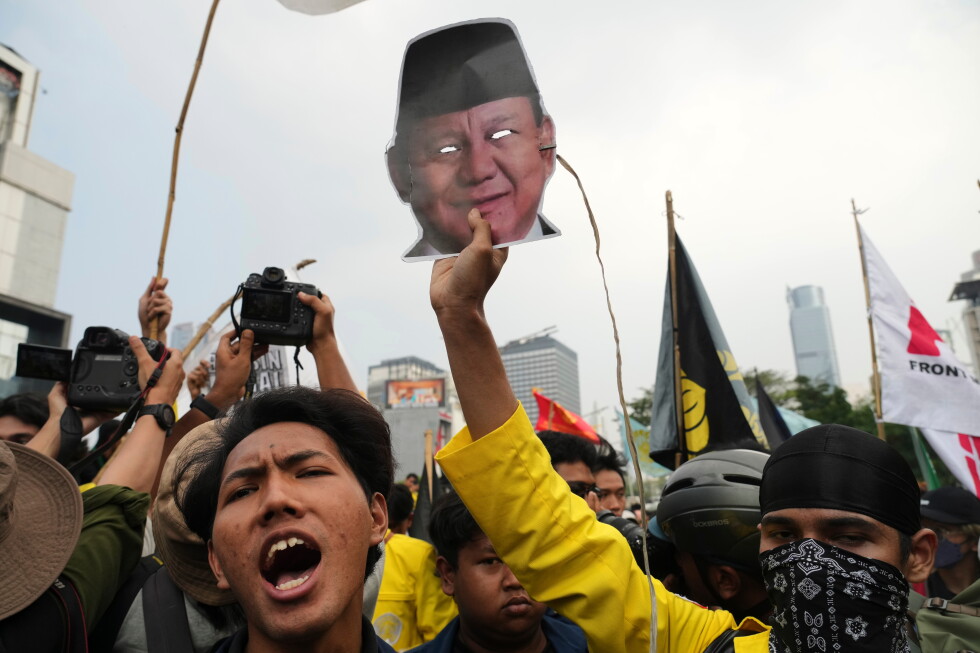
Amid growing economic strain that has squeezed household budgets across Southeast Asia’s largest democracy, hundreds of university students took to the streets of Indonesia’s capital Jakarta on Friday to deliver a clear message to the administration of President Prabowo Subianto: rein in soaring prices and roll back costly, controversial public spending programs.
Organized by a national student coalition, the demonstration drew roughly 1,500 participants, most clad in their institutions’ signature yellow university jackets, who gathered following weekly Friday prayers with plans to march to the iconic Hotel Indonesia traffic circle, a historic gathering point for public demonstrations in central Jakarta. Security forces, however, moved quickly to impede the group’s progress, blocking key arterial routes leading to the Indonesian presidential palace — the traditional end point for most major Jakarta protests — and diverting crowds away from central government hubs. In total, more than 6,000 combined police and military personnel were deployed across the capital to manage the demonstration.
Protesters anchored their grievances in the rapidly rising cost of living, a crisis they trace largely to global oil price shocks triggered by the U.S.-Iran conflict that has driven up domestic fuel prices across Indonesia. Compounding these economic pressures, the Indonesian rupiah has faced severe downward pressure on global currency markets, hitting an all-time low of 18,000 rupiah to the U.S. dollar earlier this month, further inflating prices for imported goods and basic necessities.
The rally organizers laid out five core demands for the Prabowo administration, starting with immediate cuts to what they label wasteful and excessive state spending. Top of their list for rollback are two flagship government programs: a widely publicized free nutritious meal initiative and a national rural revitalization scheme. The free meals program, which carries an annual price tag of 268 trillion rupiah (equivalent to roughly $15 billion) for 2024 alone, was originally designed to tackle widespread poverty and childhood malnutrition. But the initiative has been plunged into scandal in recent weeks, after Prabowo dismissed the program’s national director amid a sweeping high-level corruption investigation that has already resulted in multiple arrests of senior nutrition agency officials.
Beyond economic demands, protest leaders also called for an end to what they describe as the expanding role of the military in civilian governance — a shift they warn poses a direct threat to Indonesia’s young democratic institutions, which only transitioned away from authoritarian rule in 1998.
Yatalathof Ma’shum Imawan, chair of the student organization that coordinated the Jakarta rally, accused the Prabowo administration of refusing to confront the severity of the country’s ongoing economic crisis. “The government is in denial about the current situation,” Imawan told reporters on site. “We urge Prabowo to have the courage to acknowledge his mistake and stop denying it.”
Friday’s protest is one of the largest coordinated student mobilizations the country has seen since major nationwide demonstrations erupted last August. That wave of unrest saw thousands of Indonesians take to streets across the archipelago, with violent clashes between protesters and security forces leaving at least 13 people dead. Friday’s action was not limited to the capital: parallel demonstrations were also held in the West Java city of Bandung and in Pontianak, a major urban center on Indonesia’s Borneo island, showing growing discontent with economic policy among young people across the country.