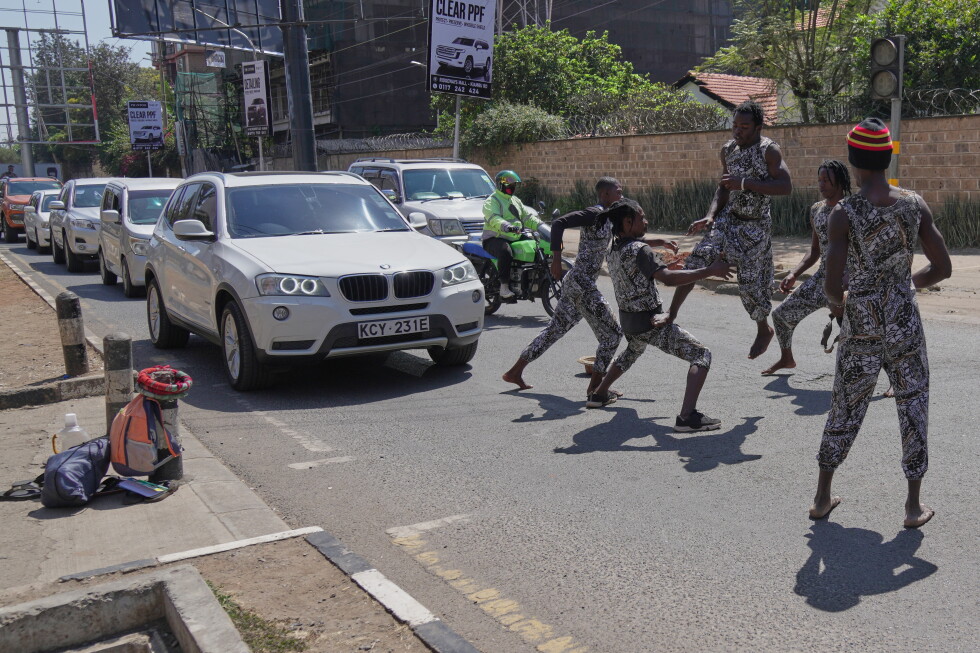
At a congested crossroads in downtown Nairobi, the glow of the red stop light signals not just a pause for traffic, but the opening curtain for a unique street performance. A young performer in a hand-dyed leopard print costume steps off the curb and launches into a series of flips and somersaults, quickly joined by five fellow acrobats who pull off a tightly choreographed sequence of gravity-defying stunts. While the team keeps the routine moving, one member weaves between idling vehicles, juggling woven hats before holding one out to drivers in a quiet plea for tips. As soon as the light flicks back to green, the group melts back to the curb, clearing the road for the rush of moving cars, waiting for the next red light to start their act again.
This informal street performance scene has become a common sight across Nairobi’s busy corridors, a livelihood born out of the economic upheaval of the COVID-19 pandemic. The city’s traffic acrobats first emerged in 2020, when widespread lockdowns and job losses pushed thousands of young Kenyans to seek new ways to earn an income. Today, they have turned the capital’s notorious permanent gridlock into a stage, trading their acrobatic skills for small cash donations from motorists.
For 22-year-old Mohammed Nyale, this street routine is more than just a way to get by—it is the first step toward a lifelong dream. Nyale began practicing acrobatics when he was just 15 years old, and fell in love with the craft immediately. He and his troupe left their coastal hometowns, lured to Nairobi with ambitions of performing in packed theater venues and landing professional on-stage careers. So far, the streets have been the only stage they can access, but they have not abandoned their goals.
Each day follows the same rhythm for Nyale and his group. They gather before dawn in an overgrown abandoned field in Kawangware, one of Nairobi’s most underprivileged informal settlements, to run through their routines and sharpen their stunts. As morning rush hour clogs the city’s main roads, they move to their chosen intersection. Before putting on their performance costumes, they gather for a group prayer for a good day of earnings. They perform in shifts until noon, with one member collecting tips while the rest of the troupe puts on the show.
Most tips are small, rarely more than 50 Kenyan shillings, equal to roughly 40 U.S. cents. To adapt to Kenya’s nearly cashless mobile payment culture, the acrobats hand out small slips of paper printed with their mobile wallet phone numbers, allowing drivers to send donations digitally. On a strong day, each performer can walk away with around $6—enough to cover rent, food, and other basic needs, and on rare occasions, they earn even more.
That daily rate matches the average income of casual laborers working in Kenya’s construction and agriculture sectors, a benchmark that matters in a country struggling with widespread youth unemployment. Official 2024 data from the Kenya National Bureau of Statistics places the youth jobless rate between 4.9% and 9.9%, a figure that understates the number of young people struggling to find stable formal work. For Nyale, this street hustle is the only thing that makes life in Nairobi possible. “Earning money from street performances is what enables us to live in Nairobi because we moved here from quite far and no one is helping us to pay rent,” he explained.
Nyale’s group is far from the only troupe working the city’s intersections. Competing groups of acrobats have sprung up across every corner of Nairobi, each staking claim to a particularly congested intersection to call their own. On the opposite side of the city, 28-year-old Jackson Okoth leads his own troupe entertaining stopped motorists along Lang’ata Road. Okoth echoes what many of his fellow performers say: with no formal job openings available, street acrobatics keeps young people occupied and out of trouble. “There are no opportunities for us that we can go to, so we like it when we are here because it keeps us busy and it keeps us fit also,” he said. “Instead of staying at home and doing reckless things, we decided to come here and perform for motorists and pedestrians.”
Like Nyale, Okoth holds tight to a big dream: one day, he hopes to join a professional circus and tour the world, bringing his skills to audiences across Europe. “I am still on my way, I am still trying, I am still working hard so that one day things might go well, and I may find myself in Europe performing in a circus show,” he said.
Reactions from Nairobi’s motorists are split. Some drivers see the acrobats as an annoying nuisance that slows their commute and creates unnecessary chaos at busy intersections. But many others welcome the unexpected break from the frustration of sitting in traffic. Geoffrey Kioi, a local entrepreneur who regularly tips the performers, says he sees the acrobats as a welcome diversion. “They are a source of entertainment here on the road. They entertain us and we feel good,” Kioi said. “They are young people. They need to hustle. They are like my sons.”