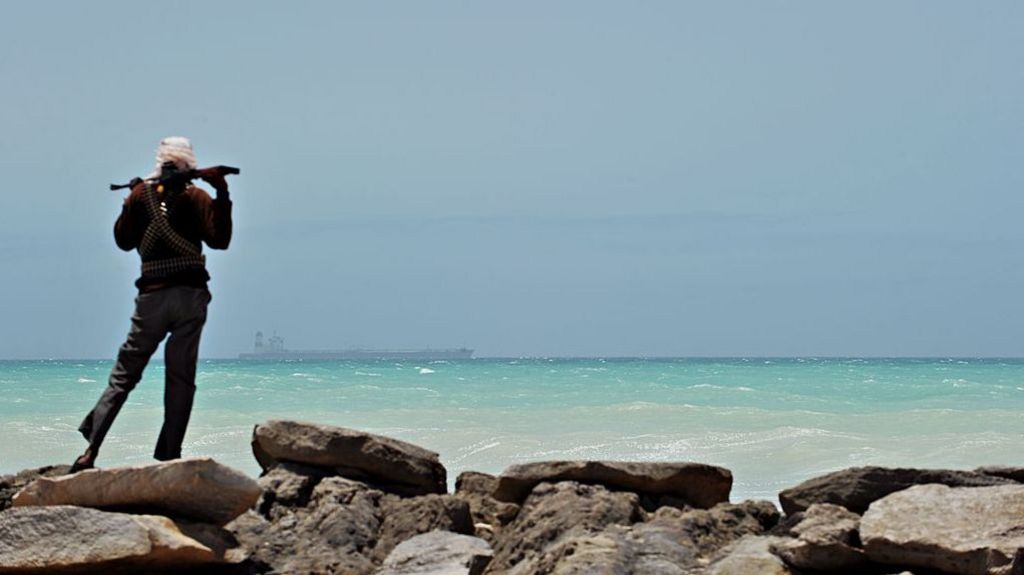
A sharp resurgence of piracy off the coast of Somalia has amplified threats to global commercial shipping, a sector already strained by maritime blockades and escalating regional tensions stemming from the ongoing conflict between the United States and Iran. In just four days last week, two separate cargo vessels were seized in the Gulf of Aden, pushing the total number of recorded attacks since the start of 2026 to at least 13. This wave of hijackings marks the most significant escalation of maritime criminal activity in the region in more than a decade, reviving long-dormant fears over security for one of the world’s most critical trade corridors.
“Piracy is always a crime of opportunity,” explained Omar Mahmood, senior Somalia analyst at the International Crisis Group (ICG). “Right now, the pirates see a clear opening to act.” That opening has been created by cascading insecurity in key waterways further north: the Strait of Hormuz remains a flashpoint for ongoing tensions between Washington and Tehran, while Iran-aligned Houthi forces in Yemen have enforced a targeted blockade of the Bab el-Mandeb Strait, the critical gateway to the Red Sea. Though the blockade was originally implemented as part of the Houthi dispute with Saudi Arabia, it has upended security for all international shipping transiting the region.
Vice-Admiral Ignacio Villanueva Serrano, operations commander for the European Union’s naval mission tasked with protecting shipping off Somalia’s coast, noted that pirates have calculated international security resources are already stretched thin by the northern crises. “They believe that international forces will be focused on managing Hormuz and Bab el-Mandeb, rather than prioritizing counter-piracy patrols off Somalia,” he said.
Two recent high-profile seizures underscore the growing threat. On August 17, the MV Lutuf, a Cameroon-flagged cargo vessel, was hijacked off the coast of Somalia’s semi-autonomous Puntland region. Just four days later, pirates boarded the MT Sibu 1, an Eritrean-flagged oil products tanker, in Gulf of Aden waters near the Yemeni coast.
The hijacking of the MV Lutuf has triggered unforeseen diplomatic and security fallout. Since August 18, two drone strikes targeting alleged pirate supply networks linked to the vessel have killed 13 men. While no party has officially claimed responsibility for the attacks, local and regional officials have blamed Turkey, claiming the MV Lutuf was carrying a cargo of Turkish weapons bound for Somalia’s capital, Mogadishu.
The BBC has confirmed that the MV Lutuf is now one of six vessels being held by pirate groups demanding multi-million dollar ransoms. Four of the seized ships are currently anchored near Bander Beyla, a coastal fishing town long recognized as a piracy hotbed. Current activity remains far below the peak of Somali piracy 15 years ago, when attacks cost the global economy billions of dollars annually: in 2011 alone, Somali pirates launched more than 200 attacks and held hundreds of crew members hostage. A coordinated international naval response, paired with the adoption of private security teams on commercial vessels, successfully drove down attacks and contained smaller flare-ups in 2023 and 2024.
But experts warn that while pirate networks were suppressed for years, they were never dismantled. Root causes including widespread poverty and persistent weak governance and security in Somalia have never been addressed, allowing criminal networks to remain intact. Locally, the current resurgence is fueled by deep-seated anger over unregulated overfishing by foreign trawlers in Somali territorial waters, which has gutted the small-scale fishing industry that sustains coastal communities in Puntland.
Shifting shipping patterns have also created more targets for pirates. As vessel operators divert their routes south to avoid conflict and blockades further north, more commercial ships are now passing closer to Somalia’s coastline. With global oil prices remaining elevated, hijacking a loaded oil tanker has become a far more lucrative criminal enterprise. Mahmood noted the confluence of factors working in pirates’ favor: “You have that combined effect of less naval patrolling but more commercial shipping in these waters, and that signals an opportunity. And once you’ve had a successful attack, that spurs other criminal groups to carry out copycat incidents.”
Analysts have also floated the possibility of limited collaboration between Somali pirate networks and Yemeni criminal groups, following multiple seizures near the Yemeni coast. Mahmood, however, says any collaboration is almost certainly between criminal factions, not with Iran-backed Houthi forces—especially since the MT Sibu 1 is reportedly part of Iran’s so-called “shadow fleet” of vessels used to transport oil in violation of U.S. sanctions. “I don’t see something specifically Iran-directed,” he emphasized.
Turkey’s role in the crisis has emerged as a major point of political tension. Unnamed Puntland security sources and a Somali federal government official have told the BBC that the MV Lutuf was carrying weapons and sensitive satellite equipment bound for a Turkish military training facility in Mogadishu, as well as a new Turkish space station being constructed north of the capital. Turkey has a long-standing defense and economic partnership with Somalia’s federal government, focused in part on strengthening Somalia’s maritime security. The sources also claim that six international warships are currently deployed near the hijacked MV Lutuf: two from Turkey, and one each from Spain, Denmark, the United States, and India. The BBC has not been able to independently verify this deployment.
The Somali government official, who spoke on condition of anonymity, alleged that Turkey carried out the second deadly drone strike on August 24 that killed nine armed men. “The men who were killed were criminals and I don’t have sympathy for them, but taking it to that level is escalating the situation even more,” he said. Turkey’s defense ministry has confirmed that its forces are providing “necessary support” to Somali authorities within the framework of their existing security agreement, but has not directly addressed accusations it carried out the drone strikes. Somalia’s federal government has only stated publicly that it is aware of counter-piracy operations and will take appropriate steps to manage the situation.
Puntland authorities have been far more vocal in their opposition. Deputy Puntland Security Minister Abdirahman Yusuf told BBC Somali Service that his administration has evidence linking Turkey to the drone strikes, citing observed Turkish military activity near the MV Lutuf and along the Puntland coast. The BBC has not independently verified these claims. Puntland’s security ministry issued a formal statement opposing “bombings by international warships targeting civilians” that “undermined co-operation in combatting piracy,” and demanded an immediate explanation for the strikes.
Analysts warn that the incident has further complicated long-running political tensions between the semi-autonomous Puntland region and the federal government in Mogadishu, which has long had a close military relationship with Turkey. This political rift already undermines efforts to coordinate a unified counter-piracy response across Somalia.
While the current wave of hijackings has not yet reached the level of a full-blown piracy resurgence, experts warn that without a de-escalation of the U.S.-Iran conflict and renewed international investment in counter-piracy deterrence, Somali piracy will continue to raise security risks in one of the world’s most economically vital maritime corridors.