In a landmark federal ruling handed down in upstate New York on Wednesday, Hadi Matar, the 28-year-old man already serving a 25-year state sentence for attempting to murder author Sir Salman Rushdie, has been convicted on additional federal terrorism charges, including providing material support to a designated foreign terrorist organization. The jury in Buffalo found Matar guilty on two counts: engaging in an act of transnational terrorism and providing material support to Lebanese armed faction Hezbollah, which has been formally listed as a terrorist group by the U.S., the United Kingdom and dozens of other governments around the world.
Prosecutors laid out a detailed case during the trial, tracing Matar’s radicalization and two years of plotting back to decades-old religious edicts targeting Rushdie. They argued that the 1989 fatwa issued by Iran’s supreme religious leadership calling for Rushdie’s death, amplified by a 2006 speech from then-Hezbollah leadership urging enforcement of that edict, directly motivated Matar’s attack. “The defendant decided no one was going to do it, so he had to do it. The defendant is the one who answered that call,” Assistant U.S. Attorney Timothy Lynch stated in closing arguments, per local reporting from The Buffalo News.
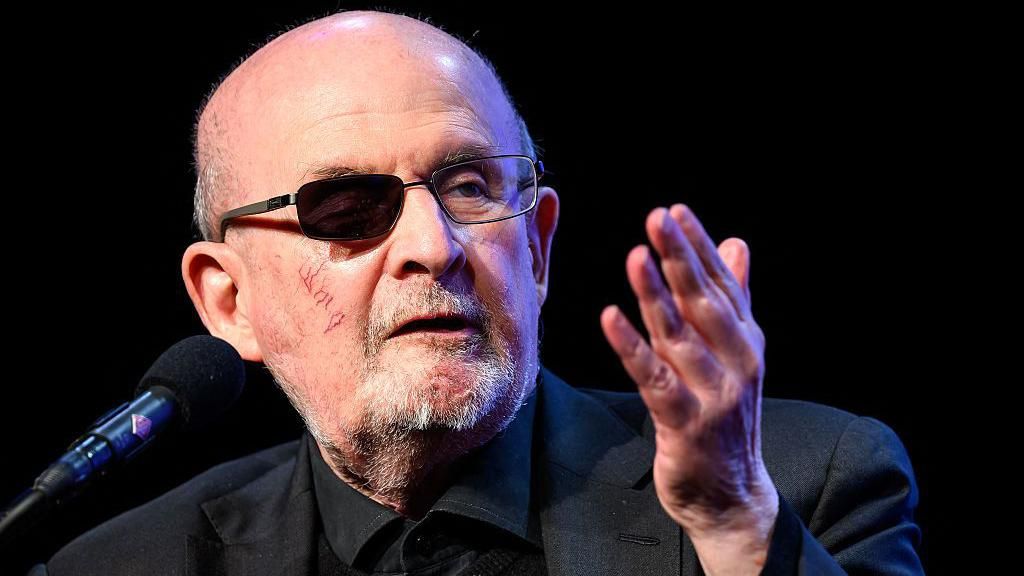
In a powerful, high-profile appearance on the witness stand, the award-winning British-Indian author recounted the brutal 2022 attack that left him permanently injured. Rushdie, 77, described being stabbed 15 times across his face, neck, chest, thigh, and eye, telling the court “I was on the stage, lying down, with an enormous pool of blood all around me. It was an enormous and expansive lake of blood.” He also lifted the darkened lens of his eyeglasses to show the jury the wound that cost him partial vision in one eye, noting that the knife came “within millimetres from my brain.” The author specifically credited a quick-acting firefighter with administering emergency on-scene care that saved his life.
Defense attorneys pushed back against the terrorism framing, arguing that Matar’s attack was not tied to organized terrorist activity. They also questioned Rushdie about whether he should have anticipated backlash to his 1988 controversial novel *The Satanic Verses*, which sparked global outrage among some Muslim communities who view its depiction of the Prophet Muhammad as blasphemous. Rushdie rejected the framing, responding firmly: “I don’t believe the book is on trial. Somebody else is on trial.”
This is not the first conviction for Matar: he was already found guilty of attempted murder by a New York state court in 2025 and sentenced to 25 years behind bars. With the new federal convictions, he now faces the possibility of a life sentence added to his existing term.
For Rushdie, the stabbing was the culmination of decades of threats that began immediately after the publication of *The Satanic Verses*. Following the 1989 fatwa, he was forced to live in hiding for nine years under constant security protection. In recent years, he has gradually returned to public life, documenting his experience after the 2022 attack and his long recovery in the 2024 memoir *Knife: Meditations After an Attempted Murder*, followed by his first post-attack novel *The Eleventh Hour* released in 2025.