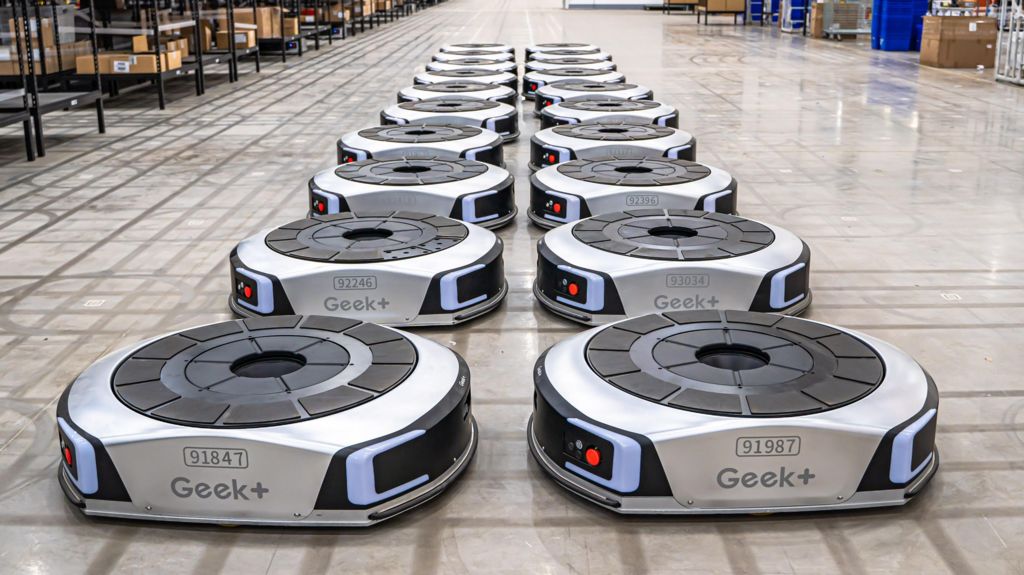
When customers hit the ‘purchase’ button for an online order, their goods are rarely processed by human hands alone these days. Increasingly, the first step in getting a purchase out the door begins with a compact silver autonomous mobile robot that glides under warehouse storage racks, lifts the entire shelf, and transports it directly to a worker waiting to prepare the order for shipping.
That seamless automation, developed by Chinese robotics firm Geek+, is already becoming ubiquitous in the UK logistics sector. Major British retail giants including Tesco, Asda, and Next have integrated Geek+’s robotic systems into their supply chains, with 2,000 of the company’s robots now operating across 10 UK warehouse sites through local partner MotionTech. This solidifies the UK as Geek+’s largest European market, at a moment when the country is grappling with persistent labour shortages and stagnant productivity growth.
Unlike traditional warehouse automation, which relies on rigid fixed conveyor belts and permanent infrastructure overhauls, Geek+’s flexible autonomous systems can be installed quickly using simple QR code floor markers and standard safety fencing. The company says automation of these repetitive inventory transport tasks boosts order picking speeds, maximizes storage capacity in hard-to-access warehouse spaces that are uneconomical for human workers to use, and drastically reduces order picking errors. For UK businesses already struggling to fill open frontline logistics roles, the technology offers an immediate solution to strained operations. ‘We have a very big shortage of labour in the UK at the moment. These technologies are really important to keep businesses thriving and meet demand,’ explained Barry Pemberton, MotionTech’s Account Director, noting that clients prioritize space-efficient, fast-deploying systems that work with existing warehouse footprints.
The growing adoption of Geek+’s technology in the UK lines up with broader economic analysis: for more than a decade, the UK has recorded anaemic productivity growth, and the OECD’s 2026 *SME Technology Adoption in the United Kingdom* report identifies wider adoption of robotics and automation as a critical step to reverse that trend. The organization notes that while UK firms have readily adopted mature digital technologies, the country lags behind other advanced economies in robotics uptake, a gap that has created major opportunities for global robotics suppliers. With one of Europe’s largest e-commerce and logistics sectors still in the early stages of automation, the UK market is primed for rapid growth in robotic deployment.
The expansion of Geek+ into Europe is part of a much larger, state-backed push by China to become a global leader in robotics, framed as a core component of developing what Chinese President Xi Jinping calls ‘new quality productive forces’. With China’s working-age population shrinking, policymakers view large-scale automation as essential to sustaining the country’s manufacturing competitiveness and boosting domestic productivity. Researchers point out that China’s robotics sector benefits from overlapping industrial ecosystems built for its booming electric vehicle industry: key components including batteries, electric motors, sensors, cameras, and semiconductors developed for EVs are now being repurposed for robotic systems, cutting production costs and accelerating development. Major Chinese EV manufacturers, including XPeng, have already launched humanoid robot development programs, with XPeng founder He Xiaopeng noting that ‘in the future, any car company will transform into a car and robotics company.’
Analysts say China’s robotics push could mirror the success of its global EV industry, leveraging domestic manufacturing expertise, dense local supply chains, and rapid iterative product development to capture an early global lead. But the sector’s global expansion faced a new setback recently, after the US banned imports of new advanced foreign-made robots over unsubstantiated national security claims. China’s embassy in Washington rejected the move, condemning the US for politicizing trade issues and imposing sanctions based on unfounded accusations.
Beyond its current wheeled warehouse robot offerings, Geek+ and other major Chinese robotics firms are investing heavily in next-generation automation, including humanoid robots designed to handle picking, packing, and other warehouse tasks. Geek+ says its long-term goal is to deliver fully end-to-end unmanned end-to-end warehouse solutions that automate every step of order processing, from inventory storage to final packing. Dozens of Chinese companies, including AgiBot and Unitree, have poured billions of dollars into humanoid robot development, and Chinese firms already account for the vast majority of global humanoid robot deployments to date.
Still, industry experts remain divided on the near-term impact of humanoid robots in warehouses. Developers argue that humanoids can fit into existing workplaces designed for human workers without costly infrastructure overhauls, but most agree that current humanoid technology lacks the dexterity to handle many complex repetitive tasks. Many industry observers, including Pemberton, frame humanoids as a complementary technology rather than a replacement for existing autonomous mobile robotic systems, noting it will likely be years before humanoids become commonplace in commercial logistics settings.
For the UK, where labour shortages and productivity pressures have created urgent demand for automation, the country’s warehouses have emerged as an early testing ground for what could be China’s next major global technology export. The Trades Union Congress, which represents nearly 6 million UK workers, has called for guardrails to ensure automation is used to improve working conditions rather than just cut labour costs, urging the government to require worker input on automation rollouts and mandate employer investment in worker retraining to avoid job displacement.