博客

  • Worth $5m? Visitors react to renovated Washington horse statues

    Worth $5m? Visitors react to renovated Washington horse statues

    A major restoration project completed on the iconic Arts of War horse statues flanking the approach to the Lincoln Memorial has sparked widespread public discussion, after the Trump administration revealed the works had been refitted with a 23.75-karat gold leaf finish at a total cost of $5 million.

    The neoclassical statues, which have stood at their location near the National Mall since the 1950s, had suffered decades of wear from weather, pollution and foot traffic, prompting calls for a full structural and cosmetic restoration. In a move that deviated from the statues’ original muted finish, administration officials approved a full regilding process that applied a thin layer of high-purity gold across the entire surface of the bronze sculptures.

    Since the project was completed, visitors to the National Mall have shared sharply differing reactions. Many tourists and heritage observers have noted that the gilded finish gives the monuments a striking, eye-catching glow under Washington’s sunny skies, bringing renewed attention to the works of public art that honor American military service. However, critics have questioned both the $5 million price tag and the decision to alter the statues’ historic appearance, arguing that public funds could have been allocated to more pressing national needs, and that the dramatic gold redesign erases the original artistic intent of the sculptors.

    The restoration project adds to a list of changes to National Mall monuments completed during the Trump administration, with the debate over the gilded statues highlighting ongoing tensions between heritage preservation priorities, public spending choices, and artistic integrity for iconic American public monuments.

  • Salman Rushdie attacker convicted of terror offenses

    Salman Rushdie attacker convicted of terror offenses

    In a landmark federal ruling handed down in upstate New York on Wednesday, Hadi Matar, the 28-year-old man already serving a 25-year state sentence for attempting to murder author Sir Salman Rushdie, has been convicted on additional federal terrorism charges, including providing material support to a designated foreign terrorist organization. The jury in Buffalo found Matar guilty on two counts: engaging in an act of transnational terrorism and providing material support to Lebanese armed faction Hezbollah, which has been formally listed as a terrorist group by the U.S., the United Kingdom and dozens of other governments around the world.

    Prosecutors laid out a detailed case during the trial, tracing Matar’s radicalization and two years of plotting back to decades-old religious edicts targeting Rushdie. They argued that the 1989 fatwa issued by Iran’s supreme religious leadership calling for Rushdie’s death, amplified by a 2006 speech from then-Hezbollah leadership urging enforcement of that edict, directly motivated Matar’s attack. “The defendant decided no one was going to do it, so he had to do it. The defendant is the one who answered that call,” Assistant U.S. Attorney Timothy Lynch stated in closing arguments, per local reporting from The Buffalo News.

    In a powerful, high-profile appearance on the witness stand, the award-winning British-Indian author recounted the brutal 2022 attack that left him permanently injured. Rushdie, 77, described being stabbed 15 times across his face, neck, chest, thigh, and eye, telling the court “I was on the stage, lying down, with an enormous pool of blood all around me. It was an enormous and expansive lake of blood.” He also lifted the darkened lens of his eyeglasses to show the jury the wound that cost him partial vision in one eye, noting that the knife came “within millimetres from my brain.” The author specifically credited a quick-acting firefighter with administering emergency on-scene care that saved his life.

    Defense attorneys pushed back against the terrorism framing, arguing that Matar’s attack was not tied to organized terrorist activity. They also questioned Rushdie about whether he should have anticipated backlash to his 1988 controversial novel *The Satanic Verses*, which sparked global outrage among some Muslim communities who view its depiction of the Prophet Muhammad as blasphemous. Rushdie rejected the framing, responding firmly: “I don’t believe the book is on trial. Somebody else is on trial.”

    This is not the first conviction for Matar: he was already found guilty of attempted murder by a New York state court in 2025 and sentenced to 25 years behind bars. With the new federal convictions, he now faces the possibility of a life sentence added to his existing term.

    For Rushdie, the stabbing was the culmination of decades of threats that began immediately after the publication of *The Satanic Verses*. Following the 1989 fatwa, he was forced to live in hiding for nine years under constant security protection. In recent years, he has gradually returned to public life, documenting his experience after the 2022 attack and his long recovery in the 2024 memoir *Knife: Meditations After an Attempted Murder*, followed by his first post-attack novel *The Eleventh Hour* released in 2025.

  • The Chinese robot army transforming the UK’s retail industry

    The Chinese robot army transforming the UK’s retail industry

    When customers hit the ‘purchase’ button for an online order, their goods are rarely processed by human hands alone these days. Increasingly, the first step in getting a purchase out the door begins with a compact silver autonomous mobile robot that glides under warehouse storage racks, lifts the entire shelf, and transports it directly to a worker waiting to prepare the order for shipping.

    That seamless automation, developed by Chinese robotics firm Geek+, is already becoming ubiquitous in the UK logistics sector. Major British retail giants including Tesco, Asda, and Next have integrated Geek+’s robotic systems into their supply chains, with 2,000 of the company’s robots now operating across 10 UK warehouse sites through local partner MotionTech. This solidifies the UK as Geek+’s largest European market, at a moment when the country is grappling with persistent labour shortages and stagnant productivity growth.

    Unlike traditional warehouse automation, which relies on rigid fixed conveyor belts and permanent infrastructure overhauls, Geek+’s flexible autonomous systems can be installed quickly using simple QR code floor markers and standard safety fencing. The company says automation of these repetitive inventory transport tasks boosts order picking speeds, maximizes storage capacity in hard-to-access warehouse spaces that are uneconomical for human workers to use, and drastically reduces order picking errors. For UK businesses already struggling to fill open frontline logistics roles, the technology offers an immediate solution to strained operations. ‘We have a very big shortage of labour in the UK at the moment. These technologies are really important to keep businesses thriving and meet demand,’ explained Barry Pemberton, MotionTech’s Account Director, noting that clients prioritize space-efficient, fast-deploying systems that work with existing warehouse footprints.

    The growing adoption of Geek+’s technology in the UK lines up with broader economic analysis: for more than a decade, the UK has recorded anaemic productivity growth, and the OECD’s 2026 *SME Technology Adoption in the United Kingdom* report identifies wider adoption of robotics and automation as a critical step to reverse that trend. The organization notes that while UK firms have readily adopted mature digital technologies, the country lags behind other advanced economies in robotics uptake, a gap that has created major opportunities for global robotics suppliers. With one of Europe’s largest e-commerce and logistics sectors still in the early stages of automation, the UK market is primed for rapid growth in robotic deployment.

    The expansion of Geek+ into Europe is part of a much larger, state-backed push by China to become a global leader in robotics, framed as a core component of developing what Chinese President Xi Jinping calls ‘new quality productive forces’. With China’s working-age population shrinking, policymakers view large-scale automation as essential to sustaining the country’s manufacturing competitiveness and boosting domestic productivity. Researchers point out that China’s robotics sector benefits from overlapping industrial ecosystems built for its booming electric vehicle industry: key components including batteries, electric motors, sensors, cameras, and semiconductors developed for EVs are now being repurposed for robotic systems, cutting production costs and accelerating development. Major Chinese EV manufacturers, including XPeng, have already launched humanoid robot development programs, with XPeng founder He Xiaopeng noting that ‘in the future, any car company will transform into a car and robotics company.’

    Analysts say China’s robotics push could mirror the success of its global EV industry, leveraging domestic manufacturing expertise, dense local supply chains, and rapid iterative product development to capture an early global lead. But the sector’s global expansion faced a new setback recently, after the US banned imports of new advanced foreign-made robots over unsubstantiated national security claims. China’s embassy in Washington rejected the move, condemning the US for politicizing trade issues and imposing sanctions based on unfounded accusations.

    Beyond its current wheeled warehouse robot offerings, Geek+ and other major Chinese robotics firms are investing heavily in next-generation automation, including humanoid robots designed to handle picking, packing, and other warehouse tasks. Geek+ says its long-term goal is to deliver fully end-to-end unmanned end-to-end warehouse solutions that automate every step of order processing, from inventory storage to final packing. Dozens of Chinese companies, including AgiBot and Unitree, have poured billions of dollars into humanoid robot development, and Chinese firms already account for the vast majority of global humanoid robot deployments to date.

    Still, industry experts remain divided on the near-term impact of humanoid robots in warehouses. Developers argue that humanoids can fit into existing workplaces designed for human workers without costly infrastructure overhauls, but most agree that current humanoid technology lacks the dexterity to handle many complex repetitive tasks. Many industry observers, including Pemberton, frame humanoids as a complementary technology rather than a replacement for existing autonomous mobile robotic systems, noting it will likely be years before humanoids become commonplace in commercial logistics settings.

    For the UK, where labour shortages and productivity pressures have created urgent demand for automation, the country’s warehouses have emerged as an early testing ground for what could be China’s next major global technology export. The Trades Union Congress, which represents nearly 6 million UK workers, has called for guardrails to ensure automation is used to improve working conditions rather than just cut labour costs, urging the government to require worker input on automation rollouts and mandate employer investment in worker retraining to avoid job displacement.


  • Amnesty: India sent 2,596 arms shipments to Israel during genocide in Gaza

    Amnesty: India sent 2,596 arms shipments to Israel during genocide in Gaza

    A bombshell new investigation from Amnesty International has uncovered that both Indian state-owned and private firms have delivered at least 2,596 consignments of arms, ammunition, and military components to Israel throughout Israel’s ongoing military campaign in Gaza. The shipments, transported between October 7, 2023, and November 30, 2025, included a wide range of lethal and strategic materiel bound for major Israeli military suppliers, the report confirms. Among the items delivered were machine gun parts, 155mm high-explosive artillery shells supplied to Israeli defense giant Elbit Systems, and explosive warheads for SkyStriker kamikaze drones — a variant of which has already been recovered from the rubble of Khan Younis, the devastated southern Gazan city. Ammunition breakdowns from the analysis show 564,970 explosive ordnance components, including drone warheads and artillery shell casings; 390,516 parts for military-grade small arms; and 298 armored vehicle components sent to large Israeli contractors that supply the Israel Defense Forces. As of July 29, 2026, the confirmed Palestinian death and injury toll from Israel’s military operation, launched in the wake of the October 7, 2023, Hamas-led attacks on southern Israel, stands at more than 247,300 people. Titled *Made in India: The Supply of Weapons and Ammunition to Israel*, the report was published Thursday and notes that its calculations rely on an intentionally conservative counting methodology, meaning the actual scale of India’s role in Israel’s military supply chain is almost certainly larger than the numbers published. This new report is not the first allegation of Indian material support for Israel’s actions in Gaza: prior investigations have already claimed New Delhi authorized deliveries of combat drones, bombs, and weapons components to Israel in the months after October 2023. Back in May 2026, the Palestinian-led Boycott, Divestment and Sanctions (BDS) movement and advocacy group No Harbour for Genocide (NHG) issued a warning about what they described as a “flood” of Indian military supplies flowing to Israel. Speaking to Middle East Eye at the time, an NHG spokesperson explained that even with Israel’s robust domestic defense manufacturing sector, it still depends on imported specialized components, ranging from high-tech aerospace materials to bulk industrial inputs like military-grade steel. A separate earlier investigation by Al Jazeera, which analyzed Israeli Tax Authority import data, reached similar conclusions, finding that India ranked as the second-largest exporter of military-related goods to Israel between October 2023 and October 2025. Al Jazeera also noted that the dataset only captured a portion of total arms transfers, and could not definitively confirm that all shipped items were ultimately used in military operations in Gaza. For its part, Amnesty’s research team built its analysis around shipments classified under specific Harmonized System (HS) codes, the global standard for customs trade classification. The team focused on HS codes 9301–9307, which cover all categories of weapons, ammunition, and their associated parts and accessories, as well as HS code 8710, which applies to armored and combat vehicles and their components. To avoid overcounting, researchers excluded any shipments marked only with internal product or part numbers where the military or civilian nature of the goods could not be confirmed. The analysis also excluded hundreds of shipments of dual-use small arms components, as well as weapons and parts intended for anti-missile defense systems. This strict filtering is what leads Amnesty to conclude that its findings underrepresent the full scope of Indian military supply to Israel. Even with these limitations, the investigation confirms that multiple Indian companies, including state-owned defense enterprises, are actively involved in the supply of military goods to Israel. Amnesty says it contacted nine companies and the Indian government for comment ahead of publication, but received no responses before the report was released. Agnes Callamard, Secretary General of Amnesty International, emphasized in an official statement that following the International Court of Justice’s (ICJ) provisional measures ruling, which recognized a plausible risk of genocide against Palestinians in Gaza, Indian authorities cannot reasonably claim they were unaware that authorizing and enabling arms transfers to Israel carries a major risk of facilitating violations of international law. Callamard added that as the Israeli military continues to inflict mass death and widespread suffering across Gaza, Indian companies continue to profit from supplying critical components and munitions to Israel’s defense sector. Bilateral ties between India and Israel have expanded dramatically over the past decade, driven by the leadership of Indian Prime Minister Narendra Modi and former Israeli Prime Minister Benjamin Netanyahu. Today, India is the single largest buyer of Israeli weapons globally, and dozens of major Israeli arms manufacturers have opened production facilities in India via joint ventures with domestic Indian firms. Earlier this year, during an official visit by Modi to Israel, the two nations elevated their bilateral relationship to a Special Strategic Partnership for Peace, Innovation and Prosperity. Since that announcement, cooperation has deepened further, with multiple new memorandums of understanding signed and ongoing discussions about potential new defense projects, including a plan for India to manufacture Iron Dome interceptor missiles for Israel. Diplomatically, the Indian government has emerged as one of Israel’s most consistent international supporters. New Delhi has declined to join South Africa’s genocide case against Israel at the ICJ, rejected international calls to implement an arms embargo on Israel, and cracked down on pro-Palestine protest and activism within its own borders. In September 2024, when Indian civil society groups petitioned the country’s Supreme Court to order a halt to arms exports to Israel, the court dismissed the case, ruling that foreign policy decisions fall exclusively within the executive branch’s authority, not the judiciary’s. Indian External Affairs Minister Subrahmanyam Jaishankar has repeatedly defended the country’s arms export policy, framing it as rooted in India’s national interest. “The issue of India’s exports, including India’s exports of anything which directly or indirectly has any military implications, is guided by our national interest and by our commitments to various regimes,” Jaishankar stated in December 2024. He added, “Where Israel is concerned, it is a country with which we have a strong record of cooperation in national security. It is also a country that has stood by us at different moments when our national security was under threat.”

  • Meta shares fall as frustration grows over AI spending plans

    Meta shares fall as frustration grows over AI spending plans

    In a move that has sent shockwaves through global tech stock markets, Meta Platforms, the parent company of major social media platforms Facebook, Instagram and WhatsApp, has seen its shares drop by 11% in Wednesday trading. The sell-off came directly after the firm released its second-quarter financial results, which laid out a sharp increase in planned artificial intelligence (AI) capital expenditure alongside declining quarterly profits.

    The April-to-June results showed Meta delivered 28% year-over-year revenue growth, hitting $61 billion (£45.6 billion). However, net profits for the quarter fell 14% year-over-year to $6 billion, a decline that caught many market analysts off guard. Most notably, the company revised its full-year 2024 capital expenditure guidance upward to a range of $130 billion to $145 billion, a $5 billion increase from the forecast it released just three months prior. The vast majority of this expanded budget will be directed toward AI research, infrastructure, and product development, cementing Meta CEO Mark Zuckerberg’s position as one of the biggest corporate spenders on AI globally.

    Zuckerberg has framed the aggressive spending push as a high-stakes, long-term bet that will pay off for the company and its investors over time. “I get that this is a big bet across the industry,” Zuckerberg told analysts during a post-results earnings call. “My personal bet is that the people who invest in this will feel very good and be rewarded over time.” The Meta chief added that existing AI investments are already driving higher user engagement on Facebook and Instagram, while also streamlining ad creation tools for small and medium-sized businesses. Looking ahead, he positioned autonomous AI agents as the next major product wave for the company, noting that soon these tools will be able to work around the clock on behalf of users.

    Beyond consumer-facing products, Meta is preparing to launch a new line of business selling AI technology and infrastructure to other companies. The first step of this rollout will be simplifying integration for Meta’s existing Muse Spark AI model, with additional coding and productivity tools planned for future release. Meta CFO Susan Li told analysts that monetizing these enterprise AI offerings will be key to generating returns on the company’s massive capital outlay. “By 2028, we’ll have turned over a lot of cards,” Li said, referencing the timeline for the new business segment to mature. Zuckerberg added that while building an enterprise AI business requires new capabilities the company has not historically prioritized, the market opportunity is too large to ignore. “It’s not just about selling compute; it’s the API services and the productivity services and I think there is a very, very large opportunity there and we’re quite focused on that,” he said.

    Despite the leadership’s optimistic long-term outlook, investors have reacted with immediate concern to the rising spending and shrinking near-term profitability. Meta’s quarterly free cash flow – the capital the company retains after covering operating expenses – fell to just $784 million, the lowest reading the firm has posted in at least five years, according to its official financial filings. Meta is not alone in this trend: Alphabet, Google’s parent company, posted its own record-low free cash flow last week, which also triggered a notable drop in its share price. For the moment, Zuckerberg’s big AI bet has split market sentiment: while the CEO and his team insist the investments will unlock massive value down the line, investors have made clear they are uneasy about the short-term hit to earnings and the unproven nature of Meta’s upcoming enterprise AI business.

  • Trump says US to hit Iran hard

    Trump says US to hit Iran hard

    A fragile lull in Middle East hostilities has collapsed, sparking fears of a broader regional conflict after Iran launched missile strikes against U.S. bases in Jordan, prompting a harsh warning of massive retaliation from U.S. President Donald Trump. The resumption of cross-front attacks has sent global energy markets into turmoil, with oil prices surging 5% in a single day as investors braced for potential disruptions to critical global energy supply chains.

    The latest wave of violence ended a brief ceasefire that had raised cautious hopes for renewed diplomatic negotiations to de-escalate the years-long regional standoff. On Wednesday alone, multiple fronts flared up simultaneously: Saudi Arabia and the United States carried out joint air strikes on militant positions across Iraq, while Israel accused Iran-backed Hezbollah of breaking an existing truce along the Lebanon-Israel border.

    For two consecutive days, Saudi Arabia — the world’s largest crude oil exporter — has suffered drone attacks on its critical crude production infrastructure, which Riyadh has blamed on Tehran-aligned Iraqi armed groups. In response to the Jordan strike, Trump made his stance clear in an interview with Fox News, saying: “We’ll be hitting them hard…We are going to beat the ‘effing s’ out of them.”

    Saudi security researcher Hesham Alghannam told Agence France-Presse that Iran is leveraging its network of regional proxy groups to maintain strategic pressure on Western and allied Arab states, even as diplomatic channels remain open to absorb international scrutiny. After Iran’s missile attack on Jordan, Jordan’s military confirmed it intercepted five incoming Iranian projectiles, while Iran’s Islamic Revolutionary Guard Corps (IRGC) confirmed it targeted U.S. military bases stationed on Jordanian territory. “As long as the threats against the Islamic Republic of Iran continue…the resistance will continue,” the IRGC statement added.

    Iranian state media later reported a U.S. counter-strike near the border town of Piranshahr adjacent to Iraq, with initial reports indicating the strike hit an unpopulated area and caused no casualties. Along the Lebanon-Israel border, the Israeli military accused Hezbollah of launching a drone attack against an Israeli vehicle overnight inside Lebanese territory, labeling the incident a “blatant violation of the existing ceasefire”. Israel joined U.S. operations against Iranian targets in the early weeks of the current conflict while fighting Hezbollah in Lebanon, but has not yet joined the latest round of strikes against Iran.

    The sudden escalation sent shockwaves through global financial markets on Wednesday. U.S. stock indexes closed sharply lower amid the oil price jump, while yields on 30-year U.S. Treasury bonds hit their highest level since 2007, reflecting growing investor anxiety over inflation risks from higher energy costs.

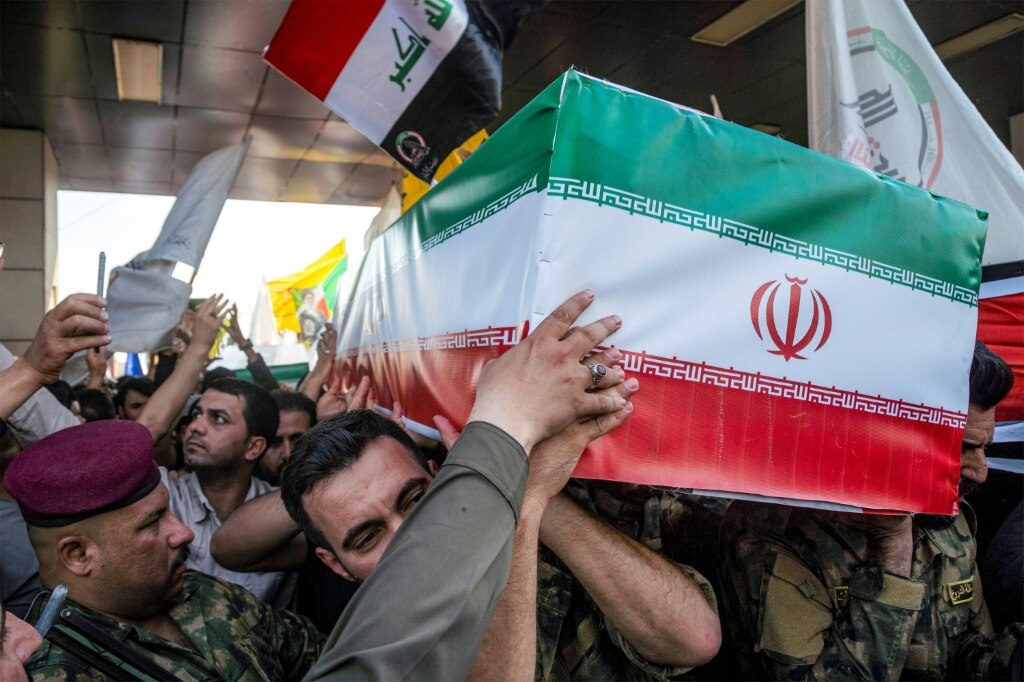
    The joint U.S.-Saudi air strikes in Iraq targeted logistics and weapons depots belonging to an Iran-aligned militant faction, according to statements from the U.S. military. Iraq’s Hashed al-Shaabi (Popular Mobilisation Forces, PMF), an integrated state security alliance originally formed in 2014 to fight extremist jihadist groups, said the strikes killed at least 20 of its members. The PMF denounced the attack as a “dangerous escalation” targeting an official Iraqi security institution. Two senior PMF officials confirmed five Iranian military advisors were among those killed, and AFP correspondents on the ground saw coffins draped in Iranian flags prepared for burial. The PMF includes multiple brigades aligned with Iran that often operate independently of Iraqi central government command.

    The Iraqi government formally condemned the joint strikes, releasing a statement rejecting “all acts of aggression, regardless of the party responsible or the justifications presented”. Iraq’s Ministerial Council for National Security said it would “confront any violation of Iraq’s sovereignty, and prevent any source from using Iraqi territory to threaten neighbouring states”. Despite this condemnation, President Trump told Fox News the strikes were “coordinated with the Iraqi government”. The operation comes amid mounting U.S. pressure on Baghdad to disarm pro-Iran militias operating within its borders; earlier this month, Iraqi Prime Minister Ali al-Zaidi conducted official visits to both Washington and Tehran in an effort to balance competing demands.

    The days-long ceasefire that collapsed this week had been billed by U.S. officials as a window to restart negotiations on multiple flashpoints, most notably the Strait of Hormuz — a critical global energy chokepoint that Iran has blockaded for much of the ongoing conflict. The IRGC recently announced it intercepted and seized three commercial tankers transiting the strait, insisting Iran exercises “full control” over the waterway that was previously open to unrestricted international passage. Tehran has stated it will maintain control of the key energy conduit, and has announced plans to charge transit fees for commercial ships passing through the strait — a policy the U.S. strongly opposes. In response, Washington announced new sanctions targeting entities linked to the IRGC, accusing the Guard of extorting fees from transiting commercial vessels.

    Iran’s blockade of the Strait of Hormuz has increased the strategic importance of the Red Sea, which Riyadh now uses as its alternative primary export route for crude oil, amplifying existing tensions over security in that critical waterway as well.

  • Inflation data gives Reserve Bank reason to pause looming interest rate hike

    Inflation data gives Reserve Bank reason to pause looming interest rate hike

    Australia’s battle against persistent inflation has hit a small but welcome milestone, with new official data showing headline consumer price growth cooled slightly in June – but top economic analysts warn ordinary households will not feel tangible relief from cost-of-living strains for a full year, and interest rate hikes remain on the table for the country’s central bank.

    New figures published by the Australian Bureau of Statistics on Wednesday put annual headline inflation at 3.8% through the end of June, a modest drop from the 4.0% recorded in May and the 4.2% reading from April. The lower-than-expected result has given some tentative hope to mortgage holders, with economists noting there is no clear trigger in the data to force the Reserve Bank of Australia (RBA) to lift interest rates at its upcoming August policy meeting.

    National Australia Bank (NAB) chief economist Sally Auld framed the latest inflation update as a small win in what remains a difficult fight to bring price growth back to the RBA’s 2-3% target range. “Whether you look at monthly, quarterly or annual readings, or core versus headline metrics, most measures came in a touch softer than anticipated,” Auld told NewsWire in an interview. “There’s no smoking gun in this data for the RBA to act in August, but we’re certainly not out of the woods yet.”

    Auld pointed to growing global headwinds that continue to threaten Australia’s inflation outlook, specifically the recent escalation of tensions in the Middle East that has already driven up global fuel prices. Those price gains will keep upward pressure on the RBA’s inflation forecasts, she said, making it far too early for the central bank to declare victory over persistent price growth. Even with the June improvement, Auld noted the RBA will remain firmly cautious, and any talk of cutting interest rates remains distant. “It’s a long way away from declaring victory on the inflation challenge or opening up the possibility of lower rates,” she added.

    Federal Treasurer Jim Chalmers echoed that cautious optimism, describing the lower inflation reading as “encouraging” while stressing the government still has more work to do to tame price pressures. “We don’t get too carried away by one set of data, one set of numbers from day to day or from week to week,” Chalmers said. “But obviously it’s a positive development that these numbers have come in lower than expected by the market, by the Treasury and by the Reserve Bank.” He also confirmed that ongoing geopolitical tensions between the United States and Iran will continue to put upward pressure on domestic inflation and the broader Australian economy.

    While headline inflation showed clear improvement, economists remain divided over the RBA’s preferred inflation metric: the trimmed mean rate, which excludes the most volatile 15% of price changes on both the upper and lower end to filter out temporary swings like sharp petrol price shifts. That core measure held steady at 3.6% in June, unchanged from previous readings and still well above the central bank’s target.

    KPMG chief economist Brendan Rynne argued that the sticky core inflation reading keeps another interest rate hike on the table for August, saying the RBA is stuck between competing priorities. “The economy is not in great shape and uncertainty driven by global and domestic factors is elevated, yet it seems inevitable that further rate rises may be necessary to bring inflation back inside the RBA’s target range within a reasonable time frame,” Rynne explained, noting the current 4.1% cash rate is still likely not high enough to bring price growth under control quickly.

    Even with the modest drop in headline inflation, cost-of-living pressures remain the top burden for most Australian households, and that strain is unlikely to ease meaningfully until mid-2025, Auld said. “Generally speaking the cost-of-living issue is still a dominant one for many bank customers and I don’t think that has changed materially in the last little while,” she said. “That is probably going to linger as we move into next year, and it probably won’t be until this time next year until households get some relief on that.”

    The pressure has also spread to business customers, who have so far absorbed higher input costs by accepting lower profit margins rather than passing all price increases onto consumers, Auld added. Over the next six to 12 months, the Australian economy can expect slower growth, a continued correction in the overheated housing market, and a modest drift higher in the national unemployment rate, she predicted.

    Still, there is a small silver lining on the horizon: if the economy weathers that period of slower growth, the RBA should be able to confirm inflation is under control and begin to normalize interest rates with modest cuts by this time next year, Auld said. “This is the nature of inflation challenges, they are not costless in the sense that we have to go through a period of below trend growth in order to get inflation back under control,” she noted.

  • A look at Trump’s $22bn plans to makeover Dulles Airport near Washington

    A look at Trump’s $22bn plans to makeover Dulles Airport near Washington

    Nestled just outside the U.S. capital, Washington Dulles International Airport has long served as a critical gateway for international and domestic travel, but its aging infrastructure has drawn growing criticism from travelers and industry experts alike. At the center of a newly proposed sweeping upgrade is a $22 billion transformation initiative put forward by former U.S. President Donald Trump, a project that would reshape one of the busiest aviation hubs on the East Coast. The BBC’s Shaimaa Khalil recently explored the airport’s current state, starting her on-site report aboard one of Dulles’ signature people movers – a transit system that has carried passengers between terminals continuously since 1962. That half-century-old transit system stands as a symbol of the airport’s stalled modernization: while other major U.S. hubs have invested billions to update concourses, security checkpoints, baggage systems and passenger amenities, Dulles has retained much of its original mid-century infrastructure that struggles to keep up with growing passenger volumes. Trump’s plan calls for a full gut-and-rebuild of key terminal areas, expansion of runway capacity to accommodate larger aircraft and reduce flight delays, replacement of outdated internal transit systems including the current people movers, and major upgrades to ground transportation connections linking the airport to downtown Washington and surrounding suburbs. Proponents of the plan argue that the overhaul would create thousands of local construction jobs, boost the regional economy by increasing Dulles’ capacity to handle growing air travel demand, and solidify the airport’s role as a key global entry point for the United States. Critics, however, have raised questions about the $22 billion price tag, how the project would be funded, and whether the overhaul aligns with long-term national aviation infrastructure priorities. As discussions around the proposal continue, the 60-year-old people movers still move thousands of passengers daily, a quiet reminder of how long infrastructure upgrades have been pending at this critical national transportation hub.

  • Nigeria dismantles meth lab, but fears of Mexican cartel links linger

    Nigeria dismantles meth lab, but fears of Mexican cartel links linger

    Deep within a dense forest straddling two rural villages in Nigeria’s southwestern Ogun State, an abandoned shed hid a chilling secret: tons of unprocessed chemicals, large cooking cauldrons, and crude filtration equipment, all remnants of an alleged $360 million transnational methamphetamine operation. On Wednesday, Nigeria’s National Drug Law Enforcement Agency (NDLEA) oversaw the full dismantling of the facility, the largest meth production hub ever uncovered in the country, a move that has renewed long-simmering concerns about the expansion of Mexican cartel influence into West Africa.

    The dismantling came one week after an unprecedented on-site court proceeding, held as part of an ongoing trial of three Mexican nationals linked to the facility. An AFP correspondent accompanied NDLEA officers as they brought in local tradespeople to cut apart and remove the lab’s production infrastructure, nearly five months after the operation was first raided. In May, law enforcement teams arrested 10 suspects – seven Nigerians and three foreign nationals – during raids on the forest lab and two high-end residential properties in Lagos’ upscale neighborhoods. When the dust settled, they had seized finished meth and precursor chemicals worth an estimated $360 million on the illegal market. While the trial has moved back to indoor courtrooms in Lagos, a judge ordered the site cleared for urgent environmental reasons, with residual toxic chemicals posing a major risk to local groundwater and air quality. When the AFP visited the site this week, abandoned barrels of chemicals and partially processed meth were still emitting acrid, choking vapors that lingered across the surrounding forest.

    For decades, West Africa has served as a key transit hub for drug trafficking, most commonly for cocaine moving from South America to consumer markets in Europe. But the Ogun State bust marks a significant shift: rather than just moving drugs through the region, transnational criminal networks are now setting up local production operations for highly addictive synthetic drugs like meth. Local security officials say the scale and professional structure of the Nigerian lab is clear evidence of direct involvement by Mexican cartels, which have been exporting their illicit production expertise to West Africa since at least the early 2010s. A 2019 report from the Institute for Security Studies already documented a steady rise in meth seizures and lab raids across Nigeria since 2011, a trend that has continued into 2024: just last June, another Mexican national was arrested during a separate meth bust in Oyo State, central Nigeria.

    Despite the growing threat from transnational cartels, NDLEA officials say they are prepared to contain the crisis. “About our readiness to combat the cartel… yes, we are ready,” James Taalba, the NDLEA’s deputy commander of narcotics, told AFP. “We have people who are capable of curtailing such a situation.”

    For local residents living just kilometers from the lab, the discovery came as a shock. Florence Banjo, a 59-year-old farmer who lives in Abidagba, one of the villages bordering the forest site, said she had noticed a foul stench drifting from the forest for months, but assumed it came from a local pigsty. Like many other area residents, she had heard rumors the cleared forest land was being prepared for a new housing development – a prospect that left her excited, as she hoped the project would bring paved roads to her isolated community. “We heard rumours that they were going to build an estate there, and I was happy that they’d finally pave the road that leads into our village,” Banjo said. “We were disappointed.”

    Public health experts warn that the rise of local meth production in Nigeria poses an acute threat to the country’s already overstretched healthcare system. Small amounts of contraband that slip past traffickers have already begun to enter domestic drug markets, creating a public health crisis that poorly funded local health services are ill-equipped to address.

  • Photo of Israeli soldiers posing next to blindfolded Palestinian fuels anger online

    Photo of Israeli soldiers posing next to blindfolded Palestinian fuels anger online

    A photograph showing two female Israeli soldiers posing beside a bound, blindfolded Palestinian young man has ignited widespread public fury across social media platforms after it spread virally online last week.

    The image was originally published this Tuesday as part of a photo carousel on the personal Instagram account of Nikol Stelmashvski, an Israeli woman who had just completed her term of mandatory military service. In the photo, the two uniformed soldiers are seen smiling for the camera while standing next to the unidentified Palestinian, who sits on the ground with his head bowed. No clear details have been released about the exact date or location where the photo was captured.

    Stelmashvski’s caption, written in Hebrew, framed the post as a reflection on wrapping up her military service, reading: “Two years and eight months, four wars… Thousands of memories, a million and one experiences. And here came the end of a chapter of my life that I will never forget.”

    By Wednesday, amid a flood of angry and critical comments from users across the globe, the controversial photograph was removed from the Instagram carousel, and the account was switched to private status within a few hours of the backlash beginning. Even after the original post was taken down, hundreds of screengrabs of the image had already been saved and shared across alternative platforms, allowing the photo to continue circulating widely online.

    Palestinian academic and prominent human rights advocate Ramy Abdu condemned the image in a post on X, writing: “Turning his humiliation into a moment of celebration.” Other social media users drew comparisons to the 2004 Abu Ghraib prison abuse scandal in Iraq, noting that global audiences were similarly horrified by images of Iraqi detainees being dehumanized by U.S. soldiers. One user, journalist Mohammad Alsaafin, wrote: “IDF revel in depravity and no one is holding Israel to account.” He added that the image required no contextual labels “and everyone will immediately know where it was taken and what country these women are from.”

    This viral incident is not an isolated case, experts and activists note: since the outbreak of Israel’s military campaign in Gaza in October 2023, Israeli soldiers have repeatedly shared graphic content online depicting actions that human rights groups say may constitute war crimes. The range of content shared by active and recently discharged soldiers includes footage of troops celebrating as they destroy civilian infrastructure, including private family homes, community mosques, and university buildings. In one notable earlier incident, a soldier posted a photo that used a blindfolded Palestinian man as a prop to advertise the soldier’s private commercial business. Other images that have circulated show soldiers posing with stacks of cash looted from Palestinian homes in Gaza, and wearing women’s underwear stolen from displaced civilians’ residences.

    Just one month prior to this latest controversy, an Israeli soldier sparked widespread backlash after posting a photo of a blindfolded, partially undressed Palestinian man lying in a stress position on a cot, his hands zip-tied behind his back and bound to a metal rod. The soldier’s caption simply read “Good morning” in Hebrew. That image, which was reposted by Palestinian activists, drew global condemnation and renewed calls for formal accountability for crimes against Palestinian detainees.

    In response to this week’s viral photo, the Israel Defense Forces released a brief statement acknowledging that it had “identified the incident” and launched an internal command investigation. The statement added that “those involved will be dealt with in accordance with the findings that emerge.” However, data from independent war monitoring organization Action on Armed Violence casts doubt on the likelihood of meaningful consequences: an AOAV investigation published last year found that nearly 90 percent of all Israeli military investigations into allegations of soldier abuse against Palestinians launched since October 2023 have either been closed without action or concluded with no actionable findings.