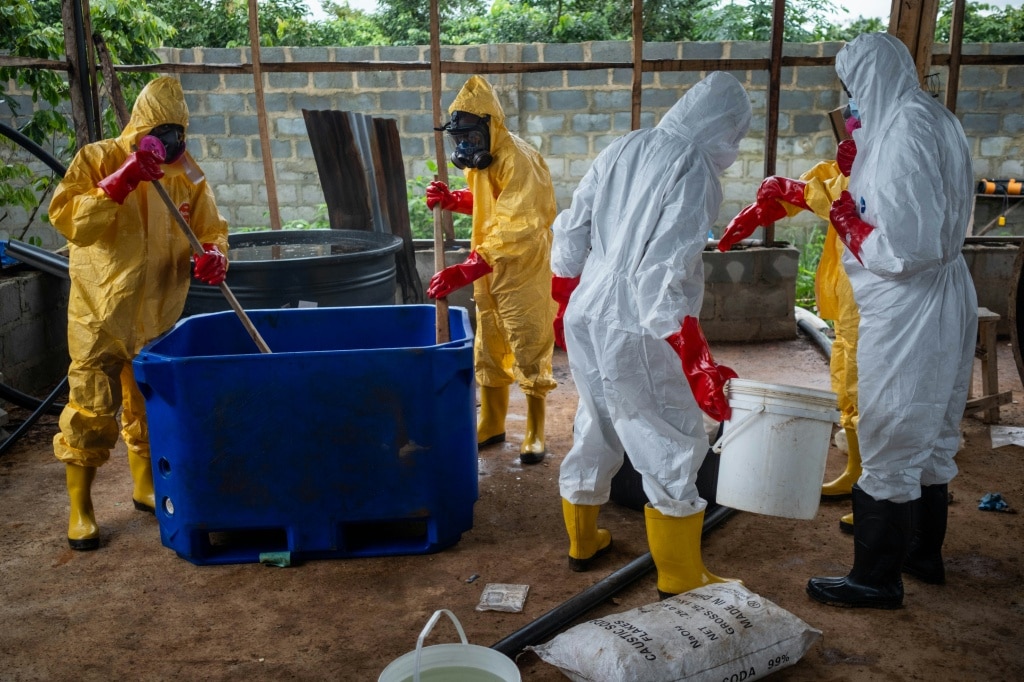
Deep within a dense forest straddling two rural villages in Nigeria’s southwestern Ogun State, an abandoned shed hid a chilling secret: tons of unprocessed chemicals, large cooking cauldrons, and crude filtration equipment, all remnants of an alleged $360 million transnational methamphetamine operation. On Wednesday, Nigeria’s National Drug Law Enforcement Agency (NDLEA) oversaw the full dismantling of the facility, the largest meth production hub ever uncovered in the country, a move that has renewed long-simmering concerns about the expansion of Mexican cartel influence into West Africa.
The dismantling came one week after an unprecedented on-site court proceeding, held as part of an ongoing trial of three Mexican nationals linked to the facility. An AFP correspondent accompanied NDLEA officers as they brought in local tradespeople to cut apart and remove the lab’s production infrastructure, nearly five months after the operation was first raided. In May, law enforcement teams arrested 10 suspects – seven Nigerians and three foreign nationals – during raids on the forest lab and two high-end residential properties in Lagos’ upscale neighborhoods. When the dust settled, they had seized finished meth and precursor chemicals worth an estimated $360 million on the illegal market. While the trial has moved back to indoor courtrooms in Lagos, a judge ordered the site cleared for urgent environmental reasons, with residual toxic chemicals posing a major risk to local groundwater and air quality. When the AFP visited the site this week, abandoned barrels of chemicals and partially processed meth were still emitting acrid, choking vapors that lingered across the surrounding forest.
For decades, West Africa has served as a key transit hub for drug trafficking, most commonly for cocaine moving from South America to consumer markets in Europe. But the Ogun State bust marks a significant shift: rather than just moving drugs through the region, transnational criminal networks are now setting up local production operations for highly addictive synthetic drugs like meth. Local security officials say the scale and professional structure of the Nigerian lab is clear evidence of direct involvement by Mexican cartels, which have been exporting their illicit production expertise to West Africa since at least the early 2010s. A 2019 report from the Institute for Security Studies already documented a steady rise in meth seizures and lab raids across Nigeria since 2011, a trend that has continued into 2024: just last June, another Mexican national was arrested during a separate meth bust in Oyo State, central Nigeria.
Despite the growing threat from transnational cartels, NDLEA officials say they are prepared to contain the crisis. “About our readiness to combat the cartel… yes, we are ready,” James Taalba, the NDLEA’s deputy commander of narcotics, told AFP. “We have people who are capable of curtailing such a situation.”
For local residents living just kilometers from the lab, the discovery came as a shock. Florence Banjo, a 59-year-old farmer who lives in Abidagba, one of the villages bordering the forest site, said she had noticed a foul stench drifting from the forest for months, but assumed it came from a local pigsty. Like many other area residents, she had heard rumors the cleared forest land was being prepared for a new housing development – a prospect that left her excited, as she hoped the project would bring paved roads to her isolated community. “We heard rumours that they were going to build an estate there, and I was happy that they’d finally pave the road that leads into our village,” Banjo said. “We were disappointed.”
Public health experts warn that the rise of local meth production in Nigeria poses an acute threat to the country’s already overstretched healthcare system. Small amounts of contraband that slip past traffickers have already begun to enter domestic drug markets, creating a public health crisis that poorly funded local health services are ill-equipped to address.