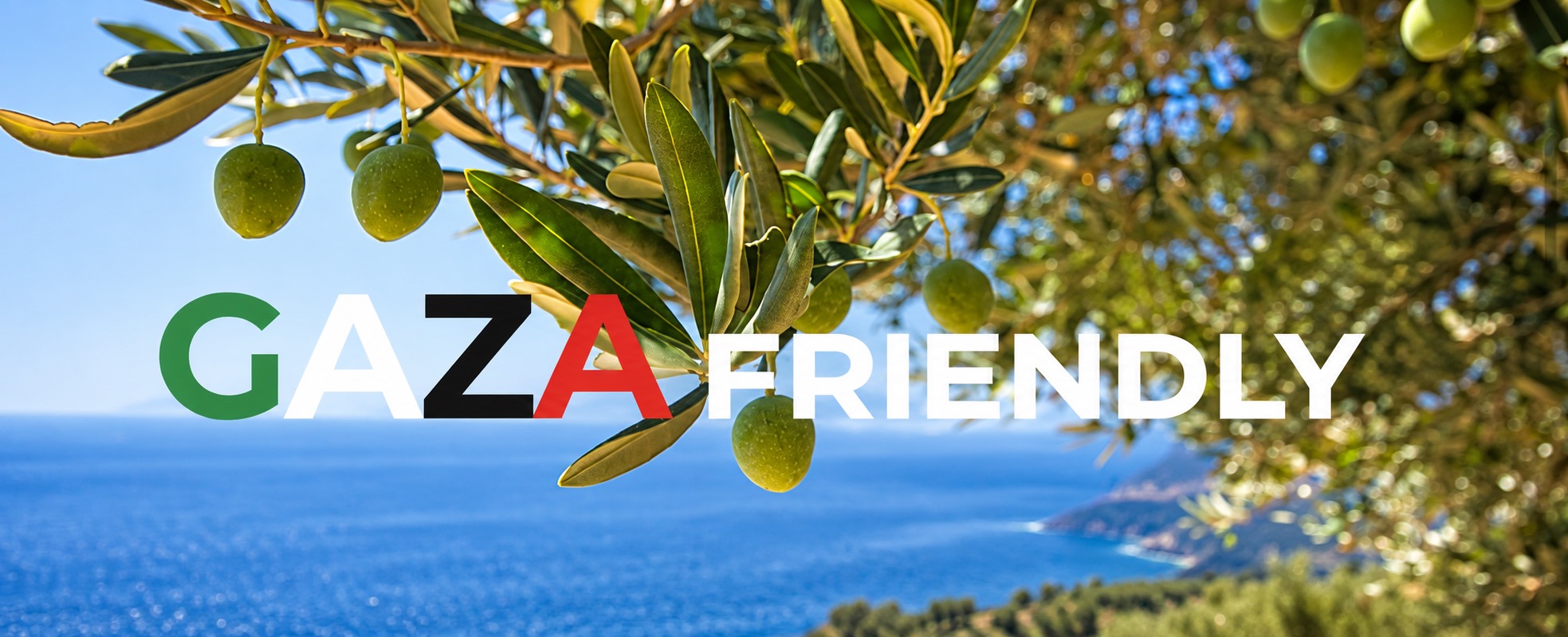
Since its launch in June 2025, a distinctive smartphone application with a heart-shaped icon emblazoned with the Palestinian flag has been gaining traction among pro-Palestinian activists and ethically minded consumers in France and beyond. Named Gaza Friendly, the app operates as a certification platform for retail and food service business owners who commit to boycotting goods sourced from Israeli-occupied Palestinian territories and produced by companies that back Israel’s illegal settlement expansion.
Today, the platform’s app and companion website feature a growing directory of 80 certified businesses across France, spanning a wide range of food and beverage-focused operations including butcher shops, restaurants, bakeries, catering services, tea rooms, and food distributors. The directory is updated on a regular basis, and the app includes a built-in interactive map that lets consumers quickly locate certified merchants within their local area. To date, the app has been downloaded more than 500 times, built from the ground up by Pierre-Amael Noailly Charny, a Tunisian-origin pediatrician based in Lyon, alongside a small circle of like-minded friends.
In an interview with Middle East Eye, Noailly Charny explained that the initiative gives participating shopkeepers a tangible way to formalize their support for the Palestinian cause. “This label gives people outraged by the genocide in Gaza the possibility to turn their consumption into a lever for justice and solidarity,” he said. The entire project draws core inspiration from the Boycott, Divestment, Sanctions (BDS) movement, the global campaign launched in 2005 by Palestinian civil society to pressure institutions and individual consumers to reject products linked to Israeli settlements, which are widely recognized as illegal under international law. “Boycott works because refusing certain products cuts off resources from the oppression,” the initiative states on its official website, with a long-term goal of building a large, interconnected network of certified merchants to amplify the reach and visibility of the global boycott campaign.
To earn Gaza Friendly certification, merchants are required to adhere to a clear three-point charter: they must remove all Coca-Cola Company beverages, all PepsiCo beverages, and all fresh produce imported from Israeli settlements from their inventory. Noailly Charny notes that targeting Coca-Cola and PepsiCo is a deliberate, peaceful advocacy strategy with powerful symbolic weight, citing well-documented evidence of the companies’ operational ties to the illegal occupation of Palestinian territories. In 2025, BDS publicly revealed that Coca-Cola maintains a regional distribution center and temperature-controlled storage facilities in the Atarot settlement located in the occupied West Bank, while PepsiCo has faced longstanding criticism for its investments and subsidiary operations tied to Israel.
Activists argue that even though PepsiCo publicly maintains it does not provide political or military support to Israel, the company’s ownership of prominent Israeli brands including SodaStream and Sabra, alongside its ongoing commercial operations within the country, constitutes indirect backing for the Israeli state. For its part, Coca-Cola has stated that it does not formally endorse any nation, government, or official policy, but has not directly addressed the specific claims regarding its Atarot facility. Both multinational corporations declined to provide official comment to Middle East Eye for this report.
Noailly Charny emphasized that long before the Gaza Friendly app existed, many independent merchants across France had already chosen independently to stop carrying Coca-Cola and Pepsi products in solidarity. “We therefore chose to put them in the spotlight and list them to set an example and encourage others to join,” he explained.
One of the most recent additions to the certified directory is Aid Boucherie Halal, located in Creteil, a suburb just outside of Paris. The business was added to the Gaza Friendly roster on September 4, after owner Akli learned of the initiative through a personal contact. “The idea appealed to me, especially since some customers had already blamed me for selling Coca-Cola. Personally, I didn’t know the company had interests in Israel,” Akli told reporters. Akli added that he has long supported Palestinian rights but lacked a clear public way to demonstrate that commitment until he joined Gaza Friendly. “Now I don’t sell Coca-Cola or Pepsi, and my business is doing just as well – actually, even better,” he said, noting that he has seen a small but steady uptick in customers since joining the certification program.
Beyond maintaining the directory of certified businesses, Gaza Friendly also provides participating merchants with branded visual materials including posters and window stickers to boost public visibility of their commitment. It also curates a non-exhaustive list of alternative consumer products, with a heavy focus on beverage brands, that can replace the products targeted by the boycott.
Many of these alternative brands were specifically created to support Palestinian humanitarian efforts. One example is Pales Drinks, a Belgian soda brand founded in 2024 by young entrepreneur Abdelhakim Tarnach, which donates 10 percent of all its annual profits to humanitarian action in Gaza and the occupied Palestinian territories. That same year also saw the launch of Palestine Cola, a soft drink produced by Safad Food AB, a company founded by Palestinian-origin entrepreneurs based in Malmo, Sweden. For Palestine Cola, a portion of every sale goes directly to funding emergency humanitarian projects in Palestine, including providing clothing, temporary shelter, and food assistance to displaced communities. In France, Palestine Cola is primarily distributed by Jebalia, an online retailer focused on promoting ethical, solidarity-centered alternative consumption. Every purchase through Jebalia is framed on the company’s Instagram page as an act of tangible support for Palestinian humanitarian causes, and Jebalia itself has been listed as a Gaza Friendly-certified business since July 2025. Jebalia owner Sofiane Slimani says he fully embraces his public commitment to Palestinian solidarity. “We’ve reached a point where boycotting products linked to Israeli settlement activity is no longer enough. We need to offer alternatives,” he told Middle East Eye. Jebalia reports that it sold more than 100,000 cans of solidarity soda in 2025, its first year of operation. In addition to marketing through social media, the company attends high-profile public events to expand its reach, including the 2025 Annual Gathering of Muslims of France held in Le Bourget last April, and regularly partners with other advocacy-focused businesses to sell its products at pro-Palestinian solidarity events such as the Salam Cup charity football tournament held earlier this year in Bobigny, near Paris. During that tournament, Jebalia’s products were sold by Inda Coffee, a Paris-based coffee shop and matcha bar that regularly fundraises for Gaza aid initiatives. Though Inda Coffee participates in the boycott campaign, it has not yet sought Gaza Friendly certification. According to Noailly Charny, widespread awareness of the label remains low among French merchants, which is why expanding public outreach is a top priority for the organization. “We’re trying to reach influencers who work in the food sector,” the pediatrician said. Already, Lyon-based food content creator AmarFood, who focuses on highlighting halal, alcohol-free dining across Lyon and the Paris region, regularly promotes the Gaza Friendly initiative in his social media videos. More recently, another independent videographer published a lengthy breakdown of the app’s mission and functionality to help spread the word to a wider audience.
Looking ahead, the Gaza Friendly team has ambitious plans for global expansion beyond its French origins. Currently, merchants from roughly 15 different countries around the world have already joined the certification network, and organizers note that no comparable platform currently exists anywhere else globally to centralize this kind of consumer boycott action for Palestinian solidarity.