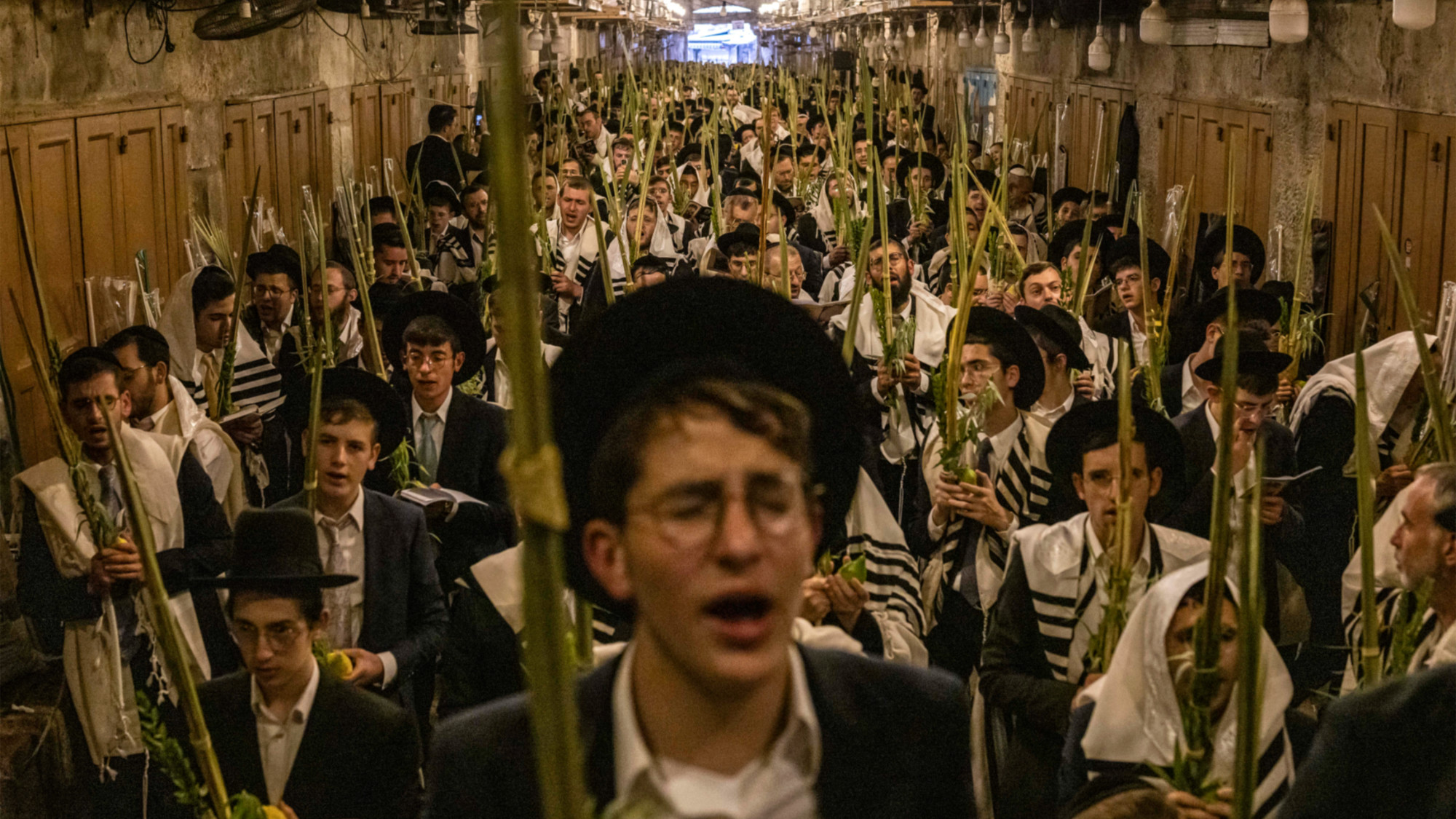
Tensions have flared in occupied East Jerusalem’s Old City after Israeli security forces ordered more than 50 Palestinian-owned businesses to close, sealed off a key access gate to the Al-Aqsa Mosque compound, and facilitated large incursions by ultranationalist Israelis into the sacred site during the Jewish Sukkot holiday.
The commercial shutdown, which went into effect Sunday morning on the third day of the week-long holiday, will remain in force through October 2. All affected shops are located in the Old City’s Muslim Quarter, along the route leading to Bab al-Qattanin — one of the primary entry points to Al-Aqsa used by Palestinian worshippers. In addition to closing local businesses, Israeli authorities ordered Palestinian residents of the area to stay indoors and fully blocked the gate to the mosque compound ahead of a mass gathering of Israeli nationals for holiday rituals Sunday night.
Local Palestinian authorities condemned the sweeping restrictions as part of a dangerous, repeated pattern of displacement and erasure of Palestinian presence in the Old City. “The situation in Jerusalem’s markets during the holidays has become a recurring and worrying pattern: streets are closed, residents’ movement is restricted, and access to the Old City is affected by security measures,” the Jerusalem Governorate said in a statement. The administration added that this sustained Israeli policy risks gradually stripping the Old City of its distinct Palestinian commercial and cultural identity, while pushing generations-old family businesses owned by local Palestinians to the brink of collapse.
Parallel to the shop closures, hundreds of ultranationalist Israeli settlers and far-right political figures stormed the Al-Aqsa Mosque compound over two days to perform unauthorized Jewish religious rituals, in direct violation of long-standing status quo agreements. According to official counts from the Jerusalem Governorate, roughly 1,500 people entered the site Sunday, with an additional 1,200 joining incursions Monday. All participants were provided with armed security protection by Israeli forces, where they held collective prayers, danced, chanted religious songs, and conducted holiday ceremonies within the complex.
High-profile far-right Israeli figures joined the incursions to signal their government’s claim over the site. On Sunday, Likud Party Knesset member Amit Halevi took part in the breach, and a group of nationalist rabbis entered the mosque courtyards alongside dozens of settlers to lead hymns. On Monday, Israeli National Security Minister Itamar Ben Gvir joined the incursion, releasing a public video declaring “Today, we are the ones in charge on the Temple Mount” — using the Israeli name for the Al-Aqsa compound. He also added inflammatory rhetoric targeting Palestinian detainees, stating “We have turned the lives of their terrorists into hell.”
The Jerusalem Governorate issued a formal condemnation of Ben Gvir’s incursion and the holding of Jewish prayers within the Al-Aqsa compound, noting that the actions violate the internationally recognized historical and legal status quo governing the site and represent a deliberate attempt to impose a new unilateral religious reality.
The status quo is a decades-old globally accepted agreement that regulates access and administration of the 144-dunam (14.4-hectare) Al-Aqsa compound. Under the terms of the arrangement, the entire site is formally recognized as an exclusively Islamic holy site, with full responsibility for access, prayer scheduling, maintenance, and archaeological work falling to the Jerusalem Islamic Waqf, the Islamic religious trust that has managed the mosque for generations.
However, since Israel occupied East Jerusalem in 1967, successive Israeli governments have systematically sidelined the Waqf and eroded the terms of the status quo. One of the most persistent breaches has been the authorization of near-daily incursions by Israeli nationalists and Jewish visitors, as well as allowing unauthorized Jewish prayer at the site, a practice that has accelerated in recent years under the current far-right Israeli government.