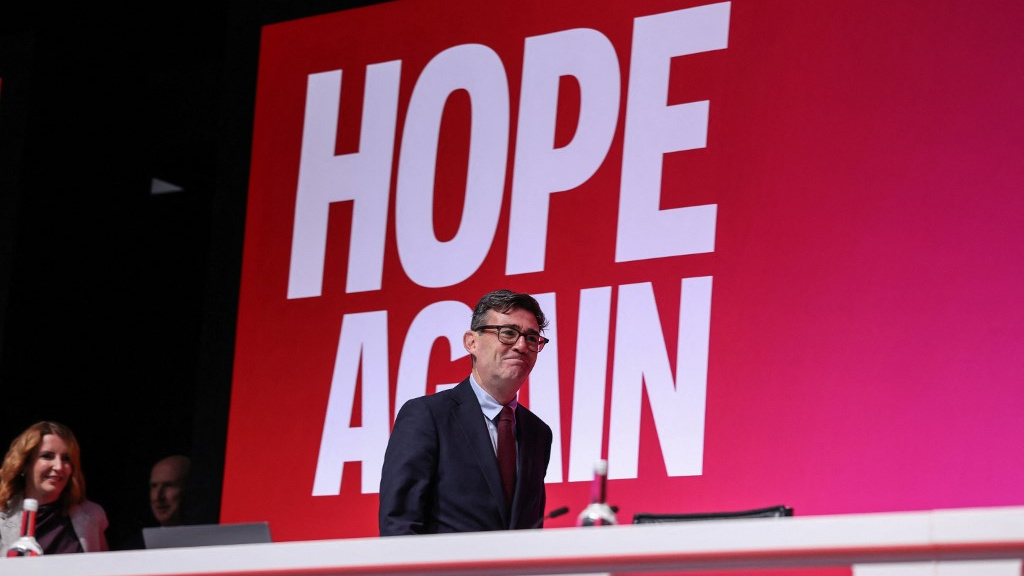
At the Labour Party’s annual conference in Liverpool, a contentious emergency proposal demanding the UK government scrap Palantir Technologies’ £330 million national health service (NHS) data processing contract has been blocked by the party’s internal Conference Arrangements Committee (CAC), sparking outrage among grassroots delegates and pro-Palestinian campaigners.
The motion was co-submitted by the Socialist Health Association, a group formally affiliated with the Labour Party, and at least three local constituency Labour parties. It targeted the controversial U.S.-based data surveillance giant over its well-documented ties to the Israeli military, calling on the newly elected Labour government to terminate the deal over allegations that Palantir has enabled serious human rights violations and breaches of international law, including Israel’s ongoing military campaign in Gaza and its unlawful occupation of Palestinian territory. The proposal stressed that any Labour government holds a core responsibility to preserve public trust in public contracting processes, particularly when vendors face credible accusations of complicity in grave human rights abuses.
Following the CAC’s decision to bar the motion from floor debate, the committee confirmed only that it determined the proposal failed to meet the required internal criteria for consideration. It stated it would provide a written explanation via email to the constituency parties that brought the motion. But the rejection has drawn immediate pushback from movement leaders and delegates, who have questioned the transparency and motivation of the CAC’s call.
Jon Byrne, a councillor representing Hazel Grove Constituency Labour Party, one of the motion’s original backers, raised a formal challenge from the conference floor on Monday morning. “We fully accept the CAC’s authority to make the decision but we ask that a detailed explanation is provided why our argument was rejected,” Byrne said, highlighting demands for greater transparency around contracting decisions involving firms linked to human rights violations.
The motion had garnered broad support from across the party’s left wing, including from the grassroots left grouping Momentum and the Palestine Solidarity Campaign (PSC). Dan Iley-Williamson, political organiser for the PSC, told Middle East Eye in an interview that the decision revealed a gap between the Labour government’s rhetorical support for Palestinian rights and its actual policy. “Labour members – just like people up and down the country – are disgusted that a company deeply implicated in Israel’s ongoing genocide and apartheid against Palestinians has this £330 million NHS contract,” Iley-Williamson said. “It is deeply disappointing that Labour blocked this emergency motion, demonstrating that while the foreign secretary today said protesters for Palestine ‘were right’, the government is still refusing to match that with action.”
The controversy over Palantir’s UK public contracts is not new. Since 2020, the firm has secured more than £670 million in public sector contracts across UK civil and defence departments, despite longstanding allegations of its complicity in Israeli abuses in occupied Palestinian territory. In January 2024, Palantir publicly announced a formal partnership with the Israeli Ministry of Defence to deploy its technology for “war-related missions” – technology that has been used to guide drone strikes targeting civilian sites in Gaza, including facilities used by journalists and humanitarian aid workers. In April 2025, Palantir CEO Alex Karp openly acknowledged the firm’s role in targeted strikes in Gaza, responding to accusations of enabling civilian deaths by stating “mostly terrorists, that’s true.”
A July 2025 report from United Nations Special Rapporteur Francesca Albanese further strengthened the allegations against the company, finding there are “reasonable grounds to believe Palantir has provided automatic predictive policing technology, core defence infrastructure for rapid and scaled-up construction and deployment of military software, and its Artificial Intelligence Platform, which allows real-time battlefield data integration for automated decision-making” for the Israeli military.
The block on the motion comes just days after the Labour government made high-profile shifts in its Middle East policy, and hours after Foreign Secretary Ed Miliband addressed the conference with conciliatory remarks to pro-Palestinian protesters. Miliband told delegates that the government heard the anger of millions of people “moved and outraged by the plight of the Palestinian people” and acknowledged “you were right.” He added that the party had reset its approach to the conflict, explicitly calling out ethnic cleansing by Israeli settler terrorists in the West Bank, acknowledging evidence of war crimes in Gaza, and condemning Israel’s decades-long illegal occupation of Palestine, claiming the government would “match words with actions.”
Earlier this month, the UK government formally designated Israel’s occupation of Palestinian territory as illegal under international law, announcing new comprehensive sanctions on Israeli settlements and a full ban on arms licenses and any other exports that “materially contribute to the occupation.” Middle East Eye has reached out to the CAC for additional comment on the motion block, and has not yet received a response.