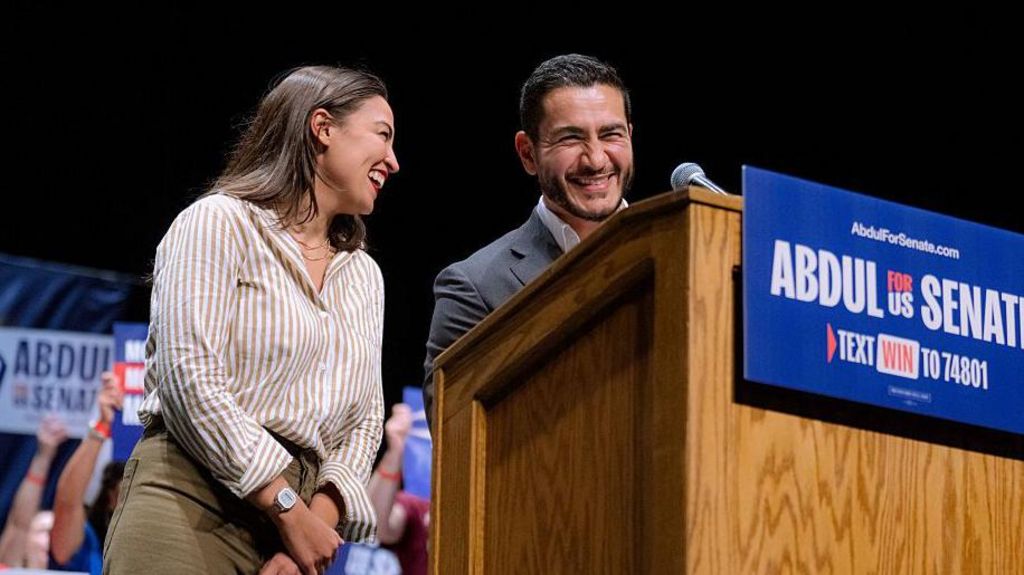
Beneath hazy skies still tinted by wildfire smoke drifting south from Canada, hundreds of Michigan voters packed Detroit’s century-old Opera House last Saturday evening, leaping to their feet in thunderous applause as two of America’s most prominent progressive leaders—Senator Bernie Sanders and Representative Alexandria Ocasio-Cortez—stepped onto the stage. The high-profile gathering was far more than a routine campaign stop: it was a public declaration that left-wing Democrats are positioning physician and Senate candidate Abdul El-Sayed as the future of the party, as the nation gears up for November’s pivotal midterm elections.
El-Sayed, a former Wayne County health director, is running on a unapologetically progressive platform anchored by Medicare for All, a wealth tax on billionaires, and the complete rejection of corporate campaign donations. His rally crowd carried signs emblazoned with his signature universal healthcare slogan, and wore shirts calling for an end to harsh immigration enforcement and cuts to U.S. military aid to Israel. But the eyes of the entire nation are fixed on this race, which has become a defining test of the progressive movement’s ability to win in critical battleground states amid deep internal divisions within the Democratic Party.
El-Sayed’s opponent in the August 4 primary is Congresswoman Haley Stevens, a well-funded centrist incumbent backed by the Democratic establishment, including Michigan Governor Gretchen Whitmer and outgoing Senator Gary Peters. Stevens has drawn massive financial support from corporate donors and pro-Israel lobbying group AIPAC, which has poured nearly $30 million into her campaign. For Democrats, the outcome of this primary will do more than pick their general election candidate: it will shape the party’s ideological direction ahead of 2028, as the faction split between establishment-aligned centrists and grassroots progressives continues to widen.
Michigan’s open Senate seat is a make-or-break race for Democrats. The state flipped from Joe Biden in 2020 to Donald Trump in 2024, and holding the seat is critical to the party’s goal of retaining Senate control and blocking Trump’s policy agenda. The primary winner will face Trump-endorsed Republican Mike Rogers in the November general election, raising urgent questions among party members about which candidate can win over swing voters.
This race comes at a moment when progressives have already notched a string of primary wins across the country this summer, most notably Zohran Mamdani’s upset victory in New York City’s mayoral race. But political analysts warn that replicating that success in the Midwest, a historically working-class region with many purple swing districts, will be far more challenging. “They got a big win with Mamdani in New York City, but New York is an outlier,” explained Adrian Hemond, a Michigan-based political strategist. “Progressives have struggled to gain traction in more politically mixed, traditionally purple areas like this.”
For many progressive voters, however, El-Sayed’s campaign has sparked unprecedented enthusiasm, drawing first-time volunteers like 35-year-old Corie Johnson, who has never canvassed for a candidate before. “Millennial voters aren’t stuck in the old, rigid ways of politics,” Johnson said while canvassing door-to-door in Hamtramck. “That’s why he’s building such momentum here.” El-Sayed’s campaign message, centered on stripping big money out of politics and lowering everyday costs for working families, has resonated with voters struggling with skyrocketing prices for groceries, gas, housing, and healthcare—issues consistently ranked as top priorities by Michigan voters in pre-election polling.
Les Lukacs, a lifelong Democrat from Monroe who lacks health insurance, says El-Sayed’s platform has earned his unwavering support. If El-Sayed loses the primary, Lukacs says he will not vote for Stevens in November. “We can barely afford basic groceries and gas,” he said. “I have to cut corners everywhere, and healthcare is the first thing that goes.” El-Sayed argues that the Democratic Party’s declining favorability, which dropped 12 points to 67% among self-identified Democrats in 2025 Gallup polling, stems from the party’s failure to prioritize the needs of everyday working people. “If Democrats cared more about the struggles of ordinary people, they’d be fighting for the exact same policies I am,” he told the BBC.
A spokesperson for Stevens’ campaign pushed back on that framing, saying the congresswoman “will fight for all Michiganders from every corner of the state to lower costs, protect manufacturing jobs, and take on Donald Trump’s corruption and abuses of power.”
The Israel-Gaza war has emerged as another defining fault line in the race, with particular resonance in Michigan, home to the nation’s second-largest Arab-American population. The son of Egyptian immigrants, El-Sayed has labeled Israel’s military campaign in Gaza a genocide and repeatedly called for an end to U.S. military aid to the country, drawing a sharp contrast with Stevens, who supports maintaining unconditioned U.S. aid to Israel and has received massive backing from AIPAC. Polling shows growing opposition to continued U.S. support for Israel among Democratic voters, and community leaders like Rex Nazarko of the American Muslim Engagement and Empowerment Network expect El-Sayed to win over thousands of Michigan Democrats who refused to support Biden and Harris in the 2024 presidential election over their Israel policy.
That divide reflects a broader existential dilemma for the national Democratic Party, which has long relied on support from both Jewish and Arab-American communities to win competitive races, according to Larry Sabato, director of the University of Virginia Center for Politics. “They have to make a choice,” Sabato said. “Both sides are working to make that choice as painful as possible for party leadership.”
Even as progressives turn out enthusiastically for El-Sayed, many Democrats across the state remain skeptical that a far-left candidate can hold the seat against a Trump-aligned Republican. Seventy-four-year-old Colleen Houlihan of Ferndale, who plans to vote for Stevens, says she supports many of El-Sayed’s policy goals but worries he is too progressive to win in November. “I want radical change for this country, but first we need an electable candidate to get power back into reasonable hands,” she said. Other Democratic officials, speaking off the record, note that Stevens’ corporate fundraising gives her a critical advantage in a high-stakes general election, arguing that established political connections are necessary to advance policy change.
Even some of El-Sayed’s own supporters share that anxiety. “I’m a little scared, a little nervous,” said 70-year-old Claire McHugh, who attended Saturday’s Detroit rally. “I just hope enough people are fed up with the status quo to turn out for him.”
For his part, El-Sayed says he is focused on building a new vision for the party, regardless of the primary outcome. “I’m not concerned with fighting over the future of the Democratic Party,” he said. “But if Democrats want to find their future, we’re showing it to them right here in Michigan.”
Sabato says it remains unclear which faction of the party will emerge victorious in the primary, but warns that failure to bridge the growing ideological gap will have long-term consequences for Democratic electoral hopes. “The party is already fraying,” he said. “If they don’t repair this divide quickly, certainly by 2028, they’re going to have to get used to losing for a long time to come.”