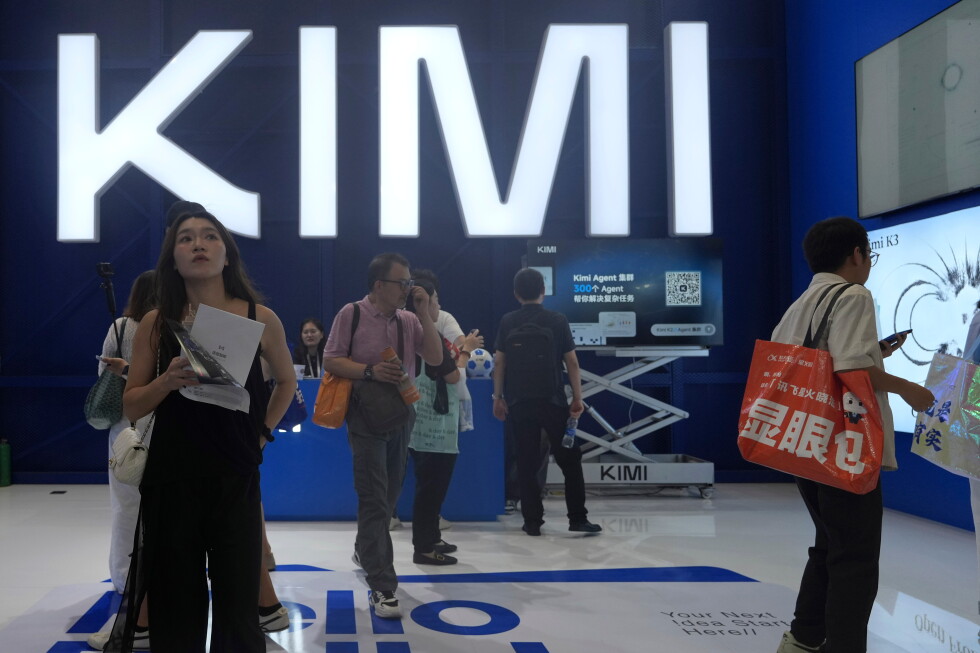
In a shifting global artificial intelligence landscape, Chinese AI models are emerging as unexpected heavy hitters in the U.S. market, drawing growing adoption from developers, corporate users, and tech industry insiders with their combination of competitive performance and far lower price points. What started as a niche alternative to U.S.-built frontier models has now reached a critical turning point, reshaping the U.S. AI market and fueling intensifying great power competition in one of the world’s fastest-growing strategic tech sectors.
Raffi Krikorian, chief technology officer at Mozilla — the organization behind the widely used Firefox browser — is among the early converts to the new wave of Chinese AI. Just over a week after Chinese AI startup Moonshot launched its powerful new Kimi K3 model, Krikorian had already shifted the majority of his daily work tasks to the system. Comparing K3 to Anthropic’s higher-priced, widely acclaimed Claude Fable chatbot, Krikorian noted that the Chinese model “just seems snappier.” Before adopting Kimi K3, Krikorian already relied on another top-tier Chinese model, Z.ai’s GLM-5.2, for routine work such as calendar management, document processing, and email sorting.
Krikorian is far from alone. A rising number of American technology professionals and companies are turning to Chinese AI systems, which have been gaining global market share thanks to their affordability and rapidly improving efficiency. Even major U.S. firms, including cryptocurrency exchange Coinbase, have announced shifts to Chinese AI models as a strategy to cut operational costs amid pressure to reduce AI spending.
This growing popularity has created frustration for leading U.S. tech giants that have long dominated the global AI market. But unless Washington imposes an outright ban on Chinese AI systems, industry analysts note that these models will likely remain attractive to independent software developers across the U.S. and other global markets.
The rising profile of Chinese AI comes amid escalating U.S. restrictions on Chinese tech access. Existing American-led trade controls already bar China from purchasing some of the world’s most advanced technologies, including cutting-edge AI chips. U.S. Treasury Secretary Scott Bessent has also warned that additional sanctions could be imposed to protect what Washington calls American intellectual property. Last Wednesday, the Trump administration accused Moonshot of using “covert” methods to develop K3 based on Anthropic’s Fable model, though the administration stopped short of labeling the activity illegal. A number of U.S. politicians and AI firms, including Anthropic itself, have claimed that Chinese startups engage in illicit “model distillation” to extract proprietary technology from U.S. models — a claim Beijing has repeatedly rejected as completely groundless.
The rapid breakthrough of cutting-edge Chinese AI models in 2025 marks a new phase in the U.S.-China AI race, which has evolved significantly since early 2024, when Chinese startup DeepSeek upended the U.S. tech industry by launching a model that matched the performance of top U.S. alternatives at a far lower cost, putting China firmly on the global AI map.
Industry experts confirm that the latest generation of models from Chinese startups — Zhipu (Z.ai)’s June release GLM-5.2, Moonshot’s July launch Kimi K3, Alibaba’s previewed Qwen3.8 Max model, and DeepSeek’s April V4 preview — all perform nearly on par with frontier models from U.S. leaders OpenAI and Anthropic. These Chinese models are already challenging the dominance of OpenAI’s GPT series and Google’s Gemini, with consistent quarterly advances that have steadily closed the performance gap.
For most business and individual users, the Chinese models hit the sweet spot between performance and cost. Curt Meinhold, a North Carolina-based technology executive and founder of digital legacy platform LilyList, says he increasingly relies on DeepSeek for commercial tasks including generating sales leads and identifying new business opportunities. “At the end of the day, most of us, the vast majority of us, 90 plus percent, don’t need (Anthropic’s) Mythos or Fable,” Meinhold explained. “We just don’t need it, we need something good enough.”
A July research report from U.S. investment bank Goldman Sachs highlighted that Chinese AI models have now reached a “critical stage” for mass global adoption. This shift is being accelerated by a global boom in “agentic” AI usage, a development that requires AI systems to autonomously complete multi-step, complex tasks, driving sharp growth in demand for cost-effective AI solutions.
AI pricing is calculated per million tokens for both input and output data, so the rise of AI agents dramatically amplifies cost differences between competing models, according to analysts including Alex Colville of the Australian Strategic Policy Institute. Meinhold echoed that observation, noting that his testing found Chinese models perform nearly as well as U.S. alternatives for coding and research work. “If I can pay a handful of cents per million output tokens versus 30 bucks or 40 bucks or 50 bucks, then it’s good enough,” he said.
Data from the past month shows just how far Chinese AI has come: on OpenRouter, a leading platform that aggregates usage data across AI models, the top five most popular models are all Chinese. Market intelligence firm Sensor Tower estimates that Kimi gained more than 930,000 downloads globally in the week following K3’s July launch, a 200% increase from the week before. In the U.S. alone, downloads jumped 387% to roughly 86,000 in that period. Demand for K3 grew so rapidly that Moonshot was forced to temporarily suspend new subscriptions after usage pushed the platform’s infrastructure close to its maximum capacity.
Despite these gains, industry analysts note that Chinese AI still has clear limits. Anastasios Angelopoulos, co-founder and CEO of AI evaluation platform Arena, pointed out that while Chinese models have become serious competitors to U.S. offerings, they still lag behind leading American AI systems in overall full-spectrum capability. Yasir Atalan, a researcher at the Center for Strategic and International Studies, added that U.S. AI firms are already responding to the price competition by developing lower-cost alternatives of their own to retain market share.
Ironically, some U.S. policy choices have ended up boosting adoption of Chinese AI models in the U.S. and global markets. Unlike most leading U.S. frontier models from Anthropic and OpenAI, which are closed-source, the vast majority of Chinese AI models are released as open-source software, meaning any developer can examine the code and build new tools on top of the existing model. Lian Jye Su, a senior analyst at tech research firm Omdia, explained that Chinese AI vendors are expected to leverage their open-source positioning to drive global adoption. Mozilla’s Krikorian noted that as Chinese open-source models become nearly comparable in performance to leading U.S. closed-source systems, “the open frontier is becoming increasingly Chinese-built.” At the same time, even as Washington weighs restrictions on Chinese AI, a group of major U.S. tech firms including Microsoft, Meta and Nvidia recently published an open letter backing the development of open AI models, aligning indirectly with the Chinese approach.
Other U.S. trade policies have also created unintended openings for Chinese competitors. Shortly after the Trump administration imposed export controls that took Anthropic’s Fable and Mythos models offline for more than two weeks, Chinese AI firm Z.ai launched its GLM-5.2 model to fill the gap. “Restricting an American model can immediately create an opening for a Chinese competitor,” Arena’s Angelopoulos said.
Within China, domestic adoption of AI technologies has grown rapidly, supported by state policy and investment. Major Chinese tech firms including Huawei and Tencent are integrating AI into a wide range of consumer products, from smartphones and AI smart glasses to humanoid robots. Now, Chinese AI developers are setting their sights on global market dominance. At a major flagship technology summit in Shanghai, Chinese President Xi Jinping has publicly championed open-source AI development, emphasized the need for greater global equity in AI access, and pledged China’s support to help developing nations build up their domestic AI capabilities.
As with many other Chinese industries, intense domestic competition has pushed leading AI startups to pursue global expansion to sustain growth. Top Chinese AI firms are now raising billions in new funding to support their international push, with several planning public share offerings to raise capital.
Chelsey Tam, an analyst at investment research firm Morningstar, noted that both the U.S. and China are focused on encouraging widespread adoption of their own AI ecosystems, while protecting core technologies that could strengthen strategic rivals. “The competition is no longer simply the United States against China; the Chinese labs are also putting a lot of pressure on one another,” Arena’s Angelopoulos explained.
Still, the huge capital requirements of AI development have raised questions about the long-term financial sustainability of many Chinese AI startups, mirroring similar concerns in the U.S. For example, Z.ai reported that its 2024 revenue surged 132% to 724 million yuan ($107 million), but its net loss jumped 60% to 4.7 billion yuan ($694 million) as heavy research and development spending weighed on profitability.
For the immediate future, however, analysts expect Chinese AI models to continue expanding their presence, even in the U.S. market. Mozilla’s Krikorian summed up the view of many American tech professionals: “I would highly recommend anyone doing any serious AI load to at least evaluate it.”