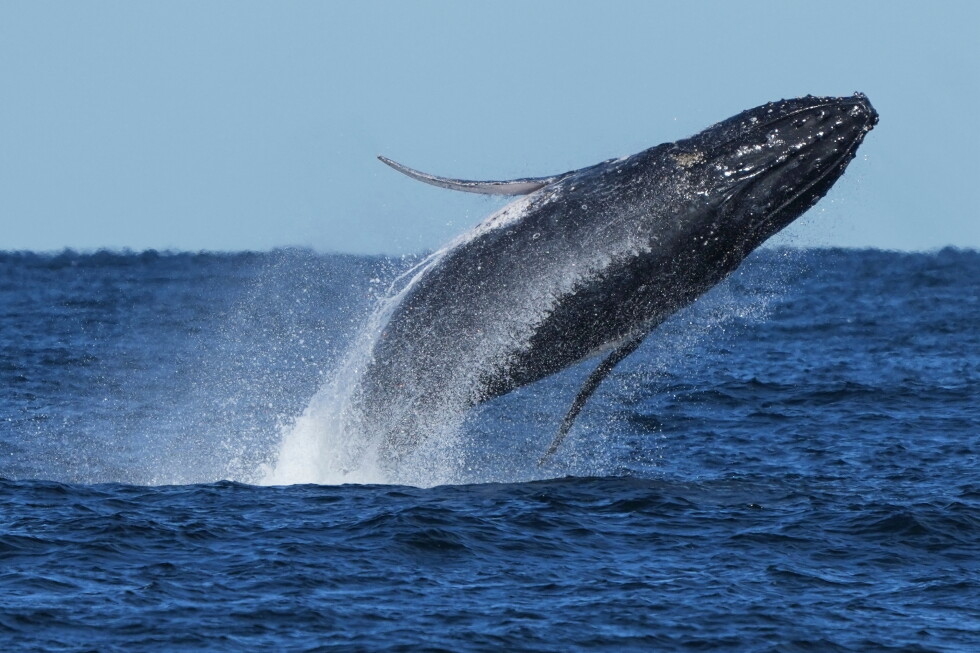
Off the rugged west coast of South Africa, a seasoned wildlife observer couple encountered a once-in-a-generation marine spectacle last December that has reinforced one of the oceans’ most remarkable conservation success stories — while shining a light on growing new dangers facing recovering whale populations.
Veteran marine photographer Chris Fallows and his wife Monique Fallows, a naturalist and author, set out on a routine excursion familiar to their decades of work documenting ocean life. What they encountered exceeded even their most optimistic expectations: a sprawling “supergroup” of humpback whales, with more than 200 enormous blowhole sprays rising steadily from the water, creating a silhouette Chris Fallows compared to the dense skyline of Manhattan. By the time the pair finished their systematic count, using the global standard practice of identifying individual whales from their unique tail flukes, they documented 299 humpbacks gathered in a single area — the largest such supergroup ever recorded.
For marine scientists, this extraordinary sighting is far more than a thrilling wildlife encounter. It is tangible proof that decades of protection have allowed humpback whale populations in the southern hemisphere to rebound dramatically from the brink of extinction. Following the 1986 international ban on commercial whaling, southern hemisphere humpback numbers have surged from fewer than 10,000 at the peak of industrial whaling to more than 100,000 today, according to data from the International Whaling Commission.
Humpback whales are typically solitary creatures or travel in small, loose pods, only forming massive supergroups in areas with extraordinary concentrations of their primary prey: tiny krill and small schooling fish. Happywhale, a global citizen science project that maintains a massive open database of whale sightings contributed by recreational and professional observers alike, confirmed the Fallows’ count as the largest humpback supergroup ever recorded. Els Vermeulen, chief scientist of the University of Pretoria’s Whale Unit, noted that humpback supergroups began reappearing in southern hemisphere waters around 2012, a trend directly tied to their population recovery after decades of overhunting.
“In general, the moratorium on whaling can be classified as one of the strongest conservation success stories in the marine environment,” said Vermeulen, a zoology expert who has studied southern hemisphere whale populations for years. She explained that once large feeding groups form, the low-frequency underwater sounds humpbacks produce attract more whales to the area, creating the massive gatherings researchers are now observing with increasing frequency.
But even as humpbacks celebrate a rare conservation win, scientists warn that new and growing threats put this hard-won recovery at risk. While humpbacks have bounced back strongly, the World Wildlife Fund notes that recovery remains uneven across all great whale species: seven of the 14 recognized great whale species are still classified as endangered or vulnerable by the International Union for Conservation of Nature, including North Atlantic right whales, whose global population numbers only around 380 individuals today. All whale species face persistent existing threats, including entanglement in commercial fishing gear, ship strikes, and disruptions to feeding and migration patterns caused by climate change.
Most alarmingly, researchers have identified a sudden, rapidly growing threat to South African whale populations tied to geopolitical conflict in the Middle East. Since the outbreak of the Israel-Hamas war in late 2023 and subsequent attacks on commercial shipping in the Red Sea by Yemen’s Houthi rebels, coupled with growing security tensions around the Strait of Hormuz linked to ongoing Middle East instability, thousands of commercial ships have diverted their routes around the southern tip of Africa to avoid the Red Sea. Preliminary research co-authored by Vermeulen found that shipping traffic around South Africa’s Cape region has quadrupled since December 2023.
This surge in traffic has drastically increased the risk of fatal ship strikes for whales, a threat that is often undercounted because most whales killed by ships sink to the ocean floor rather than washing ashore. Gregg Oelofse, coastal and environmental manager for the city of Cape Town, confirmed that whale carcasses that do wash ashore regularly show clear evidence of fatal collisions: large, deep cuts from ship propellers that cut through the whales’ bodies.
“More whales and more shipping clearly increase the risk,” Oelofse said. To mitigate this growing danger, Vermeulen and other marine conservation researchers are lobbying South African regulators to implement mandatory speed limits for large commercial vessels traveling near key whale feeding and migration routes off the country’s coast. Slower ship speeds give both crew and whales more time to avoid collisions, drastically reducing the risk of fatal strikes, researchers say.