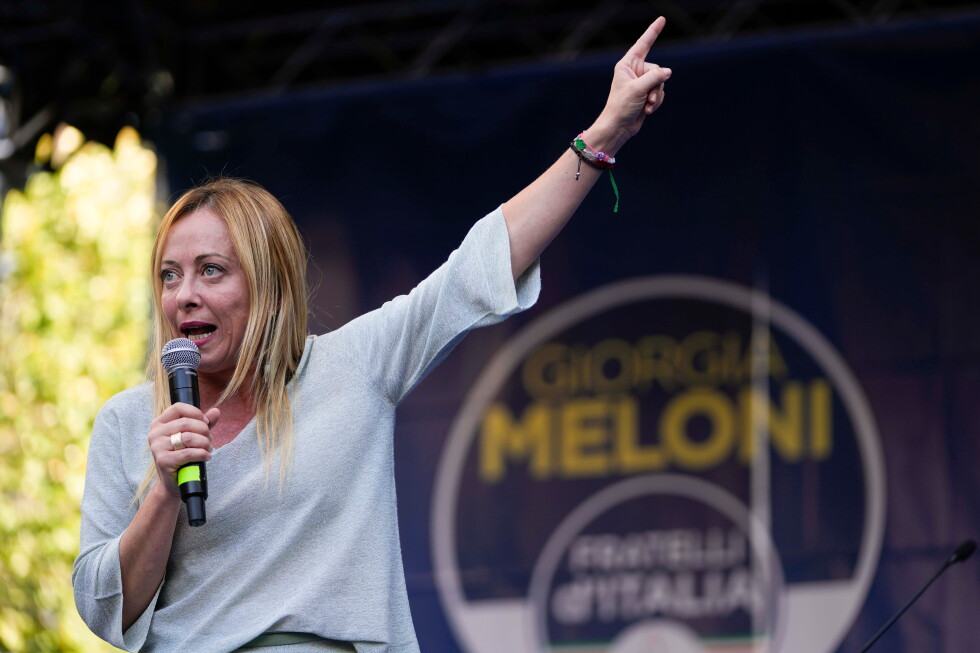
ROME — For decades, Italian politics has been defined by rapid government turnover, with short tenures and collapsed coalitions the norm rather than the exception. For most of her time in office, Prime Minister Giorgia Meloni’s perceived political success has been framed less by transformative policy wins and more by her uncanny ability to stay in power. That narrative reached a turning point this Thursday, when Meloni’s right-wing administration hit 1,413 days of uninterrupted rule — surpassing the 2001-2005 tenure of former Prime Minister Silvio Berlusconi to become the longest-serving unbroken Italian government since World War II. Meloni and her conservative Brothers of Italy party will mark the milestone Friday with a large campaign rally in the southern city of Bari, kicking off a push to secure a second mandate in national elections due no later than December 2027. When Meloni first took office in October 2022, she made history as Italy’s first female prime minister, leading the first Italian government helmed by a party with neo-fascist roots. Across European capitals and global financial markets, her rise sparked deep unease, with many observers bracing for a Euroskeptic, populist shift that would upend Italy’s long-standing alliances. In the years since, however, Meloni has governed as a pragmatic moderate, upholding Italy’s steadfast military and political support for Ukraine following Russia’s full-scale invasion, working collaboratively within European Union institutional frameworks, and committing to strict European fiscal discipline. Her cordial relationship with former U.S. President Donald Trump has also emerged as a notable asset in her foreign policy portfolio. At a time when political upheaval has toppled governments across Western Europe — from the UK to France — Meloni has kept her original three-party coalition fully intact for nearly four years, an unprecedented achievement in modern Italian politics and the core foundation of her reelection campaign. Defense Minister Guido Crosetto, a close ally of Meloni, praised her relentless commitment to governance in an interview with the Associated Press, noting that few Italian politicians have matched her work ethic and meticulous attention to detail, and that these efforts have earned her growing international credibility, even if domestic progress has been harder to nail down. “I know few people so determined, so hardworking, so precise, so meticulous, who have sacrificed both their human and private spheres in order to serve the institutions,” Crosetto said from his ministry office. “For this she is now reaping exactly what she deserves in terms of international credibility. She is not reaping the same on the Italian level.” Today, there is no longer any debate over whether Meloni is capable of governing. The central question facing voters ahead of the next election is whether her administration can point to enough tangible progress to earn a second full term. Meloni still has her sights set on another historic milestone that Berlusconi never quite claimed: a full uninterrupted five-year term, a mark that has eluded every post-war Italian government. One of Berlusconi’s mandates was cut just two days short of the full five-year threshold after he resigned following poor regional election results. Meloni and her supporters point to a series of concrete domestic wins: tighter public finances, the rollback of unsustainable costly policies, the creation of more than 1.2 million new jobs, and an overall unemployment rate that has fallen below 6%, a historic low. They also highlight a sharp drop in irregular migrant arrivals along Italy’s Mediterranean coast, a key campaign promise from 2022. “Duration is not synonymous with results … but these are important ones,” Crosetto argued. When defending her administration’s economic record at a recent labor event, Meloni emphasized that her pro-business policy approach had delivered tangible progress for Italian workers. “The government’s strategy has focused on supporting those who create wealth and jobs … we have reached a record high in employment,” she said. But critics, both from the opposition and on Meloni’s own political right, push back on these claims, arguing that Italy’s most persistent structural problems remain largely unaddressed. Stagnant productivity, a deepening demographic decline, and long-standing inefficiencies in the healthcare, education, and public administration sectors have seen little meaningful reform under Meloni’s government, even as soaring inflation and high cost of living continue to strain household budgets. “The Meloni government has been certainly stable and long-running, but it hasn’t achieved much in terms of structural reforms,” noted political analyst and pollster Lorenzo Pregliasco. Opposition leaders echo that assessment, arguing that beyond bringing public debt and deficit levels under control, Meloni’s government has failed to deliver the sustained long-term economic growth Italy needs. Former Prime Minister Giuseppe Conte, leader of the anti-establishment Five Star Movement and a potential 2027 election rival, said that the government’s celebration of its longevity rings hollow for ordinary Italians grappling with rising costs. “The government is celebrating, but Italians are not,” Conte said in a recent speech outside parliament. Many analysts agree that Meloni’s strongest and most consequential achievements have come on the international stage, rather than at home. When she took office, Italy was widely labeled as Europe’s “black sheep” prone to political and economic instability; today, that reputation has largely faded, argues Stefano Manzocchi, an international economics professor at Rome’s LUISS University. Meloni’s evolution from a nationalist outsider to a respected mainstream European leader has reassured both global investors and fellow European leaders, easing the fears that greeted her 2022 election victory. Her skill for diplomatic balancing was on full display during a recent public exchange with Trump, after the former U.S. president claimed she had “begged” him for a photo during a 2019 G7 summit in France. Meloni fired back with a blunt, public rebuke: “Italy doesn’t beg.” The moment won her widespread support from Italian voters, who saw it as proof she could maintain close ties to Washington while still forcefully defending Italy’s and Europe’s interests. “I like Meloni, I like her character because she is authoritative and doesn’t let anyone walk on her,” said David Del Sarto, a 52-year-old Rome taxi driver. Yet Meloni’s shift toward the political mainstream to secure stability and international credibility has created new vulnerabilities, particularly on her right flank. By pairing traditional nationalist positions on migration and national identity with pragmatic, moderate governing tactics, Meloni has helped accelerate the mainstreaming of hard-right politics across Europe, notes Johns Hopkins University international relations professor Nathalie Tocci. Once sidelined and viewed with suspicion by European political establishments, nationalist conservative parties now hold growing influence in national governments and EU institutions. Meloni’s supporters frame this evolution as proof that nationalist conservatives can govern responsibly while upholding democratic institutions and Western alliance commitments. But critics on the far right see her moderation as a betrayal of core campaign promises. The most high-profile challenge has come from retired army General Roberto Vannacci, who has launched his own political party to challenge Meloni from the right. Vannacci, who is known for hard-line stances on immigration and national identity, argues that Meloni abandoned the combative populist agenda that energized her original base, instead adopting a moderate, institution-friendly image to win approval from European and U.S. allies. Polling suggests Vannacci’s new movement could siphon off a meaningful share of conservative voters and lawmakers who believe Meloni moderated too far in her pursuit of political longevity. For Tocci, the legacy of Meloni’s historic tenure will ultimately hinge on what she has to show for four years of unbroken stability heading into the next election. “If you have five years in office and not much to show when you go back to voters, it can weigh against you,” she said.
Italy weighs the results as Giorgia Meloni’s government sets a longevity record