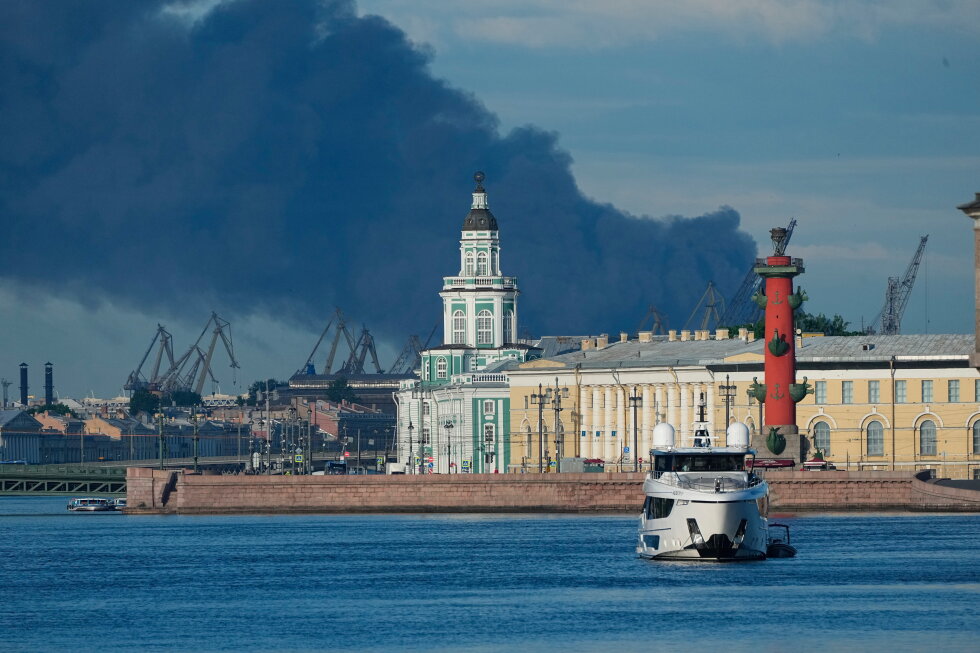
This summer, life for ordinary Russians has been upended by a wave of cross-border drone attacks originating from Ukraine, turning what were once routine daily activities into stressful, uncertain experiences and bringing the 4-and-a-half-year-old conflict in Ukraine directly into Russian homes. Long, winding lines at gas stations have become a common sight across the country, turning a quick fill-up into a hours-long ordeal. Thousands of commercial flights have been canceled, delayed or redirected, leaving vacationing travelers stranded. Even online shopping has been disrupted, after drone strikes set major e-commerce fulfillment warehouses ablaze. Data compiled by the Associated Press from Russia’s own Defense Ministry shows that between June and August, Russian air defense systems intercepted more than 43,300 Ukrainian drones over Russian territory and the illegally annexed Crimean Peninsula — a sharp, five-fold increase from the roughly 7,700 drones intercepted during the same three-month period last year. While many drones were shot down, dozens successfully reached their targets, hitting critical energy infrastructure, logistics hubs and commercial facilities across a vast geographic stretch of Russia, from the outskirts of Moscow in the west to Siberian cities like Omsk in the east. For retiree Margarita Terekhova, the disruption is impossible to ignore. “We were living a normal life, and then suddenly it’s like this,” she said, describing the multi-hour waits she endured to refuel her car in Moscow amid a nationwide fuel shortage triggered by repeated drone strikes on Russian oil refineries, a crisis that stretched well into August. As the summer draws to a close and the country prepares for its first national parliamentary election since Russia’s full-scale invasion of Ukraine, scheduled for September 18 to 20, the growing public awareness of the war’s domestic consequences has emerged as an unexpected political challenge for the Kremlin. The election, for seats in the State Duma, is held in a tightly controlled political environment that severely restricts opposition participation, leaving little doubt about the final outcome. But political analysts warn that even in this controlled system, the shifting public mood creates the potential for unexpected political volatility. “Elections are a time when people should reflect on themselves, the country, where it’s going and what to do about it,” said Nikolay Petrov, a senior research fellow at the NEST Centre, an organization founded by exiled Russian opposition figure Mikhail Khodorkovsky. Even in a strictly regulated political landscape, Petrov noted, “things that are unexpected, inconvenient (and) painful for the authorities” can still emerge. The current wave of attacks began on June 3, just as President Vladimir Putin’s signature annual economic forum got underway in St. Petersburg, when a drone strike hit an oil terminal just outside the city. In the months that followed, Ukraine expanded its campaign, targeting oil refineries, logistics centers, and the large warehouses of Russia’s two leading e-commerce retailers, Wildberries and Ozon, across the country from the Urals to Siberia. Denis Volkov, director of the Levada Center, Russia’s leading independent polling firm, told the Associated Press that the expanded scope and increasing frequency of the strikes has shocked much of the Russian public, becoming the dominant topic of public conversation for the entire summer. Despite Russian government restrictions on publishing imagery of the drone attacks and their damage, social media has been flooded with user-generated content: videos of endless lines at gas stations, posts from stranded travelers, and emotional accounts from small business owners whose entire inventory was destroyed in the warehouse fires. While the initial public shock has eased in recent weeks, long-term polling data tracked by the Levada Center shows a clear downward trend in public sentiment that has been building since last year. Assessments of Russia’s overall economic situation have worsened steadily, and public approval ratings for top political leaders have declined. Putin’s historically high approval rating, for example, has fallen to 76% as of August 2026, down from 87% in September 2025. Chris Weafer, CEO of Macro-Advisory Ltd., a business consultancy that operates in Moscow, said widespread complacency about the war that held for much of the past four years has faded, and public awareness of the conflict’s costs has grown sharply. “People are grumbling more, they’re talking more,” Weafer said, noting a striking level of pessimism about the prospect of the war ending soon, particularly among Russia’s business community. Compounding this public anxiety are persistent rumors that the Kremlin plans to launch a new round of military mobilization after the election, echoing the widely unpopular 2022 mobilization that drafted 300,000 Russian men into the military. Ukrainian officials have repeatedly claimed Putin is planning a new mobilization, a charge the Kremlin has dismissed as disinformation. But the persistent rumors have already driven many young Russian men to leave the country. A 23-year-old Muscovite, who requested anonymity for safety reasons, told AP she and her husband left Russia last month out of fear he would be drafted. She also described the constant fear triggered by the drone attacks, saying many Russians now feel war exhaustion, because the conflict can now disrupt “the life of any person in any corner of the country.” Volkov noted that anxiety over a new mobilization has lurked in the background of Russian public life for years, but flared up again after U.S.-led peace efforts stalled, leaving no clear path to end the conflict. “People don’t want (the conflict) to expand and more people to be dragged into it against their will, and this breeds certain concern, anxiety,” he said. So far, analysts agree, this growing public discontent and anxiety has not translated into large-scale anti-war protests, public unrest, or a coordinated protest vote large enough to alter the outcome of the parliamentary election. But the shift in mood has still forced the Kremlin to adjust its political strategy ahead of the vote, as authorities work to prevent any public debate about the war from undermining the narrative of stability and control they hope the election will project. A recent example illustrates this dynamic: Yabloko, Russia’s long-time liberal opposition party that runs on a platform of ending the war, was initially allowed to appear on the national ballot. Young party supporters flooded social media with campaign videos, and the party’s anti-war message resonated with many voters. But on August 10, Russia’s Supreme Court removed Yabloko from the national ballot, restricting the party to only running in individual single-member constituencies. Despite the ban, Kirill Goncharov, head of Yabloko’s Moscow office, told reporters that the party had already received 8,000 new membership applications, adding to its existing base of roughly 4,000 members. “The context of the summer of 2026 is that there is a demand for peace,” Goncharov said. Petrov explained that Yabloko’s unexpected popularity, particularly among young voters, “upended the Kremlin’s calculation” of allowing the party a small spot on the ballot to act as a safety valve for public discontent. Tatiana Stanovaya, a scholar at the Carnegie Russia Eurasia Center, said the removal of Yabloko makes clear that Russian authorities are unwilling to allow the election campaign to become an open debate “for and against peace.” For the Kremlin, Petrov explained, the primary goal of the election is not to produce a preordained result — which is already guaranteed by the state’s control over all major political parties — but rather to demonstrate broad public legitimacy for Putin’s rule. “Elections, like in Soviet times, should demonstrate the complete loyalty of all citizens,” he said, adding that the vote is intended to send a signal that Putin and the Kremlin have the situation fully under control, and that the Russian people are ready to follow whatever direction the authorities choose. Ordinary Russians interviewed by AP this week acknowledged that they still enjoyed small, happy moments over the summer, but nearly all described living with the constant disruption and uncertainty caused by the drone attacks. Natalya Bazhenova, a resident of Chita in Siberia, told AP she waited two full days in line just to fill her car with gasoline during a recent trip, and while traveling near the Ukrainian border in the Voronezh region, she received constant mobile alerts warning of incoming drone attacks. Ksenia Smirnova said her family canceled a planned flight to a Black Sea resort and is instead traveling by train to avoid the risk of flight cancellations or delays. On Tuesday, Ukrainian President Volodymyr Zelenskyy doubled down on the drone campaign, issuing an ominous warning to civilian airlines operating in Russia that the risks will only continue. “Although the Russian authorities are not properly informing people about this, Russian airspace will effectively be closing — the war started by Russia is closing its skies,” Zelenskyy said. “For now, the skies over Russia are for drones — not for civilian aviation.” Ukrainian officials have framed the cross-border drone campaign as “long-range sanctions,” designed to increase pressure on the Kremlin to end the war, and have made clear they intend to continue expanding the strikes even as Russia intensifies its own bombardment of Ukrainian territory.
Russians endured a summer of turmoil with gas crisis and swarms of drones as the war came home