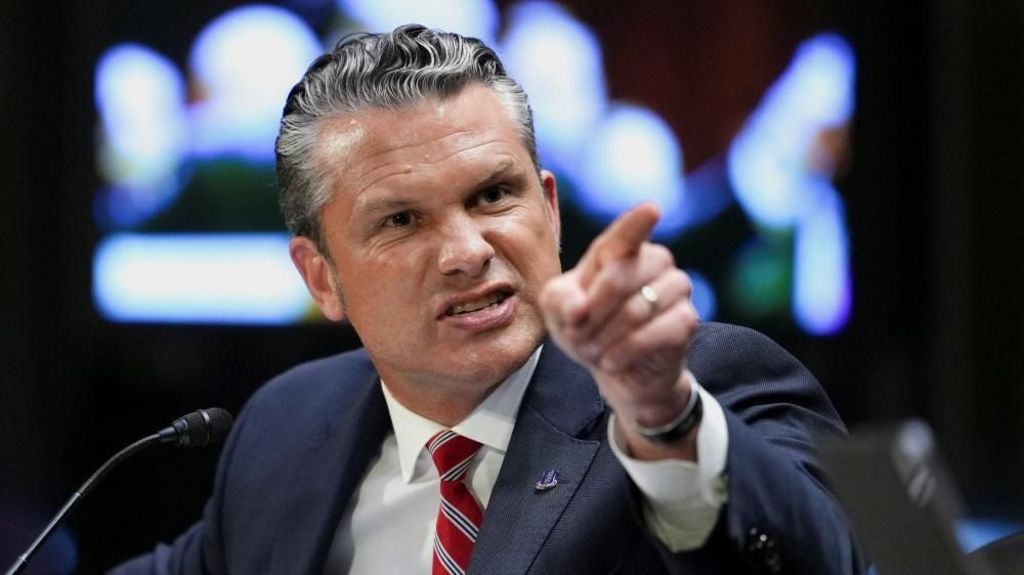
A critical congressional hearing on U.S. military funding for ongoing hostilities in Iran devolved into repeated disruptions Tuesday, as Defense Secretary Pete Hegseth pushed lawmakers to approve an $87 billion emergency funding request amid growing partisan division and mounting war costs.
In his first appearance before the Senate Appropriations Committee since U.S.-Iran hostilities resumed earlier this month, Hegseth revealed that total U.S. spending on the conflict has now reached $37.5 billion — an $8.5 billion jump from the last official estimate published in mid-May. Of the total funding he is requesting, Hegseth earmarked $67 billion specifically for Middle East operations, warning that without swift congressional approval, core military operations would face crippling shortfalls. These cuts, he argued, would extend beyond training reductions to threaten the Pentagon’s ability to pay active-duty troops, replenish critical weapons and munitions, and sustain frontline operations without interruption.
The hearing, held at a pivotal moment following the deaths of three U.S. service members in the region in recent days, was interrupted multiple times by anti-war activists, who shouted calls for an end to U.S. bombing campaigns in both Iran and Palestine before being removed from the room. Hegseth pushed past the disruptions to frame his request as an urgent, generational investment to maintain U.S. military dominance, arguing that “bold and swift action” is required to counter adversarial advances that could leave the U.S. playing catch-up. He framed every dollar of the requested funding as an investment in increasing U.S. military lethality and upholding the principle of “peace through strength.”
His testimony quickly turned into a partisan clash, as Democratic lawmakers pushed back hard against the request, arguing that the Trump administration was attempting to bypass standard congressional budget procedures to secure unrestricted war funding while American households struggle with domestic economic pressures. “It does not make a lot of sense,” Senate’s top Democrat on the committee Patty Murray said of the request, echoing comments from New York Senator Kirsten Gillibrand, who criticized the administration for asking for “unlimited money for bombs” while many U.S. citizens cannot afford to feed their families. Gillibrand also pressed Hegseth on a contradiction: why the administration was asking for billions more for a war that President Donald Trump has repeatedly claimed was already won. Hegseth defended the request, responding simply that he was asking for “the right bombs at the right time.” He also blamed the prior Biden administration for leaving the U.S. military with a legacy of underfunding, arguing that current gaps are a result of past mismanagement.
The $37.5 billion total cost figure revealed Tuesday marks the first updated official accounting of war spending in more than two months. When last measured in May, the estimated cost stood at $29 billion, with the Pentagon reporting $11.3 billion in spending in the conflict’s first week alone. The current round of hostilities comes after a brief April ceasefire between the U.S. and Iran collapsed just over a week ago, with both sides launching sustained retaliatory strikes across the region. Monday marked the 10th consecutive day of U.S. airstrikes, with Iran launching reciprocal attacks against U.S. forces and regional allies.
The request also faces headwinds from within Republican ranks, where fiscal conservative lawmakers are pushing for offsetting spending cuts to domestic programs to cover the war allocation. Compounding the legislative gridlock is the impending congressional recess: the House is set to adjourn Thursday, and both chambers will not return for joint session until September. Even if Republican leaders can round up enough votes to pass the request, that means the Pentagon will face a months-long delay before accessing any emergency funds.
The hearing unfolded as the U.S. military confirmed three recent combat-related deaths in the region, bringing the total number of U.S. service members killed in the conflict since it began February 28 to 18, a figure confirmed by President Trump in a post on social media Tuesday. On Tuesday, the Pentagon announced the death of 30-year-old active-duty Sgt. Michael Emmanuel Swinton, who was supporting operations in Iraq. That announcement followed confirmation Monday of two additional deaths: 19-year-old Private First Class Isabella Gonzales and 25-year-old First Lieutenant Tyler Feehan, both killed in action in Jordan.
The $87 billion request is part of a broader Pentagon budget proposal that would push U.S. military spending to a modern-era all-time high. The White House initially requested a $1.5 trillion Pentagon budget for the upcoming fiscal year back in April, setting the stage for what is expected to be a bitter fight over national spending priorities as lawmakers return from recess this fall.