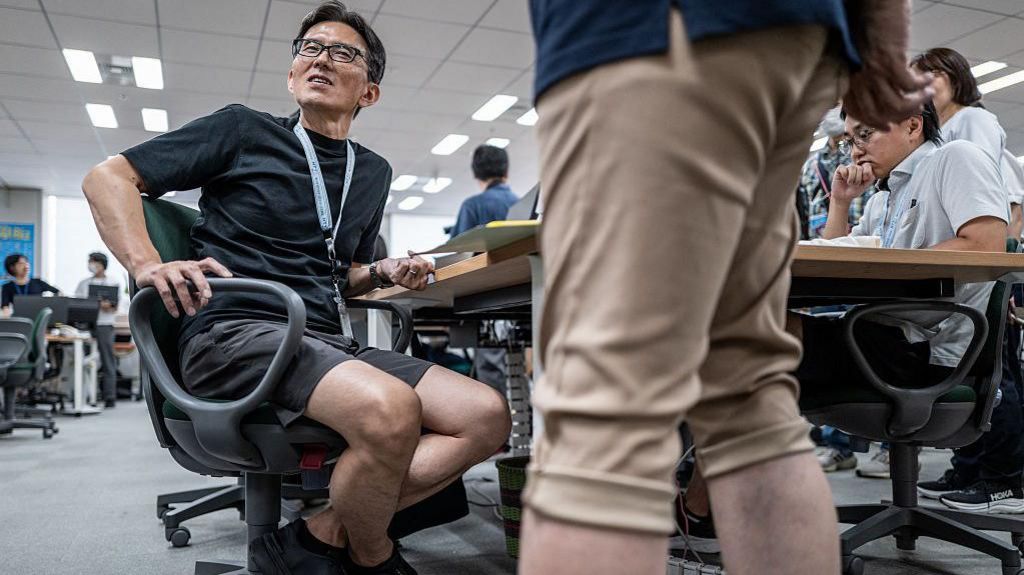
As Japan grapples with one of its most punishing summer heatwaves in recent history, a bold workplace policy from the Tokyo Metropolitan Government has split public opinion: encouraging male office workers to trade tailored suit trousers for casual shorts to beat soaring temperatures.
First conceptualized by current Tokyo Governor Yuriko Koike back in 2005 during her tenure as Japan’s Environment Minister, the Cool Biz initiative has evolved into a decades-long annual summer tradition. Koike originally launched the national program to cut energy consumption by prompting workers to adopt lighter, cooler attire, starting with short-sleeve shirts instead of formal long sleeves. After the 2011 Tohoku earthquake and tsunami disrupted national energy supplies, the initiative expanded into Super Cool Biz, which relaxed dress codes further to cut power use across workplaces and households. This April, Koike’s administration rolled out the latest iteration: *Tokyo Cool Biz*, which explicitly allows and encourages men to wear shorts in office settings to cope with extreme heat.
Nearly four months after the policy launched, public reaction has been deeply divided. Proponents argue that looser dress rules make long workdays in sweltering conditions far more comfortable, boosting productivity and reducing heat-related health risks. But critics have raised pointed concerns about gender inequity: many note that women are still widely expected to wear opaque tights if they show any leg at work, placing an unfair comfort and compliance burden on female employees that men do not face. The policy has also sparked an unexpected cultural conversation around “sunehara” — a newly coined online term translating to “leg hair harassment” — that describes the discomfort many women feel when forced to view unshaven male legs in shared office spaces.
Officials behind the initiative emphasize that its core goal is expanding choice, not mandating a specific wardrobe. “We want to give people more options in the severe heat, not tell them what to wear,” Noboru Watanabe, an environmental official with the Tokyo Metropolitan Government, told the BBC. “There should be no issue as long as the work attire is not offensive to anyone.”
Still, polling reflects the sharp divide in public opinion. A June survey conducted by Gorilla Clinic, a Japanese aesthetic medical provider, found that 53.5% of respondents opposed allowing shorts in summer workplaces, while 46.5% supported the new recommendation. For opponents of both genders, the top concerns centered on exposed body hair and body insecurities. The clinic noted that women responded to the survey in far higher numbers than men, indicating that female workers are disproportionately resistant to the shift to casual office shorts.
The policy has even created unexpected demand for aesthetic services. Akifumi Funatsu, Gorilla Clinic’s director, reports a sharp uptick in male clients seeking laser leg hair removal. What was once a purely cosmetic choice has become framed as a matter of workplace social etiquette, Funatsu explained, as many men internalize the widespread expectation that women prefer men to have minimal leg hair, and want to avoid making colleagues uncomfortable.
While the shorts policy has dominated public conversation around this year’s Cool Biz, it comes amid far more serious heat-related challenges facing Japan. Like much of the world, Japan has recorded record-breaking high temperatures in recent months, compounded by soaring global energy prices driven by Middle Eastern geopolitical instability. The Japan Meteorological Agency has even introduced a new term, *kokusho-bi*, or “brutally hot day,” to alert the public when temperatures exceed 40°C, in a push to raise awareness of deadly heat risks.
Official data underscores the severity of the threat: between July 6 and 12, seven people died from heatstroke and 4,580 were hospitalized across the country, according to Japan’s Fire and Disaster Management Agency. Beyond encouraging basic precautions like regular hydration and adjusted air conditioner use, Japanese residents have turned to a growing market of heat-fighting gadgets, from fan-embedded clothing and disposable cooling towels to heat-blocking umbrellas and portable handheld fans, all of which have sold out at many retailers nationwide.
Disaster reduction experts stress that proactive preparation is key to avoiding heat illness. Researchers with the Japan Academic Network for Disaster Reduction note that the human body requires several weeks to build heat acclimatization, so the best time to start preventive measures is during the country’s rainy season, before peak summer heat sets in. They add that Japan’s uniquely high humidity makes heat even more dangerous, as it slows sweat evaporation and undermines the body’s natural ability to cool itself.
While casual workplace attire has slowly gained traction in Japan over recent years — particularly in startups and tech firms — this year’s Tokyo government recommendation has normalized the shift for traditional industries. For many Japanese workers, adapting to hotter summers means not just changing what they wear to the office, but navigating new social expectations around professional appearance in a warming climate.