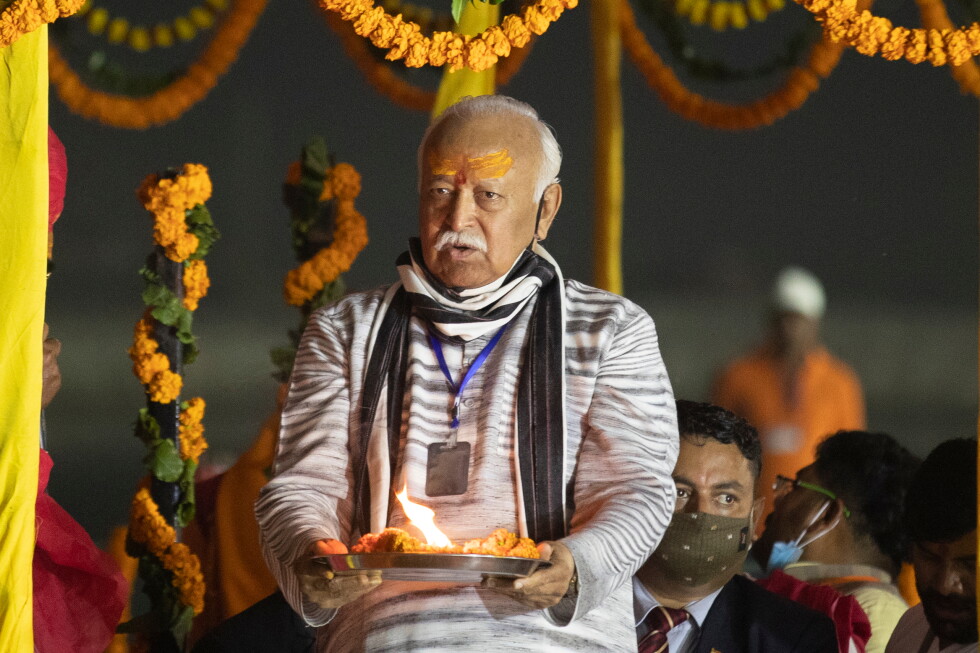
A planned Saturday address at New York City’s iconic Madison Square Garden by Mohan Bhagwat, chief of India’s Rashtriya Swayamsevak Sangh (RSS), has sparked fierce public opposition, drawing protests from interfaith groups, a formal denunciation from the city’s mayor, and a call for U.S. government sanctions from a federal religious freedom commission.
The RSS, a century-old right-wing Hindu nationalist organization, is widely recognized as the ideological backbone of India’s ruling Bharatiya Janata Party (BJP), led by Prime Minister Narendra Modi—who himself rose through the ranks of the paramilitary group. Critics have long accused the RSS of advancing Hindutva, a political ideology that frames Indian national identity exclusively through Hindu values, while fostering systemic intolerance against religious minorities and enabling documented human rights violations, including targeted mob violence, the demolition of minority religious sites, and the bulldozing of properties owned by Muslim communities.
Organized by American Hindus for Engagement and Dialogue and co-sponsored by more than 200 Hindu American groups, the event is branded as the “Universal Oneness Celebration,” rooted in the ancient Sanskrit concept of Vasudhaiva Kutumbakam, or “the world is one family.” Organizers say the gathering builds on the themes of the Hindu festival Rakshabandhan, expanding its celebration of familial bonds to a global call for collective responsibility across communities, nations, and the natural world. Expected attendees include entrepreneurs, educators, artists, youth leaders, faith and public officials, and representatives from Hindu temples and yoga centers, with an estimated 5,000 people in attendance. Organizers have declined to respond to interview requests from The Associated Press.
Opposition to the event has moved quickly across political and civil society lines. New York Mayor Zohran Mamdani this week publicly condemned the gathering, arguing that RSS’s core ideology is exclusionary and fundamentally incompatible with New York’s longstanding commitment to pluralism. On Wednesday, the U.S. Commission on International Religious Freedom (USCIRF), a nonpartisan federal advisory body, called on the U.S. government to impose sanctions on RSS members and revoke Bhagwat’s visa over allegations of ongoing religious freedom abuses tied to the organization. India’s Ministry of External Affairs swiftly rejected the commission’s statement, dismissing USCIRF as a biased body with no credibility to comment on India’s internal affairs.
A coalition of interfaith and civil rights groups—including Hindus for Human Rights, the Indian American Muslim Council, and the Interfaith Center of New York—held a protest press conference outside New York City Hall on Tuesday, demanding the event be canceled entirely. Sunita Viswanath, executive director of Hindus for Human Rights, noted that 61 interfaith and secular organizations have signed an open letter opposing the gathering, and hundreds of opponents will gather outside the venue Saturday to deliver a clear message: the RSS and its Hindutva ideology do not speak for all Hindus or people of Indian origin.
“Even if a majority of the Indian diaspora does not support Hindu nationalism, too few have spoken out publicly against it,” Viswanath said. “Our only option is to show up again and again with love, with the intention that our love will drown out the hate spread by these organizations.”
The event has laid bare deep divisions within the 5 million-strong Indian American community around issues of Hindu nationalism and the BJP’s rule. While the RSS maintains more than 250 local centers and youth chapters across the U.S. and enjoys broad support from many Indian American voters aligned with Modi, opponents have organized widespread resistance. One Muslim Indian American activist, Safa Ahmed, plans to travel from North Carolina to join Saturday’s protests, saying she is deeply disturbed by the large turnout expected for a leader she says promotes a politics of hate.
“That is very disturbing to me as an Indian American Muslim,” Ahmed said, though she added she has been encouraged by growing pushback against Hindutva from progressive Hindus, Sikhs, Christians, and Dalits—who have faced systemic caste discrimination in India for generations.
The Hindu American Foundation, a nonprofit advocacy group for U.S. Hindus, has pushed back against criticism of the event, calling on attendees to remain vigilant and civil while condemning Mayor Mamdani’s public opposition. “The mayor should honor his sworn duty to protect all New Yorkers, regardless of their national origin, religion or political beliefs,” the group said in a Wednesday statement.
Many analysts frame Bhagwat’s high-profile New York appearance as part of a deliberate multi-year public relations campaign by the RSS to soften its international image, as the BJP it spawned enters its third consecutive term governing the world’s largest democracy. Bill Drexel, a Hudson Institute senior fellow specializing in U.S.-India relations, noted that Bhagwat has toned down some of his more provocative public rhetoric in recent years, marking a new phase of the group’s global outreach.
“RSS is an organization with a uniquely complex history that is tied intrinsically to Indian politics, so it is hard to compare to more familiar political or religious movements in the U.S.,” Drexel explained. “We are seeing a new chapter in how they engage with the outside world. They grew as a grassroots movement for decades, and now that the political party they created holds national power, they face a new set of expectations and responsibilities.”
RSS national spokesperson Sunil Ambekar defended the gathering in a statement posted to X, writing that Bhagwat would “communicate with a diverse, multicultural, and multifaith audience” during his address. “Organized in the spirit of open dialogue and mutual respect, the event reflects Bharatiya (Indian) ethos which is fundamentally inclusive and welcoming to all,” Ambekar said. “This initiative aligns with RSS’s longstanding tradition of engaging with varied communities across India and the world to foster understanding and shared purpose.”
But critics like Viswanath reject the group’s framing of the event as a sincere push for inclusive dialogue, arguing the core ideology of Hindutva remains unchanged. “I just don’t buy it,” she said. “It’s still the same Hindutva ideology.”