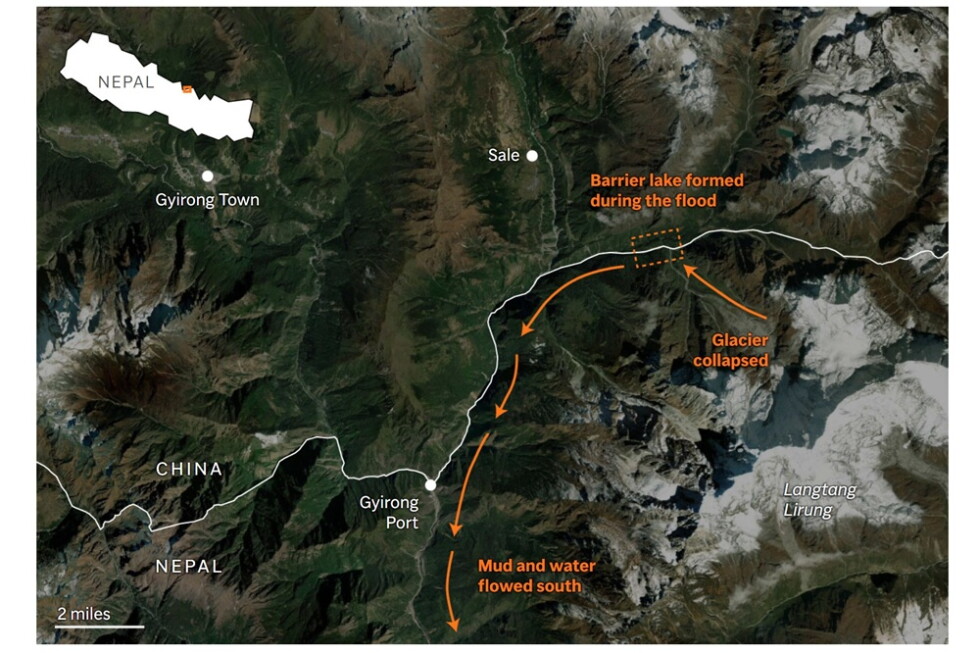
Rescue teams continued digging through thick mud and debris across flood-ravaged terrain along the Nepal-China Himalayan border on Friday, even as disaster officials issued an urgent new warning: a dammed glacial lake formed by this week’s catastrophic event is growing and could overflow, triggering a second round of destructive flash flooding.
Nepalese authorities have ordered all security personnel, rescue workers, and local civilians involved in search and relief operations to remain on the highest alert, with standing instructions to evacuate immediately to higher ground if conditions deteriorate. Nepal Police spokesperson Abi Narayan Kafle confirmed to the Associated Press that rescue work has not been suspended, but operations are proceeding with extreme caution amid the fresh danger.
Satellite imagery analyzed by China’s state broadcaster CCTV places the newly formed lake in the exact same area as a glacial detachment that occurred on Wednesday, the initial event that set off a chain reaction of downstream destruction that left hundreds dead and more than 1,500 unaccounted for. The lake formed after glacial debris blocked the flow of an upstream river, and according to Nepal’s national disaster management authority, preliminary satellite assessments confirm the water body is expanding, raising the risk of a sudden barrier breach and catastrophic downstream flooding.
CCTV reports place the natural debris barrier holding the lake more than 10 kilometers from Gyirong Port, the key Nepal-China border crossing that was already completely submerged by mud and floodwater earlier this week. The lake sits at an elevation of 2,950 meters, roughly 1,000 meters above the already inundated border crossing.
Climate researchers tracking the fast-moving situation in the Himalayas explain that Wednesday’s ice-rock avalanche scattered massive amounts of rock and debris across river valleys, creating several small, unstable water bodies in its wake. “Another dammed lake was formed by the August 26th ice-rock avalanche and this has begun to outflow,” explained Qianggong Zhang, head of climate and environmental risks at the Kathmandu-based International Center for Integrated Mountain Development. Zhang noted the lake holds roughly a few million cubic meters of water — enough to fill around 1,200 Olympic-sized swimming pools — and sits in a valley segment with minimal elevation change between the lake and downstream population centers.
As the region grapples with the aftermath of the initial disaster, the threat of a second catastrophic event has sent urgent alarm through response teams. Climate and geoscience experts note that ongoing high temperatures are accelerating glacial melt across the region, leading to more water accumulation behind the unstable debris dam, which is already obstructing the natural flow of the river.
While both Zhang and Jakob Steiner, a Dhaka-based geoscientist from Austria’s University of Graz, emphasize that the current high alert must be taken seriously to protect rescue workers on the ground, they add that a second flash flood on the same scale as Wednesday’s deadly event is unlikely.
This reporting features contributions from Huizhong Wu in Bangkok, and is part of the Associated Press’ ongoing climate and environmental coverage, which receives philanthropic funding from private foundations. The AP maintains full editorial control over all content.