分类: business

  • US drivers head to Native American lands for cheaper gas

    US drivers head to Native American lands for cheaper gas

    Across the United States, as retail gasoline prices continue to fluctuate and strain household budgets, a growing number of motorists are changing their refueling routines to seek out significant savings: they are traveling to Native American tribal territories to fill up their tanks.

    The core draw behind this trend lies in the unique legal status of federally recognized tribal lands, which grants these sovereign nations exemptions from most state and federal fuel taxes. Unlike standard public gas stations operating off-reservation, retail outlets on tribal land do not pass these accumulated tax costs down to consumers, resulting in per-gallon prices that are often 10 to 50 cents lower than the national average, and in some high-tax states, the gap can stretch even wider.

    For budget-strapped drivers, even a small per-gallon discount adds up to meaningful savings over time, especially for those who commute long distances or rely on their vehicles for work. Many motorists now plan regular trips around stops at tribal gas stations, sometimes driving several miles off their regular routes to lock in lower prices.

    This trend also highlights the economic role that tax exemptions play for tribal communities, where gas retailing has become a key revenue stream that funds local public services and infrastructure development. At the same time, it has sparked ongoing discussions about tax policy equity across different jurisdictions in the US, though for now, cost-conscious drivers show no signs of slowing their visits to tribal fuel outlets.

  • US home buyers ‘frozen’ as sales slump over Iran war fears

    US home buyers ‘frozen’ as sales slump over Iran war fears

    The United States housing market, which many analysts predicted would finally see a long-awaited recovery in 2026, has been thrown into unexpected turmoil after the escalation of conflict involving the US and Israel in Iran sent borrowing costs surging, derailing earlier momentum. New data released by the National Association of Realtors (NAR) reveals that existing home sales dropped 3.6% month-over-month in March, hitting a nine-month low of just 3.98 million units on an annualized basis — the weakest reading since June last year. Even though most of the March sales transactions were finalized before the military strikes began in February, the figures still show that the sector was already facing mounting pressure well before geopolitical tensions flared. Before the conflict escalated, mortgage rates had been trending downward through January and February, leading economists and industry experts to forecast that 2026 would bring a much-needed rebound for a market that has struggled with affordability for years. But that outlook has shifted dramatically. Average rates for the benchmark 30-year fixed mortgage climbed to 6.37% last week, up from 5.98% recorded just before the strikes began. The surge in mortgage rates is tied to growing market expectations that the Federal Reserve will keep its benchmark interest rates higher for longer as policymakers work to keep inflation in check, wiping out earlier hopes for multiple rate cuts that many homebuyers were counting on. For many prospective homebuyers, the sudden volatility has created a paralyzing sense of uncertainty. Andrew Vallejo, a principal listing agent based in Austin, Texas with national real estate brokerage Redfin, explained that rapid, unexpected geopolitical developments outside of consumers’ control have left many shoppers stuck on the sidelines. “Some buyers feel like they’re frozen — they don’t know how to make their decisions because events like the ones we’re talking about spring up so rapidly and so out of our control,” Vallejo told the BBC. The strain extends beyond hesitant buyers. Limited inventory of available homes continues to put upward pressure on prices, pushing the median existing home price to $408,800 in March — a 1.4% increase compared to the same period one year ago. For sellers, the shift in market conditions has also been a disappointment. Many had hoped that 2026 would bring more stable conditions after years of market chaos, but the new geopolitical uncertainty has thrown those plans off track. Economists say the entire slowdown can be traced directly to spillover effects from the Iran conflict. Thomas Ryan, North America economist at Capital Economics, notes that the jump in mortgage rates and a sharp collapse in consumer confidence, both knock-on effects of the conflict, have combined to weaken housing demand broadly. NAR chief economist Dr. Lawrence Yun echoed that assessment, adding that March sales were also dragged down by ongoing weakness in the US labor market alongside falling consumer confidence. Industry insiders warn that the situation could get worse before it gets better. Vallejo pointed out that if the conflict pushes energy prices higher, it could trigger a broader economic slowdown that would hit the housing market even harder. Rising unemployment from a broader slowdown would take even more prospective buyers out of the market, deepening the sector’s slump. “It’s a topic of concern that we’re all aware of because it would make people lose jobs,” Vallejo said. “A lot of it has been buyers feeling like they should either wait a little bit… and then for sellers, I think that in their mind they were hoping it would be a bit of a less chaotic world this year and things would be a little bit more calm.”

  • Sweeping US tariffs fail to deliver on stated goals

    Sweeping US tariffs fail to deliver on stated goals

    Twelve months have passed since the United States rolled out sweeping protectionist tariffs across a wide range of trading partners, and new official data confirms what many economic analysts predicted: the policy has failed to deliver on nearly all of its core stated objectives, while triggering a cascade of unintended negative consequences for both the US economy and the global trading system.

    When the tariffs were first announced on April 2 last year, the US government framed the measures as a bold solution to long-running economic challenges, promising to bring manufacturing jobs back to American shores, shrink the persistent US trade deficit, and drive stronger domestic economic growth. A full year later, results have fallen drastically short of these promises.

    Official federal data on manufacturing reshoring paints a particularly bleak picture: since the tariffs took effect, US manufacturing has cut jobs in nearly every month, with only small, temporary gains recorded in January and March of this year. Progress on narrowing the trade deficit has also stalled. 2025 full-year government figures show the US goods trade deficit widened by 2.1% to hit an all-time high of $1.24 trillion. The overall US trade deficit shrank by just $2.1 billion for the entire year, a negligible change driven almost entirely by a growing surplus in services trade, not the manufacturing gains the tariffs were meant to deliver.

    Economic experts across academic and policy institutions say these outcomes were entirely predictable, arguing that tariffs are structurally ill-suited to solve the deep-rooted domestic economic problems the US claims to be addressing, from industrial decline to persistent trade imbalances.

    Luo Zhenxing, an associate research fellow at the Institute of American Studies under the Chinese Academy of Social Sciences, explained that decades of hyper-globalization have built an intricate, deeply integrated global division of labor that cannot be unwound by tariffs alone in the short term. “Even if policymakers wanted to reshore manufacturing, US domestic production costs remain far higher than most emerging market economies, so low and mid-end manufacturing is extremely unlikely to return,” Luo noted. He added that large-scale reshoring requires long-term capital investment and a stable policy environment, but constant shifts in US tariff policy have created widespread uncertainty that makes long-term corporate planning nearly impossible.

    Song Guoyou, deputy director of the Center for American Studies at Shanghai’s Fudan University, echoed this critique, saying the US government has drastically overstated what tariffs can achieve. “The economic problems the US is trying to fix are primarily internal and structural,” Song explained. “Attempting to use trade barriers and tariffs to force an adjustment is fundamentally wrong-headed — it is simply a way to avoid doing the hard work of passing the necessary domestic reforms that would actually address these issues.”

    Beyond failing to meet their core goals, the tariffs have already caused measurable harm to multiple sectors of the US economy. Data from the US Commerce Department’s National Travel and Tourism Office shows that through November of last year, total international visitor arrivals to the US fell by 5.4% compared to the previous year, as protectionist trade policies damaged the country’s global standing and appeal. The sharpest drop came from Canadian travelers, who visit the US in large volumes for tourism and business — arrivals from Canada plummeted 22%, or 4 million fewer visits, a decline that Forbes estimates cost the US economy roughly $4.5 billion in lost revenue.

    The tariffs have also thrown global supply chains into disarray, raising costs for American businesses and consumers alike. Neil Bradley, executive vice president and chief policy officer at the US Chamber of Commerce, emphasized in a recent statement that after a full year of elevated tariffs, the costs are impossible to ignore. “Tariffs have increased prices, disrupted supply chains and added uncertainty for the very families and businesses they are meant to help,” Bradley said.

    A February analysis from the Yale Budget Lab projects that the tariffs will push the US unemployment rate 0.3 percentage points higher by the end of 2026, and forecast that in the long run, the total size of the US economy will be a persistent 0.1% smaller than it would have been without the tariffs.

    Luo explained that tariffs erode US economic performance by discouraging domestic investment and raising prices for imported goods, which directly cuts into household purchasing power. “Tariffs also drive up input costs for US manufacturers that rely on imported materials and components, forcing them to raise prices and making US exporters less competitive in global markets,” he added.

    The damage extends beyond immediate economic costs to eroding international investor confidence in US assets, experts warn. By weaponizing mutually beneficial trade relationships for political gain, the US has amplified foreign investors’ concerns about persistent policy unpredictability in the country, Song said. “The long-held idea of American exceptionalism — that global capital always flows to the US for safety during crises — is being undermined by this self-inflicted tariff crisis,” he noted.

    Early signs of this shifting confidence are already visible. Financial newsletter The Kobeissi Letter reports that the US Dollar Index dropped 9% in 2025, its worst annual performance since 2017. Goldman Sachs forecasts the dollar will continue to weaken through 2026 as global demand for US assets declines. US media also notes that European and Asian stock markets outperformed US markets by a significant margin in 2025, a clear indication that international investors are beginning to diversify their holdings away from US assets.

    “The unpredictability of US government policy is heightening uncertainty around US assets and eroding international confidence in them,” Luo said. “This will undermine long-term US economic growth and may even put the global reserve currency status of the US dollar at risk.”

    Even after the US Supreme Court ruled in February that the legal basis for the administration’s reciprocal tariffs was unconstitutional, the White House moved quickly to implement replacement tariffs and launch new investigations into alleged unfair trade practices. Experts warn that this persistence indicates protectionist “America First” trade policies could become a permanent feature of the global economic order, with far-reaching negative implications for global economic integration.

    “US tariff policies will lead to a fragmentation of the global trading system,” Song said. “In response to US protectionism, other countries are ramping up their own efforts to defend free trade, which is creating two distinct blocs: one US-centered protectionist camp, and another that remains committed to upholding the rules-based global free trade system.”

    Luo added that prolonged US protectionism has already disrupted the existing global economic order. “The world is facing major uncertainty and undergoing a period of rapid adjustment, with fragmentation risks rising quickly,” he said. “In the end, this will only hold back shared global economic development.”

  • Gold miners and tech stocks drag Aussie sharemarket down, but oil soars amid further Middle East tensions

    Gold miners and tech stocks drag Aussie sharemarket down, but oil soars amid further Middle East tensions

    Geopolitical tensions in the Middle East sent ripples through Australia’s domestic share market on Monday, as a surprise order from former U.S. President Donald Trump to block the Strait of Hormuz upended commodity prices and dragged the benchmark ASX 200 into negative territory. The move came on the heels of collapsed peace negotiations between the United States and Iran, triggering immediate volatility in global energy markets.

    Brent crude prices skyrocketed 7.05% in the wake of the announcement, settling at $US101.91 per barrel by market close. The energy price surge translated directly to gains for Australia’s domestic energy sector, the largest winner on a otherwise downbeat trading day. Woodside Energy climbed 2.61%, while fellow major Santos notched a 1.65% increase. Coal producers also benefited from the broader energy market upswing, with Whitehaven Coal rising 2.59% by closing bell.

    Despite the energy sector’s gains, the ASX 200 ultimately closed lower, dragged down by steep losses in gold mining and technology stocks. The benchmark index fell 34.6 points, or 0.40%, to end the session at 8926, while the broader All Ordinaries index dropped 0.5% (42.3 points) to 9113.5. Eight of the 11 tracked market sectors finished in negative territory, with only energy, communication services and utilities posting marginal gains. Among Australia’s big four retail banks, results were mixed: Commonwealth Bank of Australia (CBA) dipped 0.1%, Westpac fell 0.42%, National Australia Bank dropped 0.9%, and Australia and New Zealand Banking Group held steady to close flat.

    Technology stocks were among the hardest hit, led by a sharp 8.06% plunge in Life360 shares. The decline marked a continued sell-off following the company’s announcement last Friday that it would cut headcount to streamline operations around artificial intelligence integration. Other major tech names also posted losses: WiseTech Global fell 1.25%, while cloud accounting firm Xero dipped 1.46%.

    Gold mining stocks also underperformed, as spot gold prices fell 0.46% to $US4729.95 per ounce, pressured by mounting inflation concerns tied to rising energy costs. Top Australian gold producers recorded significant losses: Northern Star Resources slipped 1.96%, Evolution Mining fell 2.44%, and Pantoro Gold dropped 3.88%.

    Alongside market volatility, new wage data from CBA released Monday offered a steady picture of Australian wage growth amid rising inflation pressures. The bank’s quarterly Wage Insights series, drawn from de-identified data of 400,000 customer accounts, recorded a 0.8% rise in wages over the three months to March. Annual wage growth held steady at 3.1%, defying expectations of upward pressure from a persistently tight labour market.

    Belinda Allen, CBA’s head of Australian economics, noted that wage growth has stabilized at a new baseline even as conflict-driven inflation risks rise in the wake of Middle East tensions. “The labour market remains on the tight side with the unemployment rate at 4.3 per cent according to ABS data,” Allen said. “However, according to CBA data, wages growth is finding a new base at around 3.1 per cent per year, having hovered between 3.1 per cent and 3.2 per cent since mid-2025. Our data is not yet showing any response to the tightening in labour market conditions through late 2025 and into early 2026. We are expecting some loosening in the labour market as economic growth slows in 2026.”

    In corporate news, a handful of major individual stocks posted extreme moves on the back of company announcements. The a2 Milk Company plummeted 12.99% after downgrading its 2025-26 profit outlook, citing ongoing supply chain disruptions in its key Chinese market. The company cut its expected EBITDA margins and warned that net profit would be flat to lower compared to the previous financial year. Payments firm EML Payments saw an even steeper drop, falling 35.65% after downgrading its 2026 fiscal year underlying EBITDA guidance to a range of $47 million to $50 million, blaming weaker-than-forecast trading and delayed program launches. On the positive side, fertility service provider Monash IVF jumped 15.79% after confirming it had received a $351 million takeover offer at 90 cents per share from a private consortium. Supply chain firm Brambles declined 1.93% after the Federal Court partly upheld shareholder claims alleging the company made misleading public guidance disclosures.

    The Australian dollar closed trading at 0.70 U.S. cents, following the day’s market shifts.

  • Iran war’s global energy crisis sharpens China’s advantage in clean tech

    Iran war’s global energy crisis sharpens China’s advantage in clean tech

    The ongoing conflict in Iran has upended global energy markets, with widespread disruptions to shipping through the Strait of Hormuz — the chokepoint through which most of the world’s traded oil and natural gas flows. With the strait mostly shut and most of its pre-conflict cargo bound for Asian markets, regional governments are racing to conserve existing supplies and rebuild depleted energy reserves, even as a fragile temporary ceasefire struggles to hold. Soaring gasoline prices have already hit consumers across the United States and Europe, and the crisis has laid bare the deep geopolitical and economic risks of global dependence on fossil fuels. For most energy-importing Asian nations, the shock has delivered severe economic pain. But against this backdrop, analysts and industry experts predict China, the world’s largest buyer of Iranian crude oil, is uniquely positioned to turn the global energy disruption into a major strategic and economic gain.

    Decades of targeted investment have left China as the unrivaled global leader in the clean energy technologies the world is now scrambling to adopt. China controls more than 70% of global electric vehicle (EV) manufacturing capacity and roughly 85% of global lithium-ion battery cell production, according to data from the International Energy Agency. Its domestic industry giants, including EV manufacturer BYD and battery producer CATL, already dominate global export markets for these products, and years of policy prioritization have cemented this lead: China’s current five-year development plan running through 2030 reaffirms clean technology as a core national strategic priority.

    This position is the result of a deliberate policy shift dating back more than a decade, when Chinese President Xi Jinping integrated long-term energy security into the country’s broader national security framework. While fossil fuels still make up the majority of China’s domestic energy mix, consistent government support has allowed its clean energy sector to outpace development in most other major economies, particularly the United States.

    Under the second Donald Trump administration, U.S. energy policy has doubled down on fossil fuel development, leaning on the country’s vast domestic oil and gas reserves to pursue what Trump has called “energy dominance,” centered on the slogan “drill, baby, drill.” Washington has prioritized expanding exports of liquefied natural gas while scaling back federal support for renewable energy development. Even before the Iran conflict broke out in late February, this created what analysts call a “bifurcation” in global energy markets, with the world’s two superpowers pushing competing visions for the future of energy and leaving other nations to navigate complicated choices about which path to pursue.

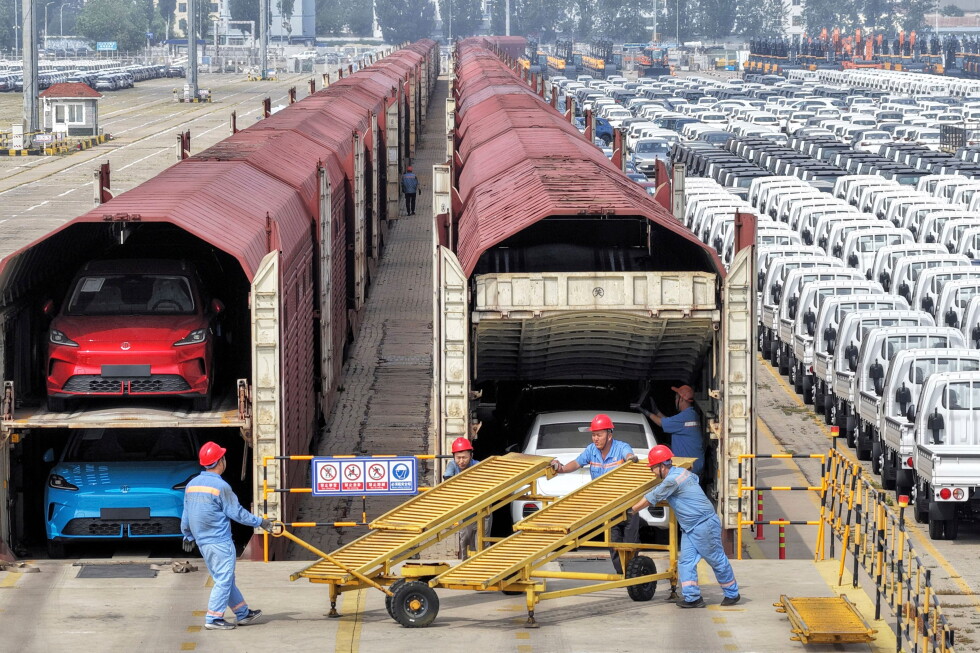
    Now, the energy shock from the Iran war is tilting that balance sharply in China’s favor. Global demand for affordable clean energy technology has spiked as governments, businesses and households wake up to the fragility of global fossil fuel supply chains. Data from London-based energy think tank Ember shows Chinese exports of solar panels, batteries and electric vehicles hit a record high of nearly $22.3 billion in December 2025, a 47% year-over-year increase, with most shipments bound for Southeast Asia and Europe. Credit rating firm Fitch Ratings projects investment in renewable power and battery storage will surge across energy import-dependent nations, particularly in Western Europe, as countries look to insulate themselves from future fossil fuel price shocks.

    Financial markets have already priced in this expected growth: in March 2026, shares of CATL and BYD traded on the Hong Kong Stock Exchange rose roughly 24% and 11% respectively, as investors bet on rising global demand for Chinese clean energy products.

    China’s EV sector was already outpacing U.S. and European rivals before the conflict, with aggressive expansion of production capacity and affordable pricing helping Chinese brands gain significant market share across emerging markets in Southeast Asia and beyond. Analysts say that growth will only accelerate in the wake of the energy crisis. “The energy shock is going to help the Chinese industry globally and hurt the American car industry globally,” said Amy Myers Jaffe, senior fellow at New York University’s Center for Global Affairs. While high U.S. tariffs have largely blocked Chinese EVs from the American market, surging domestic fuel prices are expected to further boost BYD’s sales growth within China’s own large EV market, according to Chris Liu, an analyst at research and advisory firm Omdia.

    Early data from around the world already shows a sharp shift in consumer and government behavior in response to rising fuel costs. In Pakistan, which previously relied on the Strait of Hormuz for 80% of its oil imports, decades of gradual renewable expansion has already softened the blow of the current crisis. By December 2025, Pakistan had imported more than 50 gigawatts of Chinese solar panels as part of its national renewable rollout. Analysts from Renewables First and the Centre for Research on Energy and Clean Air estimate that if current fuel prices remain high, existing solar capacity will save Pakistan $6.3 billion in fossil fuel import costs over the next year. “The shock isn’t as big as it would have been without solar,” said Nabiya Imran of Renewables First.

    In the United Kingdom, British renewable energy group Octopus Energy reported that EV leasing demand jumped more than a third in the first three weeks of March 2026 compared to the pre-conflict period in February, alongside sharp increases in sales of rooftop solar systems and customer inquiries about solar energy. Even in Southeast Asia, where regional EV maker VinFast has moved to offer discounts to offset rising fuel prices, the crisis has reinforced interest in transitioning away from gasoline-powered vehicles. While analysts note it will take time for long-term purchasing trends to shift, as consumers wait to see how the Iran conflict evolves, the prolonged price shock is expected to act as a lasting catalyst for EV adoption.

    Even Indonesia, the world’s largest coal exporter, is accelerating its transition to electric transportation, a shift that stands to benefit Chinese clean energy firms. In March 2026, Indonesian President Prabowo Subianto announced a major national push into EV production and charging infrastructure development. Chinese firms already hold a dominant position in Indonesia’s clean energy supply chain: they signed more than $54 billion in deals with Indonesia’s state utility in 2023, and added a further $10 billion pledge during Prabowo’s 2024 visit to Beijing. “There will be direct financial benefits to Chinese companies,” said Sam Reynolds, energy analyst at the U.S.-based Institute for Energy Economics and Financial Analysis (IEEFA).

    Experts say the conflict has fundamentally vindicated China’s long-term approach to energy policy and geopolitics. “China’s approach to energy sector development and geopolitics has been completely validated by the Iran conflict,” Reynolds noted. Li Shuo, director of the Asia Society Policy Institute’s China Climate Hub, added: “They are at the very forefront of this, more so than any other countries in the world, certainly more so than the United States.”

    This reporting was contributed by Ghosal in Hanoi, Vietnam, Delgado in Bangkok, and AP Business Writer Paul Wiseman. The Associated Press’ climate and environmental coverage receives financial support from multiple private foundations, with the AP retaining full editorial control over all content.

  • Already under financial pressure, Midwest soybean farmers are squeezed further by tariffs, Iran war

    Already under financial pressure, Midwest soybean farmers are squeezed further by tariffs, Iran war

    As 60-year-old fifth-generation farmer Doug Bartek stepped into a Nebraska grain bin this spring, shoveling soybeans toward a conveyor amid gusty plains winds, the weight of mounting industry stress was far heavier than any load of grain. For Bartek, who chairs the Nebraska Soybean Association and runs a 2,000-acre operation near Wahoo where three-quarters of the land is rented, this planting season has brought a tangled web of crises that have left many American soybean producers trapped between skyrocketing input costs and stagnant, depressed crop prices.

    Bartek’s anxiety is far from unique. Across the U.S. Midwest, which produces the bulk of the nation’s soybean crop, thousands of commercial grain farmers are grappling with overlapping economic pressures that have pushed many toward negative margins, cash flow crunches, and even the risk of bankruptcy. What began as a gradual trend of rising costs and oversupplied global markets has been compounded in recent months by trade policy fallout and geopolitical conflict in the Middle East, creating a perfect storm for an industry that forms the backbone of American agriculture.

    Soybeans have grown from a minor crop to one of the United States’ most valuable agricultural exports over the past 60 years. Driven by rising international demand, particularly from China, production exploded in the 1990s, and today soybeans and corn are the two dominant row crops across U.S. farm country. But even before recent geopolitical and trade disruptions, farmers faced systemic financial headwinds. Global soybean production has consistently hit new record highs in recent years, largely fueled by expanded output from Brazil, which overtook the U.S. as the world’s top soybean producer years ago. The resulting global supply glut has kept soybean prices stubbornly low for nearly a decade.

    At the same time, every major cost associated with farming has climbed steadily, and in many cases sharply. U.S. Department of Agriculture data shows overall farm production expenses, including seed, pesticides, equipment, and land, have trended upward for decades, with soybean operating costs remaining elevated since 2020 and projected to rise again by 2026. For many Midwest farmers who rent at least part of their land — a common arrangement across the region — rising rental rates have added an extra layer of strain. Bartek notes that many absentee landowners, unfamiliar with the struggles of on-the-ground farming, are hiking rents to cover their own rising property taxes, passing that cost directly onto producers.

    Paul Mitchell, a professor of agricultural and applied economics at the University of Wisconsin-Madison, says the combination of low commodity prices and bloated input costs has left many farmers in a critical liquidity crunch. Long-term industry consolidation has amplified this pressure: the number of U.S. farms has shrunk for decades, as larger, more capital-intensive operations have absorbed smaller struggling farms. Today’s modern commercial farm requires far more financial reserves than it did a generation ago, leaving producers far more vulnerable to sudden market and cost shifts.

    Market forces are not the only drag on farmer profits. In 2025, sweeping tariffs imposed by the Trump administration on Chinese goods triggered a full-scale trade war, with Beijing responding by placing retaliatory tariffs on U.S. soybeans — China was the top global buyer of American soybeans at the time, representing a critical export market for Midwest producers. The result was an immediate collapse in soybean prices that left farmers who needed to sell to cover operating costs and mortgage payments facing devastating losses.

    While the two nations reached a trade deal later that year, with China committing to large annual soybean purchases and the Trump administration rolling out a $12 billion emergency aid package for affected farmers, industry experts and producers agree the damage was lasting. Even with federal aid, the American Soybean Association estimates farmers still lost nearly $75 per harvested acre of soybeans from the 2025 crop. More importantly, the trade war pushed China to permanently shift its purchasing toward competing suppliers, primarily Brazil, accelerating the long-term decline of U.S. soybean market share in China. Today, U.S. soybean exports remain 15% to 20% below pre-trade war levels, a gap that has never been filled by other global markets, according to Iowa State University agricultural economist Chad Hart.
    “We’re not nearly as dominant in the world export market as we used to be,” explained Joseph Glauber, former chief economist at the U.S. Department of Agriculture. Global competitors have reaped permanent benefits from the trade shift caused by the dispute, he added.

    The most recent shock to hit soybean farmers came from the February 2026 Iran conflict, after joint U.S.-Israeli attacks on Iran triggered a near-total shutdown of shipping through the Strait of Hormuz, a critical global chokepoint for energy and commodity trade. The shutdown sent global oil prices soaring, pushing up the cost of gasoline and diesel that farmers rely on for planting, harvesting, and transporting crops. More critically, the disruption cut off access to key fertilizer exports from the Persian Gulf: roughly half of the world’s traded urea, a widely used nitrogen fertilizer, comes from the Middle East, which is a top supplier of U.S. fertilizer imports.
    While soybeans do not require nitrogen fertilizer, nearly all U.S. soybean farmers also grow corn, which depends heavily on nitrogen inputs. The result was an immediate, dramatic spike in fertilizer prices that has not fully abated.
    A two-week ceasefire was reached in early April that called for reopening the Strait of Hormuz, but ongoing tensions over related conflicts have kept shipping slow, and fertilizer prices remain far higher than pre-conflict levels. While many farmers locked in fertilizer prices last fall by purchasing ahead of planting season, producers short on cash last year are now facing unmanageable input costs, according to Dave Walton, an Iowa farmer and vice president of the American Soybean Association. The conflict also damaged critical energy and chemical export facilities in the Middle East, and supply chain disruptions for crop chemical inputs will persist long after the ceasefire, according to Seth Goldstein, senior equity analyst at investment research firm Morningstar.
    For many corn and soybean farmers like Chris Gould of Maple Park, Illinois, the cumulative effect of higher fuel and fertilizer costs makes a negative return nearly inevitable this growing season. “It’s hard to say if I’m gonna come out ahead or behind on this whole deal,” Gould said. “But I suspect I’m going to come out behind.”

    The cumulative strain of these overlapping crises is already showing up in national farm health metrics. While still relatively low by historical standards, farm bankruptcies continued to climb in 2025, according to the American Farm Bureau Federation. A late March survey of 400 U.S. farmers conducted by Purdue University’s Center for Commercial Agriculture found that nearly half of respondents reported their operations were in worse financial shape than one year prior. Goldstein warns that if input costs continue to outpace crop price growth, the U.S. will see more bankruptcies in coming months.

    For Bartek, who has farmed Nebraska soil for 43 years, the thrill of spring planting remains — but the uncertainty about the future has never been heavier. He has watched neighbors lose their farms to bankruptcy or forced retirement auctions, and even heard of farmers dying by suicide amid unmanageable financial stress. Today, he questions whether he made the right choice in helping his son purchase his own farm just a few years ago. Like many of his peers across the Midwest, Bartek compares modern commercial farming to a high-stakes gamble, where producers bet millions of dollars on an unpredictable growing season, with increasingly little guarantee of a return that will cover their costs.

  • House prices in two major cities to surge by over $50,000 this year, say Canstar

    House prices in two major cities to surge by over $50,000 this year, say Canstar

    Australia’s long-held cultural ideal of homeownership is edging further out of grasp for millions of prospective buyers, as new property industry forecasts reveal stark divergent trends across the nation’s major urban markets this year. Alongside uneven price shifts, successive cash rate increases continue to squeeze how much would-be buyers can borrow, creating fresh risks for household financial stability.

    Financial comparison site Canstar projects that two of Australia’s fastest-growing capital cities, Perth and Brisbane, will outpace all other major markets in 2026, defying broader monetary tightening to deliver double-digit and near-double-digit price growth respectively. By the end of the calendar year, median house prices in the two cities are set to jump by more than AU$50,000 each: Perth will see a 12.3% rise, while Brisbane will record a 9.7% gain.

    These gains will push median house prices to new unaffordable thresholds for many. Perth’s current median will climb from AU$551,690 to AU$1.11 million, while Brisbane’s median will surge from AU$754,919 to AU$1.26 million, according to Canstar’s analysis. The growth in these two markets has been fueled in large part by investor interest, drawn to Perth’s historically lower relative prices compared to other capitals and increasingly tight rental conditions across both southeast Queensland and Western Australia.

    “Both of these markets are hurtling towards prices that are fast becoming unaffordable for people looking for four walls and a patch of grass,” said Sally Tindall, Canstar’s director of data insights.

    The picture looks very different in Australia’s two largest property markets, Sydney and Melbourne, where prices are projected to dip slightly over 2026. Sydney’s median house price is forecast to drop 0.6%, equal to a AU$2,139 decline, while Melbourne will see a steeper fall of AU$7,829. While even a small price drop might sound like promising news for aspiring first-home buyers, the reality of rising interest rates has erased any potential affordability gains.

    Major Australian banks including ANZ, Commonwealth Bank of Australia and National Australia Bank are already forecasting another cash rate hike in the coming month, adding to the two increases implemented in February and March this year. Westpac goes further, predicting three additional 0.25 percentage point rate hikes by the end of 2026.

    Canstar’s analysis calculates that these hikes have already dramatically cut borrowing capacity for average earners. A single full-time worker on the national average wage has already lost AU$25,000 in borrowing power after the February and March increases alone. If Westpac’s forecast of three more hikes comes to pass, that total cut to borrowing capacity will jump to AU$58,700.

    Beyond worsening affordability, Tindall warned that current market conditions create significant long-term risk for overstretched buyers. “The danger is, people will borrow to the limit, banking on prices continuing to climb. If circumstances change – whether that’s interest rates, job security or the economy – it could leave some households overexposed,” she said.

  • Uber driven by fuel crisis to fresh price hike

    Uber driven by fuel crisis to fresh price hike

    Australian riders using Uber will soon face another increase to their ride costs, as the rideshare giant has rolled out a new temporary fuel surcharge to support drivers grappling with unprecedented global fuel price spikes.

    This new charge comes less than four weeks after a routine fare review already pushed average Uber prices up by 6% across the country. Designed as a targeted short-term intervention to offset drivers’ growing fuel-related expenses, the new 5 cent per kilometer surcharge will go into effect this Wednesday, stacked on top of the March fare increase.

    Industry union leaders have thrown their support behind the measure, noting that it is structured to deliver direct financial relief to drivers who bear the full cost of fuel for their work. Transport Workers’ Union (TWU) national secretary Michael Kaine estimates that the extra revenue from the surcharge could add up to roughly $35 in extra savings for drivers every time they fill up their tanks. Kaine pointed out that rideshare operators face the same inflated fuel costs as all other transport workers, with drivers now paying $40 to $50 more per tank than just a few months ago, and the surcharge will go a long way toward easing their financial strain.

    The TWU has actively collaborated with major rideshare brands operating in Australia, including Uber and its main competitor Didi, to address the mounting pressure on drivers amid the ongoing fuel crisis. Didi was the first major player to roll out the exact same 5-cent per kilometer surcharge, a policy that the company says has been widely well-received by its driver base. Uber’s matching surcharge will launch this Wednesday, and will run as a temporary emergency measure through June 8 of this year.

    Kaine expressed confidence that Uber customers will be understanding of the extra cost, noting that Australian consumers are already well aware of skyrocketing fuel prices from their own household budgets. “Australians have grown accustomed to the reliable convenience that rideshare services provide, and they recognize the pressure that drivers are under to keep operating right now,” Kaine explained. “If paying a small extra amount means drivers can earn a fairer income while keeping that convenience available, I believe the vast majority of customers will accept this change.”

    Emma Foley, Managing Director of Uber Australia, confirmed that the surcharge was developed through close, productive collaboration between the company and the TWU. “We have worked hand-in-hand with the union to tackle the rising fuel costs that cut into our driver partners’ earnings,” Foley said. “This temporary fuel surcharge delivers immediate, short-term relief for drivers as we navigate this ongoing fuel crisis, and it builds on the national fare update we rolled out in March that already boosted driver earnings across the country. This move reaffirms our ongoing commitment to improving driver compensation.”

    For its part, Didi implemented its 5-cent per kilometer surcharge roughly a month ago, and has reported that the policy has been popular among its driver workforce. Following the positive reception of the initial surcharge, Didi has also moved to increase its minimum fare prices across several major Australian markets. “We will continue to monitor fuel prices and adjust our fare structures and surcharge policies as needed to ensure our driver community gets the support they need through this crisis,” a Didi spokesperson said.

  • ‘Out of control’ diesel prices threaten Australia’s crucial freight industry

    ‘Out of control’ diesel prices threaten Australia’s crucial freight industry

    As the ongoing conflict in Iran sends global oil prices soaring to unprecedented levels, Australia’s critical road freight sector is grappling with an unprecedented crisis, where skyrocketing diesel costs have doubled operational expenses for thousands of trucking operators and left many small businesses on the edge of collapse.

    The global energy market shockwaves have hit Australia particularly hard, with the country recording one of the steepest spikes in transport fuel prices in its modern history. Latest official data from the Australian Institute of Petroleum confirms the national average retail price of diesel has jumped to 312.7 cents per liter, more than 70 percent higher than the pre-conflict average of 180.2 cents per liter. Petrol prices have also surged, rising from 171 cents to 240.1 cents per liter in the same period. For a sector almost entirely dependent on diesel to power heavy long-haul vehicles, the cost surge has delivered a crippling blow.

    In a rare primetime televised national address recently, Australian Prime Minister Anthony Albanese acknowledged the scale of the unfolding fuel challenge, urging the public to adjust their fuel consumption to preserve critical supplies for essential transport workers. “These are uncertain times,” Albanese told the nation. “But I am absolutely certain of this: we will deal with these global challenges, the Australian way.” He called on motorists to prioritize public transit where possible and “think of others” when fueling up, to ensure diesel supplies remain available for workers who have no alternative to driving for their livelihoods.

    But for small independent trucking operators across the country, the prime minister’s appeal has done little to ease the crippling financial pressure they face day-to-day. Aaron Fischer, an owner-operator whose business is based in Howlong, a border town between New South Wales and Victoria, says he now lies awake at night poring over spreadsheets trying to keep his firm afloat. “Before all this stuff happened, it used to cost me A$3,600 to fill up a single tank… now I’m spending $7,500. That’s the problem: it’s literally doubled my bill,” he explained in an interview with the BBC. Where Fischer once spent around A$150,000 a month to keep his fleet of 12+ long-haul road trains on the road, that monthly fuel outlay has now jumped to A$300,000 – an expense he has to cover out of pocket long before clients pay their invoices.

    Fischer’s fleet crosses the harsh, treeless expanse of the 1,200-kilometer Nullarbor Plain between South Australia and Western Australia every week, with stretches of up to 200 kilometers between available fueling stations. Already, reports of intermittent diesel shortages along the route have forced drivers to detour or risk running out of fuel mid-journey. “We’ve had a few [drivers] that went to put fuel in and they’ve had none,” Fischer said. Compounding the cash flow pressure is the standard 60-day waiting period for freight operators to receive payment for completed jobs, meaning Fischer must front roughly A$600,000 in operating costs before he recovers any revenue from recent runs. “This is where a lot of people are going to come unstuck,” he warned.

    The crisis is hitting new entrants to the industry particularly hard. William Hawkes launched his own trucking business just three months ago, and has already been forced to re-price every existing contract, raising rates by roughly a third to offset fuel costs – a move that has strained newly formed client relationships and driven many customers to cancel or delay jobs. “That’s pretty catastrophic when you’re starting out,” Hawkes said. His company specializes in transporting essential heavy equipment to areas facing emergency works, including flood-affected outback New South Wales and regions requiring emergency road repairs in Queensland. When one of his drivers was tasked with moving modular homes 5,300 kilometers from Bendigo, Victoria to Broome, Western Australia recently, reports of empty diesel tanks at Nullarbor Plain service stations shared via UHF radio forced a last-minute detour that added hours to the multi-day journey. While Hawkes has adjusted rates to keep his profit margin stable, the volume of work has plummeted as clients pull back on projects.

    Even veteran drivers with more than 40 years of experience in the industry say they have never seen conditions this bad. Terry Snell, 68, has cut his weekly runs to once every fortnight, after skyrocketing costs left his profit margin “very slim”. “We used to run every week. We now run every fortnight, because with the increase in the fuel charges, if we run weekly, we need to go off to a bank or a financial institution to borrow to cover costs,” he explained. After completing a recent run from Perth to Brisbane transporting a combined crane truck, Snell charged the client A$18,000 – double the rate he would have charged just a few weeks prior. He warned that dozens of small operators have already parked their trucks permanently, unable to cover operating costs, creating a shortage of available freight capacity that will soon ripple through the entire national economy. “If we don’t get this problem sorted and get it sorted very quickly, we are going to have a supply chain crisis,” Snell said. “Everything that you get has come off a truck at one point – whether it’s your food, your drinks, the shirt you’re wearing, the phone you’re using,” added Michael Webb, a 10-year industry veteran who currently drives for Fischer. “We need far more support than what we’re getting right now.”

    To address the sector’s distress, the federal government has announced a A$1 billion package of interest-free loans available to transport and freight operators, as well as fuel and fertilizer producers. But industry advocates say the measure falls far short of what small businesses need. “Interest-free loans are still debt,” said Alex Randall of freight marketplace Loadshift. “If you’re a small carrier whose fuel bill has just doubled and your customers are cancelling jobs, the last thing you need is more debt on the books.” Randall and other operators are calling for direct cash grants and faster targeted relief to help small carriers cover the sudden surge in fuel costs, rather than pushing them to take on more financial risk that could sink their businesses.

  • Long running legal stoush between miners Gina Rinehart, Angela Bennett over billions in mining royalties nears climax

    Long running legal stoush between miners Gina Rinehart, Angela Bennett over billions in mining royalties nears climax

    One of Australia’s longest-running and highest-stakes business disputes is poised to reach a critical turning point this week, as the Western Australian Supreme Court prepares to issue a landmark judgment in a multi-billion-dollar battle between two of the nation’s most powerful mining figures. At the center of the clash is Gina Rinehart, Australia’s wealthiest individual and head of Hancock Prospecting Pty Limited (HPPL), and Angela Bennett, an influential mining heiress who controls Wright Prospecting Pty Limited (WPPL), the family firm of her late father Peter Wright.

    The roots of the disagreement stretch back to the 1950s, when Wright and Rinehart’s father, Lang Hancock—two pioneers of Western Australia’s Pilbara region iron ore industry—first discovered the mineral deposits that would become the productive Hope Downs mining complex. Decades after their joint exploration, the two families that built their fortunes from that discovery are now fighting over who holds legal rights to critical royalties and assets at the site.

    Today, Hope Downs is operated as a 50-50 joint venture between global mining giant Rio Tinto and HPPL, producing roughly 50 million tonnes of iron ore annually. The project generates hundreds of millions of dollars in annual royalty income, with HPPL currently receiving a 2.5% cut of all production revenue. WPPL, however, argues that a historic agreement between Wright and Hancock entitles the Wright family to half of that 2.5% royalty stream, as well as a 25% stake in three specific Hope Downs tenements that hold the high-value East Angelas deposits, which have been in operation since 2013.

    If the court rules in WPPL’s favor, the firm would be entitled to 1.25% of all royalty payments backdated to the start of commercial mining at Hope Downs in 2007. Industry analysts value that retroactive payout alone at hundreds of millions of dollars, and the total value of the disputed assets is estimated to exceed $1 billion. Under a successful WPPL claim, Rio Tinto would retain its 50% stake in the project, while HPPL and WPPL would each hold 25% of the remaining share.

    Rinehart’s HPPL has pushed back aggressively against the claims, contending that the firm has taken on all financial and operational risks to develop the Hope Downs project, and thus holds exclusive rights to the assets and royalty stream outside the terms of the original Hanwright partnership agreement.

    The case has drawn extra attention due to the addition of other interested parties beyond the two main billionaire combatants. Rinehart’s own children, John Hancock and Bianca Rinehart, have joined the proceedings, as they already have an ongoing separate dispute with their mother over control of family trust assets established by Lang Hancock. The pair claim Rinehart improperly transferred trust shares meant for them to benefit herself. DFD Rhodes, a firm controlled by associates of the late Lang Hancock, has also laid claim to a 1.25% stake in the Hope Downs royalties, making the judgment’s outcome far-reaching for multiple stakeholders. Even joint venture partner Rio Tinto is impacted, as the ruling will reallocate which parties receive profit distributions from the mine.

    While Wednesday’s judgment will determine whether any of the claimants hold valid rights to the disputed royalties and assets, legal proceedings will not end there. Any follow-up dispute over the exact monetary value of what is owed will be settled in a separate, future trial, extending what has already been one of the most drawn-out legal battles in Australian mining history.