The repatriation of King Oyo Nyimba Kabamba Iguru Rukidi IV’s remains to Uganda has kicked off an official nine-day period of national and royal mourning, while also sparking an unprecedented public dispute over who will succeed the beloved traditional ruler. Aged 34, the 13th monarch of the Tooro Kingdom passed away last week in the United States while receiving treatment for an aggressive form of cancer, cutting short a decades-long reign that captured global attention from its very start.
King Oyo made history in 1995 when he ascended the Tooro throne at just 3 years old following the death of his father, earning a place in the Guinness World Records as the world’s youngest reigning monarch. He was formally crowned when he turned 18 in 2010, and grew into a progressive leader who ruled over more than two million people in the Tooro Kingdom, a culturally significant traditional institution based in western Uganda that retains strong cultural influence despite holding no formal political power in the country’s elected constitutional system.
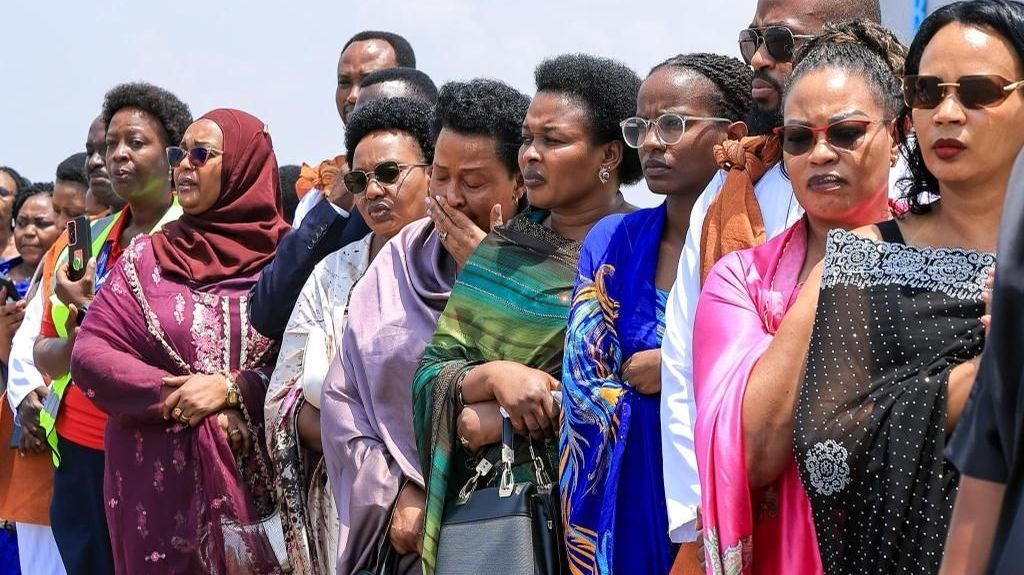
On the day his remains touched down at Entebbe International Airport, top Ugandan political leaders including President Yoweri Museveni joined hundreds of royal mourners to pay their respects. After a short formal welcome ceremony at the airport, President Museveni laid a wreath on the king’s sealed coffin. The remains were then airlifted via military helicopter to Kyegegwa in western Uganda, before being transported by road to the Karuziika Royal Palace in Fort Portal, where Oyo’s body will lie in state for the full mourning period. Members of the public are welcome to visit the palace to pay their respects, with evening prayer services scheduled each night through the funeral.
Across the country, tributes have poured in for the king, who was widely praised for his modernizing leadership and public advocacy. Uganda’s parliament held a special commemorative session last Thursday, where lawmakers from both the ruling party and opposition celebrated his work advancing access to education, expanding public health access, and creating economic opportunities for young Ugandans. Prime Minister Robinah Nabbanja remembered him as a unifying national figure who led critical public awareness campaigns on HIV and AIDS for youth. Acting opposition leader Patrick Nsamba Oshabe echoed these sentiments, noting that King Oyo had successfully balanced respect for centuries-old cultural heritage with a commitment to national progress and development.
In a mark of national respect, President Museveni has granted King Oyo an official state burial, and has ordered all national flags to fly at half-mast for three days leading up to the funeral. The service is scheduled for next Saturday, September 13 – the same date King Oyo had originally planned to mark the annual Empango celebration of his coronation, a dream he held until his final days. Tooro Kingdom Prime Minister Calvin Armstrong Rwomiire Akiiki revealed that the monarch had asked officials to conceal the severity of his illness, as he remained confident he would recover and return home to mark the occasion with his people.
As the nation mourns, a growing public rift over succession has cast uncertainty over the future of the Tooro monarchy. Because King Oyo was never officially married, there had been no publicly named heir until Akiiki announced last week that the late king did leave behind a young son, whose identity will be revealed at a later date in line with traditional Tooro customs. President Museveni also confirmed that Oyo’s mother, Queen Best Kemigisa, had told him the king had an heir.
However, the head of the Babiito royal clan – the hereditary clan from which all Tooro kings are drawn – has publicly stated he has no knowledge of any such child. Other senior clan members have echoed the skepticism, questioning how the royal family could be kept unaware of an heir while the kingdom’s prime minister claimed knowledge of the child. “The prime minister is not supposed to talk about the king’s heir. It is a cultural process,” one anonymous senior clan member told Uganda’s state-owned New Vision newspaper. “How can we, blood relatives, not know of the child, and the prime minister says he knows? That is totally out of order.”
Akiiki has since called for the dispute to be resolved privately out of respect for the mourning period, warning that inflammatory words spoken in grief could deepen divisions that would take generations to repair. The Ugandan national government has also stepped in to urge calm, calling on the public and cultural leaders to avoid spreading unfounded speculation on social media. Culture Minister Henry Tumukunde noted that the entire world is watching Uganda as it mourns King Oyo, and urged all parties to exercise restraint and respect. He added that any succession disputes will be resolved in accordance with Uganda’s existing laws governing traditional and cultural leaders.
In line with longstanding Tooro tradition, King Oyo’s funeral will follow strict ceremonial customs. A church service will be held at a local congregation ahead of the burial, before a traditional royal procession carries his remains to the Karambi Royal Tombs. All burial rites must be completed by 2 p.m. local time, as tradition forbids burying Tooro monarchs after sundown.