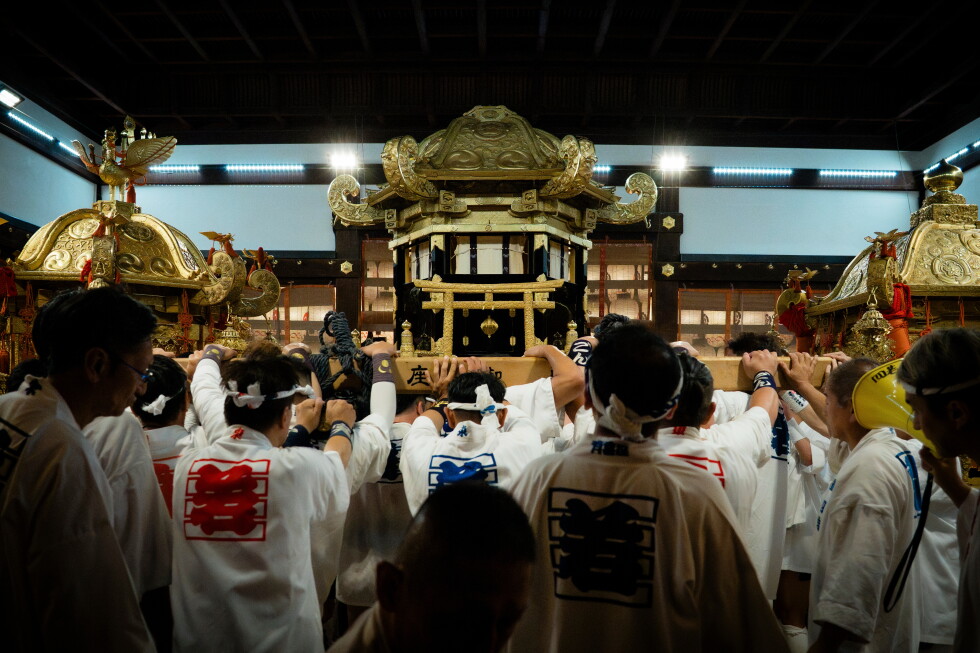
In the heart of Kyoto, Japan’s former imperial capital, a 1,000-year-old tradition draws thousands of visitors each July, blending ancient spiritual belief, centuries of religious evolution, and tight-knit community bonding. This is the Gion Matsuri, a festival born from a desperate plea to ward off deadly disease that endures today as one of the country’s most iconic cultural events.
For participants like Katsushi Horikawa, who rides atop one of the procession’s towering, hand-built floats, the experience is inherently sacred. The 12-ton wooden structures, pulled through Kyoto’s crowded streets by teams of organizers, create an unmatched feeling of closeness to the divine. “I am conscious of [the gods] when I’m riding on top,” Horikawa says. “When we’re assembling it as well, but I think the main time is when I’m riding on it.”
Many casual visitors see the Gion Matsuri as a vibrant public celebration, filled with traditional dance, folk music, and street performances. But religious scholars emphasize the festival’s core purpose remains deeply spiritual, not recreational. “Those performances are not meant primarily for the entertainment of people,” explains Fabio Rambelli, a religious studies professor at the University of California, Santa Barbara. “They are offerings to the gods.”
Rooted in the late 9th century, the festival originated as a Shinto ritual to appease supernatural spirits believed to cause devastating epidemics. It takes its name from Kyoto’s historic Gion District, with “matsuri” being the Japanese word for festival. At its center is the Yasaka Shrine, a religious site whose history traces centuries of overlapping religious change in Japan. Until 150 years ago, the site operated as a Buddhist temple, a reflection of the long-standing syncretism, or blending, of Shinto and Buddhist traditions that shaped Japanese religious life for millennia.
In its earliest forms, the shrine centered worship of Gozu Tennō, an ox-headed syncretic deity thought to hold power over epidemics, able to either spread or halt disease. Scholars note the deity drew influences from Indian religious traditions, Korean belief, and local Japanese folklore, a common trait for many Japanese gods that emerged from centuries of cultural exchange. Early processions carried the deity’s image through Kyoto’s streets to demonstrate divine protection from evil forces — a practice that evolved into the parades seen today.
Japan’s dramatic religious restructuring in the 19th century reshaped the shrine and the festival permanently. In 1868, during the Meiji Restoration, the national government formally separated Shinto and Buddhism, bringing Shinto shrines under state control and centering the emperor — believed to be a direct descendant of the Shinto sun goddess — as the core of Japan’s new national identity. “Because the emperor was the direct descendant of the goddess of the sun, they purified the whole system creating what now we see as Shinto,” says Andrea De Antoni, professor of anthropology and religious studies at the University of Kyoto. The policy sparked a widespread anti-Buddhist movement that saw thousands of Buddhist temples, artworks, and statues destroyed across the country. While Shinto was formally separated from state control after World War II, its modern institutional form still carries the marks of this 19th century restructuring. Today, Shinto is organized around worship of kami, or deities and spirits, a belief system rooted in ancient animist traditions shared with many indigenous cultures across Southeast Asia and the Pacific.
Beyond its religious history, the Gion Matsuri remains a vital force for bringing Kyoto’s neighborhood communities together, even for long-time foreign residents. Jacques Garrigues, a French resident of Kyoto who has lived in the city for 30 years, attended the 2024 procession with his son, calling it a unifying experience for local residents. “This is the festival of all the people in the neighborhood,” Garrigues explains. “We also come together through a certain sense of religion, although the religious significance is not the same as in France.”
Many core traditions remain unchanged after centuries. One key custom selects a young boy to serve as a sacred messenger to the gods; during the parade, he sits atop a float with his feet never touching the ground, a sign of his sacred status. Neighborhood teams spend months building and preparing their floats, with many participants holding the belief that the structures ward off evil spirits. Atsushi Matono, who is tasked with installing the shingi — a sacred tree placed at the top of a float, believed to be the point where a deity descends to join the procession — shares the same sense of divine presence felt by riders like Horikawa. “I always carry out my work with great care and respect,” Matono says. “Feeling the presence of the gods.”