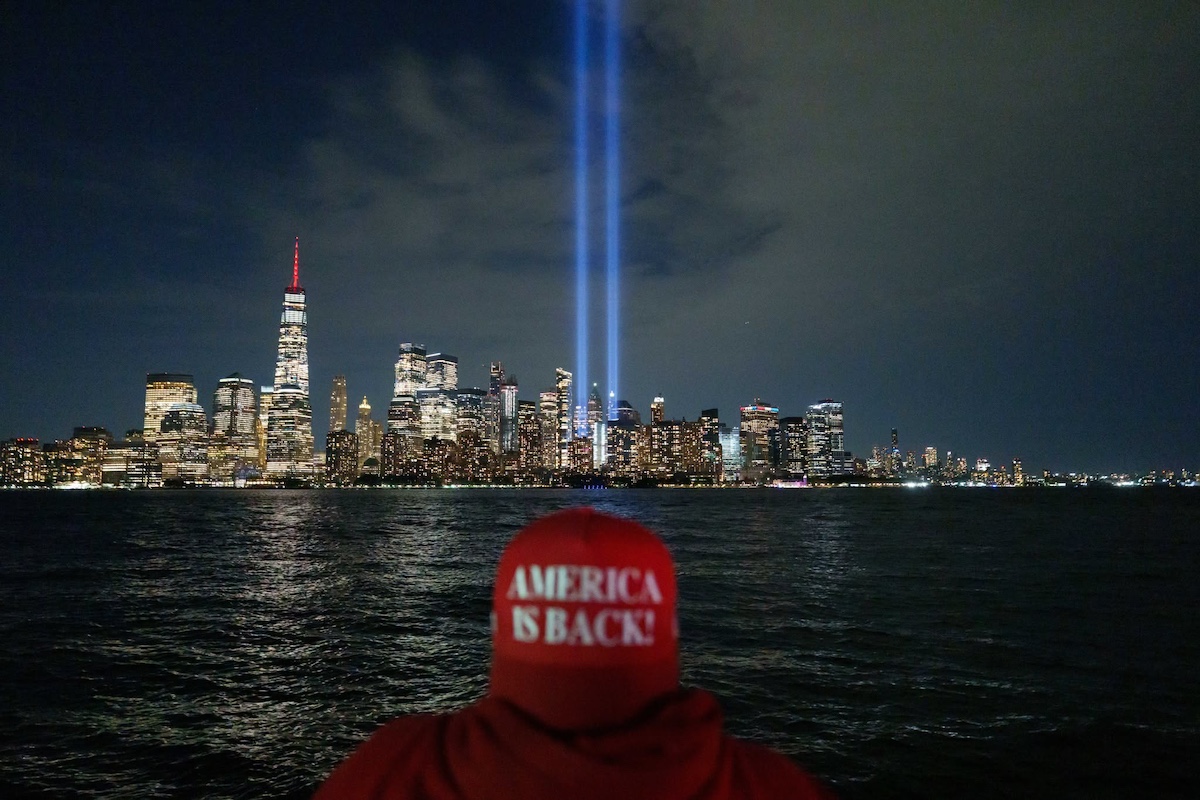
Twenty-five years have passed since the devastating terrorist attacks of September 11, 2001, and rather than rehashing the details of that tragic day, it is long past time to examine the strategic conclusions U.S. policymakers drew in its aftermath — and to question whether those conclusions have served the nation well. There is no question that the coordinated al-Qaeda strikes that killed thousands of civilians and targeted the heart of American power represented a profound national trauma and an unconscionable act of mass violence. But the policy assumptions built atop that trauma have become a catastrophe in their own right, a legacy of avoidable loss whose human, financial and institutional costs are still being borne by Americans today.
The first and most foundational wrong lesson Washington embraced after 9/11 was the claim that the attacks proved the world had grown uniquely dangerous, requiring an unprecedented expansion of U.S. military engagement across the globe. This narrative flipped the reality of the attacks on its head. Al-Qaeda’s ability to launch successful strikes against New York and Washington was not evidence of insufficient American military presence or global weakness — it was largely a byproduct of that longstanding presence. Osama bin Laden openly articulated his core grievances: the permanent stationing of U.S. troops in Saudi Arabia, harsh economic sanctions levied against Iraq, and unwavering U.S. backing for Israeli policy in the occupied Palestinian territories. None of these grievances can ever justify the mass murder of innocent civilians, but foreign policy realists have long warned that ignoring the direct causal link between overseas intervention and domestic “blowback” is not moral courage — it is dangerous strategic negligence. Instead of reevaluating overextension, however, Washington doubled down, concluding the U.S. needed to intervene more aggressively, not less, in every corner of the world.
The second flawed lesson held that large-scale foreign nation-building was the definitive solution to the threat of global terrorism. What began as a limited, strategically sound mission in Afghanistan — destroy al-Qaeda’s training camps and safe havens, and punish the Taliban regime for sheltering the terrorist network — quickly metastasized into a 20-year nation-building experiment. This effort attempted to impose a liberal democratic state on a country that had repeatedly repelled foreign efforts to remake its social and political order, stretching back centuries. The 2003 invasion of Iraq was an even greater failure: a war of choice, justified by flawed intelligence that ultimately collapsed under scrutiny, that had no tangible connection to the 9/11 attacks and was driven entirely by the ideological conviction that American military power could forcibly remake the entire Middle East in a pro-U.S. democratic image. Both wars grew from the same wrong premise: that terrorism could be cured by democratic transformation imposed at gunpoint. The outcome was not stable, pro-American democracies. Instead, it delivered two decades of deadly insurgency, brutal sectarian conflict, and in Iraq, the power vacuum that allowed the rise of the Islamic State (ISIS).
The third wrong lesson centered on the false tradeoff between national security and civil liberty, arguing that liberty must always give ground to security in the face of terrorist threats. In the wake of 9/11, the U.S. government rolled out an unprecedented architecture of expanded executive power: the Patriot Act, mass warrantless surveillance programs, indefinite detention of suspects at the Guantanamo Bay detention camp, and a host of emergency authorities that were sold to the public as temporary, proportional responses to an immediate crisis. Most of these powers have since become permanent fixtures of the American national security state. This approach embedded a dangerous assumption: that a free society facing a small but determined terrorist threat should automatically prioritize expanding state power over requiring the government to prove such expansion is necessary. A tradition of limited government would have demanded the opposite: that emergency powers include built-in sunset provisions, that surveillance be narrowly tailored to specific threats, and that the burden of proof always falls on those seeking to expand state authority, not on citizens defending constitutional checks on government power.
The fourth and most durable wrong lesson held that American credibility demanded endless open-ended military commitment, no matter the cost or diminishing strategic returns. Withdrawal from any engagement — whether Iraq, Afghanistan, or any other theater — would be interpreted as weakness by U.S. adversaries, the argument went, so the U.S. had to maintain a military presence regardless of changing circumstances. It was this logic that extended two wars meant to last months into conflicts that stretched across decades. It turned an open-ended military presence into an end in itself, disconnected from any realistic assessment of what additional troops and additional time were actually achieving. The eventual chaotic withdrawals from both Iraq and Afghanistan did not come from a deliberate change of strategy or a recognition of past error; they came only when the unsustainable cost of maintaining the status quo could no longer be ignored.
What would a more grounded, strategic response to 9/11 have looked like? A far more restrained path was already available in 2001: a targeted, focused campaign to eliminate al-Qaeda’s leadership and dismantle its safe havens, a refusal to conflate the threat of a single terrorist network with a blanket mandate for global regime change, and a honest reevaluation of how permanent forward-deployed U.S. military power in the Middle East was generating the very anti-American resentment it claimed to suppress. In the raw, emotional climate of 2001 and 2002, shaped by widespread grief and anger, that restrained path was politically unthinkable. But a quarter-century later, after two failed nation-building projects, more than $2 trillion in public funds spent, thousands of American service members killed and maimed, and a permanent surveillance state that has outlived every original justification offered for it, the case for that more modest, realistic reading of 9/11’s lessons looks far stronger than the aggressive approach Washington actually chose.