Twenty-five years after the deadliest terrorist attack on U.S. soil that killed nearly 3,000 people, newly unsealed evidence in the ongoing lawsuit brought by 9/11 victims’ families has exposed explosive new details about long-buried connections between a central suspect, senior Saudi government figures, and future al-Qaeda leadership — along with repeated failures by the FBI to disclose critical evidence to investigators, prosecutors, and the official independent inquiry into the attacks.
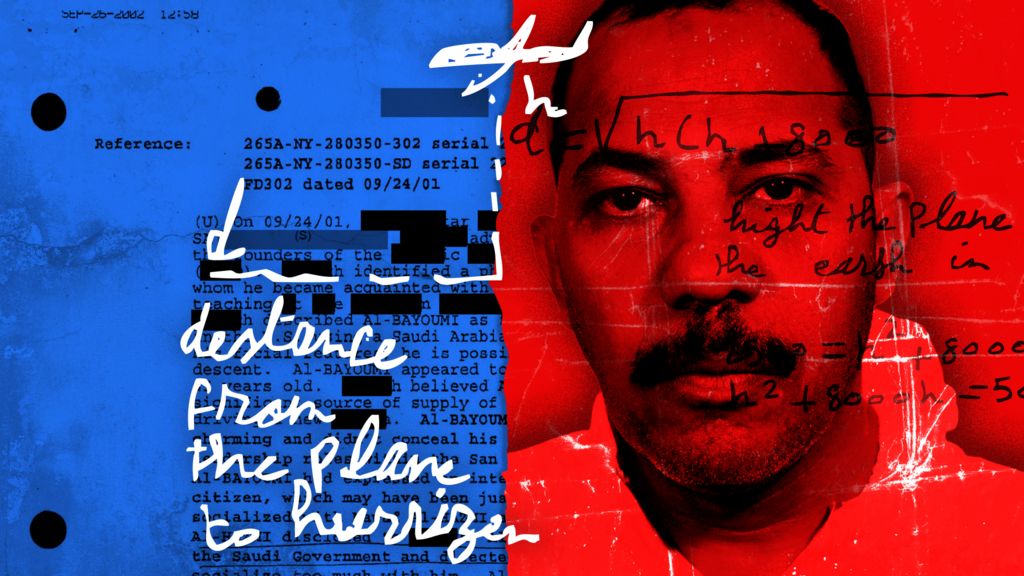
At the center of the $1 trillion civil suit is Omar al-Bayoumi, a Saudi national who moved to San Diego in 1994 claiming to be an English language student. Court records show Bayoumi quickly abandoned his studies to focus on organizing religious events, and his name was found on the apartment lease of two of the 19 9/11 hijackers, Nawaf al-Hazmi and Khalid al-Mihdhar, who crashed a plane into the Pentagon. For decades, Bayoumi has denied any ties to extremism or being a Saudi intelligence asset, claims that the newly public video evidence directly contradicts.
The BBC has obtained and verified never-before-seen video footage that the FBI acquired within days of the September 11, 2001 attacks. One clip, filmed in January 1998, captures Bayoumi embracing Anwar al-Awlaki, who would later rise to become the leader of al-Qaeda in the Arabian Peninsula before being killed in a 2011 CIA drone strike. A second video, recorded between 1997 and 1998 near San Diego, shows Bayoumi, Awlaki, and an official from Saudi Arabia’s Ministry of Islamic Affairs participating in a military-style paintball exercise. Participants are seen wearing military fatiguges, practicing urban combat drills, and shouting “Allahu Akbar” during simulated charges, with Bayoumi addressing Awlaki with the honorific title “Sheikh Anwar.”
Additional footage also documents multiple private meetings between Bayoumi and Ministry of Islamic Affairs officials, including a public outing at SeaWorld where Bayoumi explicitly positioned himself to be recorded alongside the Saudi representatives. Established in 1993, the Ministry was long known to be dominated by hard-line Sunni clerics who exported radical Islamist ideology globally, spending hundreds of millions of dollars to build mosques and place ideological operatives across the United States.
The explosive video evidence is not the only suppressed piece of evidence unearthed by the BBC’s joint investigation with Panorama and Radio 4, which reviewed thousands of declassified documents, court records, and interviewed dozens of former FBI agents and investigators involved in the case. When British Metropolitan Police arrested Bayoumi at his home in Birmingham, UK, just 10 days after the 9/11 attacks, officers seized more than 80 videotapes, thousands of pages of documents, and a handwritten diagram of an airplane accompanied by a mathematical descent equation written in Bayoumi’s own handwriting. Legal representatives for the 9/11 families describe the diagram as the long-sought “smoking gun” that proves Bayoumi had prior knowledge of the attack plot: the handwritten numbers calculate the altitude and distance required for a pilot to crash a plane into a fixed ground target. A federal judge overseeing the lawsuit ruled in 2023 that the document, on its face, connects Bayoumi to advance knowledge of the 9/11 attacks. Bayoumi claimed in 2021 court testimony that he collected random equations and could not recall writing the diagram.
Within 48 hours of the seizure, copies of the plane diagram were delivered to the FBI’s liaison at the London police station where Bayoumi was being held, and passed between three senior FBI agents. Yet the British detectives interrogating Bayoumi were never informed of the diagram’s existence, nor were they briefed to question him about the paintball video or his ties to Awlaki. When Bayoumi’s seven-day detention window expired, U.S. Department of Justice officials rejected British investigators’ recommendation to extradite Bayoumi to the U.S. to face charges, claiming there was insufficient evidence — even though the critical evidence had been intentionally withheld from the prosecution team. Bayoumi was released in September 2001, and he has never been prosecuted.
Multiple FBI agents interviewed by the BBC confirmed a pattern of deliberate evidence suppression spanning field offices. The diagram was couriered to the FBI’s New York field office, the lead agency for the 9/11 investigation, but no formal analysis report has ever been uncovered. Only one reference to the diagram exists in declassified FBI files, created 11 years after it was seized. The San Diego FBI field office, which was actively investigating Bayoumi’s local activities including his ties to the hijackers, repeatedly requested copies of all evidence seized in Birmingham but never received most of the materials. Rick Lambert, who led the San Diego 9/11 investigation, told the BBC that New York refused to comply with repeated requests, and that early access to the evidence could have allowed investigators to uncover the full plot network much faster.
The paintball video faced a similar fate: a copy was sent to New York and viewed by agents, but it was never mentioned in official summaries of Bayoumi’s connections to extremism, and his long-standing relationship with Awlaki was omitted from all internal 2002 FBI and DOJ memos that otherwise noted Bayoumi’s anti-American and jihadist writings. Jeffrey Breinholt, former deputy director of counterterrorism at the Department of Justice who oversaw post-9/11 terrorism prosecutions, told the BBC that Bayoumi was initially identified as a high-priority candidate for charges, but the New York U.S. Attorney’s Office never submitted a prosecution proposal for approval. Breinholt noted that both the plane diagram and paintball video would have been more than enough evidence to secure a conviction on material support for terrorism charges, adding “we’ve convicted people for less.”
Investigators also faced explicit political roadblocks when trying to question Saudi officials connected to Bayoumi. In 2001, Lambert’s San Diego team requested permission to interview multiple Saudi Ministry of Islamic Affairs officials in the U.S. whom they suspected of coordinating Bayoumi’s support to the hijackers. Permission was denied by FBI headquarters and the U.S. State Department. The following year, the Los Angeles FBI field office faced the same block when requesting to interview a Saudi religious diplomat who met Bayoumi immediately after his first meeting with Hazmi and Mihdhar. The State Department declined to comment on the BBC’s inquiry.
The pattern of suppression extended to the 9/11 Commission, the independent congressional inquiry tasked with producing a full public account of the attacks. When the Commission interviewed Bayoumi in Riyadh in 2003, he had returned to Saudi Arabia following his release, and the interview was held in the presence of Saudi secret police, who later explicitly requested that Bayoumi be cleared of any wrongdoing. The final 2004 Commission report effectively exonerated Bayoumi, describing him as “obliging and gregarious” and concluding there was no evidence of extremist ties. But the BBC has confirmed that multiple Commission staff objected to the conclusion that Bayoumi was “unlikely” to have ties to Islamist extremists, and the final report was revised to attribute the claim only to “our investigators who have dealt directly with him.” Critically, the Commission was never given access to the plane diagram, the paintball video, or any of the other evidence seized by British police. Commission executive director Philip Zelikow declined to answer specific questions about the suppressed evidence, noting that the Commission’s findings had been reviewed twice by U.S. government bodies and that the panel was open about its uncertainties.
The unsealed evidence comes as the long-running civil lawsuit brought by 9/11 families against the Saudi government moves forward, after a 2018 court ruling allowed the case to proceed and a 2021 executive order from former President Joe Biden ordered the declassification of thousands of 9/11 investigation files. Bayoumi and the Saudi government have never responded to the BBC’s requests for comment, and both have repeatedly denied any involvement in or prior knowledge of the 9/11 attacks, calling all allegations of complicity categorically false. The FBI has also declined to comment on the BBC’s findings, while the DOJ said it could not comment on 25-year-old decisions involving staff who no longer work at the agency.