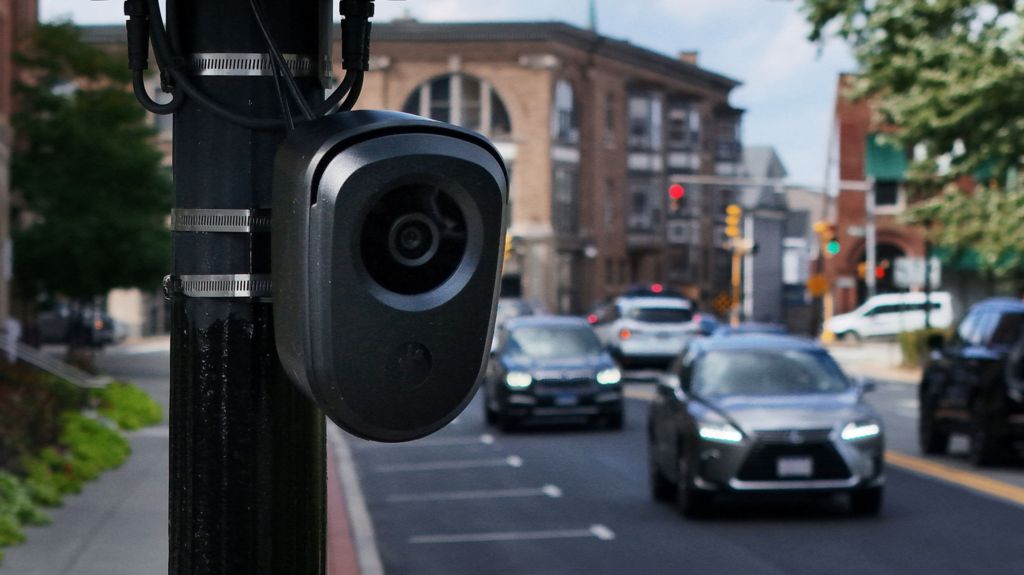
Across the tree-lined, affluent streets of Houston’s historic Old Braeswood neighborhood, an unusual act of coordinated resistance unfolded in the dead of late July night. Four surveillance units operated by private technology firm Flock Safety were torn from their metal mounts, their distinctive black oval casings and attached solar panels left crumpled on the pavement. Each camera bore a red sticker warning of constant 24/7 recording, and this act of sabotage is far from an isolated incident: similar attacks have already been reported in Minnesota, California, and Georgia, marking a sharp escalation in public backlash against the rapid nationwide expansion of AI-enhanced mass surveillance.
Founded in 2017, Flock Safety has grown to become the United States’ largest provider of automatic license plate readers (ALPRs), AI-powered cameras that capture images of every vehicle that passes their field of view. While the company does not release exact deployment figures, it confirms partnerships with more than 7,000 U.S. communities and estimates roughly 100,000 Flock cameras are currently installed across the country. What sets Flock apart from older generations of ALPR technology is not just its AI capabilities, but its interconnected national database: local law enforcement agencies that purchase a small number of Flock cameras gain access to a network of tens of thousands of devices spanning multiple states. For example, Houston’s METRO Transit Authority owns just 35 Flock cameras, but can search data from more than 20,000 devices across the network, extending as far as Albany County, New York. Internal documents obtained by the BBC show this network’s scope has expanded exponentially in recent years: in Houston’s Cypress-Fairbanks Independent School District, a typical 2024 license plate search covered roughly 270 camera networks; by 2025 that number nearly doubled, and by 2026, one in five searches span more than 6,000 separate networks.
For civil rights advocates, this broad, unregulated access to everyday movement data poses an existential threat to personal privacy. Christopher Rivera, a policy advocate with the Texas Civil Rights Project, argues that the network allows law enforcement to map every detail of a person’s daily routine: their commute to work, their children’s school campuses, their places of worship. Recent high-profile cases of misuse have amplified these concerns. Just last week, a Kentucky police officer was arrested and charged after abusing the Flock system to track his ex-girlfriend, who had a active protection order against him, more than 2,000 times. The incident was only detected by Flock’s new mandatory AI-powered audit tool designed to flag suspicious activity. In a separate 2025 case, a Johnson County, Texas, detective searched more than 80,000 Flock images to locate a woman suspected of obtaining an abortion — all without a required judicial warrant.
Immigrant rights organizers add another layer of concern: while federal Immigration and Customs Enforcement (ICE) does not hold a direct contract with Flock, there have been multiple documented cases of local law enforcement using the Flock database to track people on behalf of immigration authorities. For Jessie, a Central American immigrant living in Houston who requested anonymity to protect her pending green card extension application, the Flock camera installed outside her home has turned daily life into a constant exercise in evasion. “It makes me feel as if I’m being stalked,” she explained, adding that she now changes her commute route daily to avoid creating a predictable movement pattern.
Surveillance technology is not a new innovation in American policing, but the combination of AI integration and Flock’s national connected network has pushed the issue into the national spotlight. Unlike older ALPR systems that only allow searches by license plate number, Flock’s AI enables officers to search footage using descriptive terms — such as “Caucasian man, blue shirt” — expanding the scope of surveillance far beyond vehicle tracking. While Flock itself does not integrate facial recognition technology, the BBC has uncovered previously unreported documents showing that the Harris County Sheriff’s Office, which serves Houston, already uses a controversial competing facial recognition tool called Clearview AI. Clearview’s database contains more than 70 billion images scraped from public social media and internet platforms, and the company has already been fined millions in data penalties across multiple European countries, including a £7.5 million fine from the UK’s Information Commissioner’s Office. The Harris County Sheriff’s Office has declined to comment on its ongoing Clearview AI contract, which runs through March 2027.
Law enforcement supporters of Flock argue the technology has delivered transformative public safety results that cannot be ignored. Chief Ray Schultz of the Memorial Villages Police Department, a small Houston-area jurisdiction, says his department averaged just three stolen vehicle recoveries per year before adopting Flock; today, that number stands at 45. Schultz also cited a recent case where Flock data helped locate an elderly woman with dementia who had become lost 60 miles from home, reuniting her safely with her family. “It’s a very good tool. It makes the community safer,” Schultz said, adding that while officers who misuse the system should face accountability, “don’t throw out a tool that is valuable, that can help recover a missing child.”
The growing backlash has already led to tangible policy and business shifts across the country. More than 200 U.S. communities have chosen to cancel or decline to renew their Flock contracts since 2021, according to privacy advocacy group Secure Justice — including 90 cancellations in August 2026 alone. Major cities including Los Angeles, Seattle, and Austin have already cut ties with the company, driven by both cost concerns and widespread public opposition to mass surveillance. The issue has also become a key talking point in upcoming 2026 midterm elections, with bipartisan calls for regulatory guardrails. Republican Congressman Keith Self has introduced federal legislation that would require law enforcement to obtain a warrant before accessing Flock data for federal investigations.
Flock has adjusted some of its policies in response to public pressure: it now requires mandatory AI-led audits of user activity, and has reduced the default data retention period from 30 days to 7 days for non-investigation related footage, though individual law enforcement agencies can still opt to store data for much longer periods. Flock founder and CEO Garrett Langley told the BBC that decisions around data retention and information sharing should be left to local governments, not private technology companies. “I don’t think a technology company should be making decisions like that,” Langley said. “As long as it’s a lawful investigation, we are not going to tell cities what laws they should or should not enforce.” Langley frames Flock as a public safety company, not a surveillance firm, a claim that is undermined by three patents the company filed between 2020 and 2025 that all include the word “surveillance” in their titles. He also noted the company’s technology has helped solve roughly one million crimes and locate more than 10,000 missing people, calling the ongoing vandalism of cameras “disappointing” and saying the debate over balancing safety and privacy is a necessary one.
For critics and community members like Jessie, however, no policy changes can ease their concerns about the growing power of AI-driven surveillance in everyday life. “I just don’t trust that they’re doing it to keep us safe,” she says.