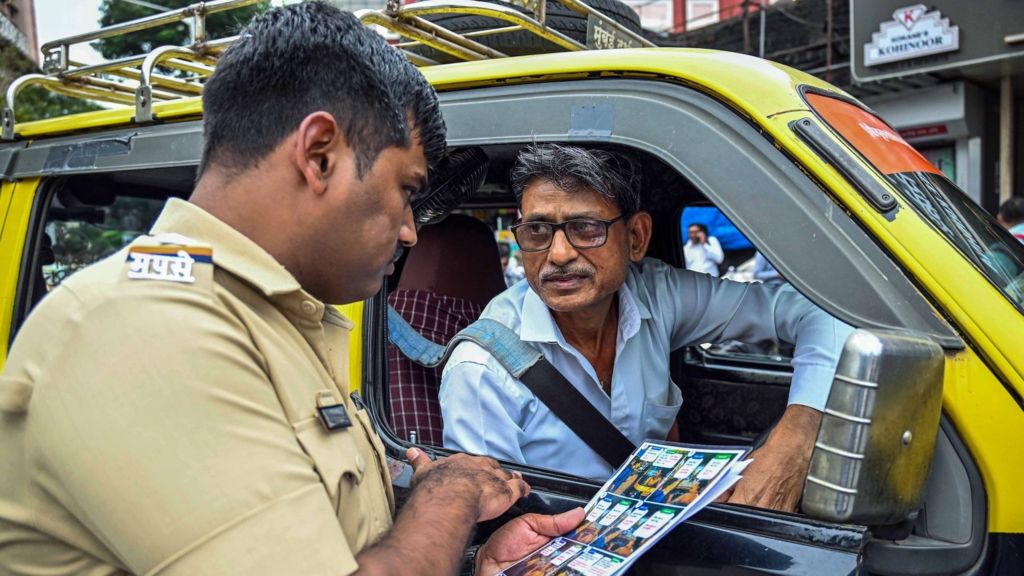
A contentious new regulation mandating basic conversational Marathi for taxi and tuk-tuk drivers in India’s western state of Maharashtra has triggered widespread pushback, prompting state authorities to delay enforcement by 12 months and reigniting decades-old tensions over language, migrant labor and regional identity.
The policy, which aimed to require all commercial passenger vehicle drivers to demonstrate basic proficiency in Maharashtra’s official language, launched its first round of testing on August 20. Under the original framework, drivers who failed the oral assessment faced a one-month grace period to re-test, after which their operating licenses could be suspended or revoked entirely. State officials framed the rule as a practical public safety measure, arguing that improved communication between drivers and local passengers would reduce confusion and create safer journeys for all road users.
But the mandate immediately sparked outcry from drivers’ unions, who warned that forcing working drivers into a high-stakes test threatened to put thousands out of work overnight. A large share of commercial drivers in Maharashtra are internal migrants, who relocated to the state from other parts of India – most notably the populous Hindi-speaking states of Uttar Pradesh and Bihar – in search of stable employment. Many of these drivers have been out of formal education for decades, leaving them little time or flexibility to study a new language while working full time to support their families.
Amid growing public protests, Maharashtra Chief Minister Devendra Fadnavis announced the one-year extension last week, acknowledging that most migrant drivers needed far more time to build basic conversational skills. State Transport Minister Pratap Sarnaik added that further extensions could be granted down the line, after the full year of learning is completed.
Maharashtra is home to nearly 979,000 active taxi and tuk-tuk permits, with almost half of those concentrated in the bustling Mumbai metropolitan region, one of India’s largest commercial and population hubs. For drivers who faced immediate risk of losing their livelihoods, the extension has delivered much-needed relief. “We were worried that if our licences were suspended, our daily income would be affected,” explained Lakhan Pandey, a Mumbai-based taxi driver. “Now we feel somewhat relieved.”
Beyond the immediate policy dispute, the row has dragged into the open a political debate that has shaped Maharashtra’s public life since the state’s founding. The state was created in 1960 following a years-long mass campaign for a separate Marathi-speaking state. As Mumbai grew into India’s financial capital, it attracted wave after wave of internal migrants from across the country, and language quickly became tied to fierce disputes over access to jobs and economic opportunity for native Marathi speakers.
In 1966, the regional nationalist party Shiv Sena was founded on a “sons of the soil” platform, which argued that Marathi speakers were being displaced from work by incoming migrants. The party went on to become one of the most dominant political forces in the state, with Marathi identity at the core of its political appeal. Today, Maharashtra’s ruling coalition is led by Fadnavis’ Bharatiya Janata Party and a faction of Shiv Sena that split from the original party in 2022, while the rival Shiv Sena faction and the regional Maharashtra Navnirman Sena both continue to prioritize Marathi identity politics.
Political analysts note that while widespread support exists for encouraging migrants to learn basic Marathi, the issue is often amplified for political gain. “The issue is not simply about communication between drivers and passengers, but about Marathi identity, migration and employment,” said Prakash Akolkar, a veteran journalist, author and political analyst. “Ordinary people do not always treat language with the same intensity as political parties. Parties have often raised the issue when it suits the political circumstances.”
Some advocates for Marathi promotion take a firmer stance, however. Deepak Pawar, a political scientist and head of the Marathi Abhyas Kendra, a center that promotes Marathi language learning, argued that any person who has lived and worked in Maharashtra for years should have already acquired at least basic familiarity with the language. Refusing to do so, he said, amounts to “linguistic arrogance”.
Similar tensions have played out across other Indian states, including neighboring Karnataka, where local language activists have raised alarms that Kannada is being sidelined as many migrants rely exclusively on Hindi or English to get by.
Under the revised Maharashtra policy, drivers are not required to read or write Marathi, or achieve fluency – only a basic working knowledge for routine work conversations. To support drivers, the state government has organized targeted training courses focused on common phrases drivers need for work: asking for passenger destinations, discussing fares, and sharing basic directions.
Thus far, state transport department data shows that roughly 166,000 drivers have completed the training and passed the required oral test. Munawar Sheikh, a 58-year-old tuk-tuk driver, was among those who completed the course at a training center in Thane, just outside Mumbai. Over four days of classes, Sheikh and his peers learned 16 high-frequency phrases and questions, from “Where do you want to go?” to “the fare will be according to the meter.” Sheikh said the course left him confident enough to hold basic conversations with Marathi-speaking passengers.
For many drivers, however, the biggest barrier remains finding the time to learn while working full time. Ajay Singh, a Mumbai taxi driver, said he is eager to learn Marathi but cannot afford to take time off work to attend classes. “From the time we wake up until late at night, we have to drive. Otherwise, there is no food on the table. Taking a few hours out of the day for a class is financially difficult for me,” he explained. Singh earns between 1,500 and 2,000 rupees (roughly $17 to $23) per day, and says losing even a few days of wages would leave him unable to cover rent and his children’s school fees. Instead, he is learning on the job, listening to Marathi radio during his shifts and practicing phrases with native-speaking passengers.
Like many other migrant drivers, Pandey said he never opposed learning Marathi – he only asked for enough time to learn without putting his livelihood at risk. The one-year extension has addressed that core concern. “We live here, we work here. Of course we should learn Marathi,” Pandey said. “Just give us the time to learn it without putting our livelihoods at risk.”