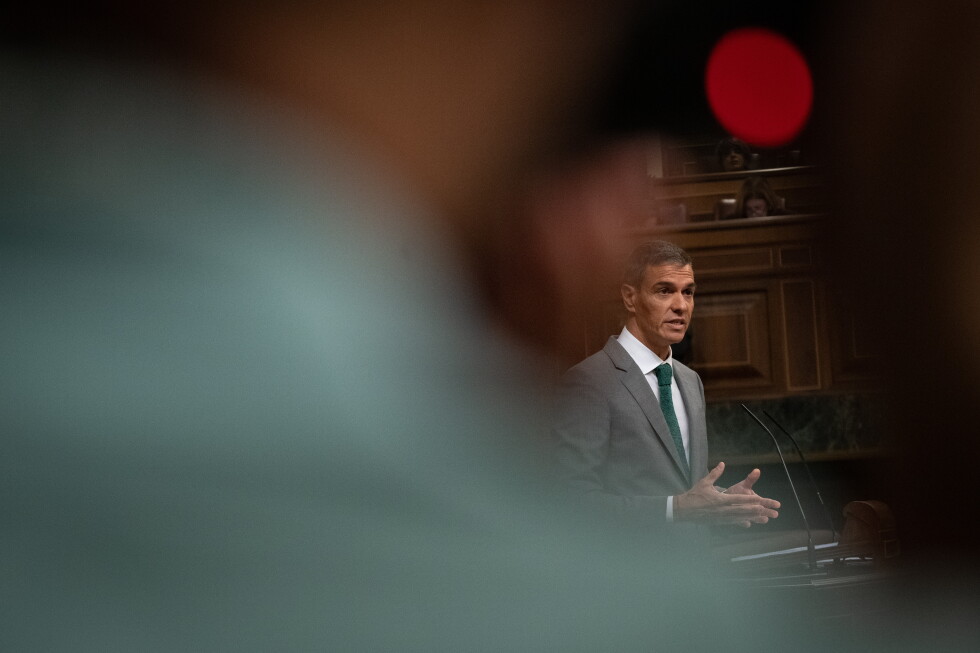
MADRID – Standing before Spanish lawmakers on Thursday, Prime Minister Pedro Sánchez pushed back against growing opposition pressure and widespread public anger over his government’s response to the deadly mass migrant crossing into the North African Spanish exclave of Ceuta, denying claims that Moroccan state authorities planned and coordinated the unprecedented influx. “I can state with complete certainty that no institution – not our own diplomatic corps, not the European Commission, not any major international body – has presented the Spanish government with credible, solid proof that Morocco orchestrated or directly carried out this incident. There is no such evidence,” Sánchez told the legislative body. The prime minister’s comments came one day after tens of thousands of demonstrators gathered in cities across Spain to protest the ongoing humanitarian emergency in Ceuta, calling for immediate policy action and demanding Sánchez step down over his handling of the crisis. The incident, the deadliest border crossing of its kind in recent history, unfolded in late July, when roughly 72,000 migrants pushed past border barriers, swam across coastal boundaries, and entered the tiny exclave – a territory home to only 84,000 permanent Spanish residents. While the vast majority of arrivals were either sent back to Morocco voluntarily or deported by Spanish authorities within the first week, an estimated 5,000 people, including 1,200 unaccompanied minor migrants, remain stranded in Ceuta weeks later, according to figures from Spain’s national government. Local officials in Ceuta have put the remaining number even higher. Sánchez confirmed that 141 people died during their attempts to reach Ceuta, a figure that has raised questions among critics, as neither the prime minister’s office nor Spain’s interior ministry has offered transparency into how that death toll was calculated. To date, the root cause of the mass crossing remains a matter of intense debate. The Spanish government has framed the event as being primarily driven by a coordinated online recruitment campaign spread across social media platforms. Earlier this week, Spanish media published details from an internal police report that alleged Moroccan security forces showed deliberate permissiveness toward the migrants crossing from Moroccan territory. While Spanish officials quickly pushed back against framing that suggested the report directly blamed the Moroccan government in Rabat, Sánchez acknowledged on Thursday that for a 10-hour window on July 30, when arrivals reached their peak, Morocco’s national Gendarmerie police “allowed the border to be crossed.” The Spanish government has long avoided open public criticism of Morocco, a key diplomatic and trade partner for Spain and the European Union. But Sánchez did condemn inflammatory remarks from two Moroccan government ministers that questioned Spanish sovereignty over both Ceuta and Melilla, the second Spanish exclave on the North African coast. He confirmed his administration had officially summoned Morocco’s ambassador to Madrid to protest the comments. The two North African territories represent the European Union’s only shared land borders with the African continent, making them a critical frontline for EU migration policy. In a bid to address growing demands for transparency, Sánchez announced his government would eventually release key official reports detailing the circumstances of the border breach. However, the administration has not yet announced a timeline for the publication, nor has it specified what details the documents will include.
Spanish Prime Minister rejects suggestions that Morocco was behind Ceuta border crisis