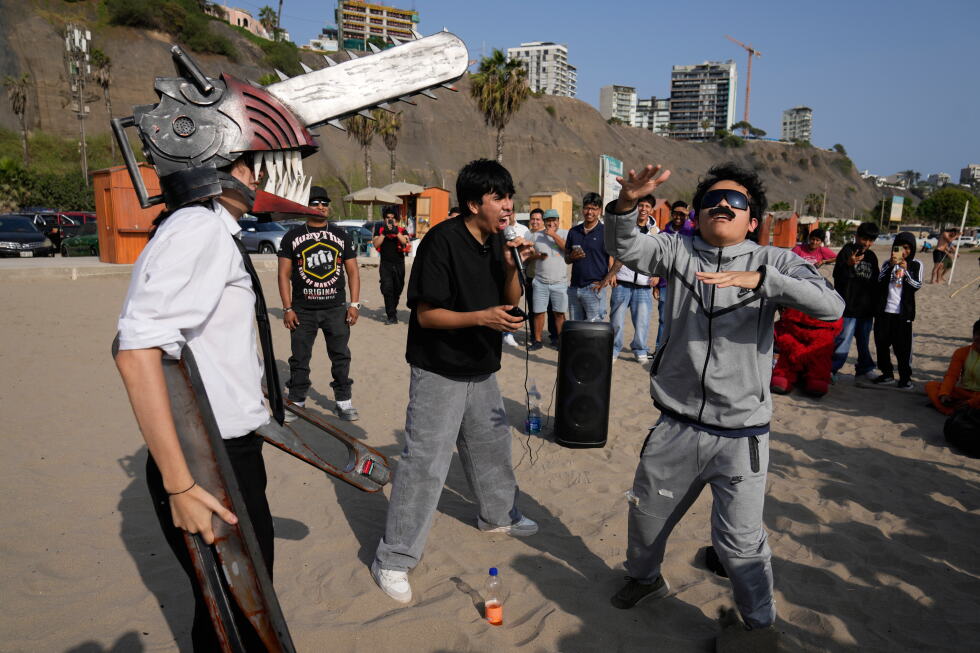
On a sunlit beach in Peru’s capital Lima, dozens of young people recently converged to dance, strike playful poses, and showcase wildly creative choreography — all with one shared goal: growing their aura. The gathering was one of the first official “aura battles” held in the country, a tangible offshoot of the viral internet phenomenon “aura farming” that is rapidly capturing the attention of Gen Z creators across Latin America.
Participants lean into elaborate, playful cosplay, drawing inspiration from comic book heroes, animated movie characters, public figures and even internet memes, competing in informal dance-style showdowns decided entirely by audience applause. The competitor who draws the loudest cheers and brings the most original energy to the floor moves on to the next round. One recent attendee dressed as Spider-Man wowed the crowd with acrobatic forward rolls and push-ups set to thumping techno beats, while another pulled off a sharp, one-legged kicking routine straight out of a popular action video game.
Originating in video game culture and amplified by viral social media content, aura farming first popped up in community gatherings across Brazil before spreading rapidly across borders. Unlike traditional competitions that focus on technical skill or fame, the trend centers on unfiltered self-expression and positive energy.
“”Aura farming is about letting your essence flow in a space where you’re in front of other people, but there’s no room for shame,” explained 20-year-old film student Liam González, who attended the Lima event in full costume as the beloved animated character Shrek. Another attendee, 19-year-old Gonzalo Cornelio, drew attention for his costume inspired by former Venezuelan President Nicolás Maduro, replicating the grey tracksuit the leader wore the night he was detained by U.S. military forces.
The name “aura farming” draws direct inspiration from video game mechanics, where players “farm” or repeatedly collect points and resources to level up their characters. In this trend, the resource being cultivated is positive energy, or “good vibes,” that boost a person’s aura — a term borrowed from spiritual traditions referring to the unseen energy field said to surround every individual. Peruvian digital content creator Fernando Lícito, who brought the aura battle trend to Peru after seeing a viral Brazilian contest clip in June, has organized three sold-out events in the country so far. He emphasized that unlike many competitive youth events, aura battles have no place for conflict: participants never physically touch one another or trade insults, with victory going solely to whoever can get the biggest reaction from the crowd.
Many participants weave in other popular internet trends into their routines: some copy soccer superstar Cristiano Ronaldo’s iconic “siuu” goal celebration, while others repeat the phrase “six, seven” while moving their hands in a nod to a widely shared viral meme. From its origins in Brazil, the trend has spread to major Latin American capitals including Mexico City, Quito and Buenos Aires, where dozens of participants held a public battle in front of the city’s famous Obelisk monument. It has even jumped across the Atlantic, with public events popping up in Madrid, Burgos and Zaragoza in Spain.
María Paula Martínez, an arts professor at Colombia’s Los Andes University, notes that the trend’s biggest impact has been moving online community connection into real physical spaces. “It’s not about becoming popular,” she explained. “It’s about putting out good vibes, and having other people recognize that energy.” For many young participants, it provides a low-stakes, joyful outlet to socialize and embrace creativity after years of isolated digital connection during the COVID-19 pandemic.
Like many viral youth trends, aura farming has drawn a mixed reaction from public officials and institutions across the region. Some local authorities have pushed back against public events: in Lima’s upscale Miraflores district, officials recently scrapped a planned aura battle after organizers failed to secure the required public space permits. In July, the mayor of Cuiabá, a city in southwest Brazil, rejected permit applications for an aura tournament, arguing the event did not serve the public interest, forcing organizers to relocate the gathering to a local university campus. In Costa Rica, the ministry of education has banned aura battles from all public schools, claiming the events could fuel student conflict and disrupt academic activities.
The trend has found official support in other corners of the region, however. In Mexico, the federal education minister publicly embraced the trend, posting a lighthearted viral video where he joked he was “farming good education” ahead of the new school year. For young participants like González, the pushback from older generations comes as no surprise — and it doesn’t dampen their enthusiasm for the new hobby.
“My grandmother doesn’t understand what I’m doing, she thinks it’s all silly,” González said. “But we were born in a different era. This is just how we have fun and show who we are.”